WRS – Installation Manual
4.12.7 Battery level low
The LOW BATTERY signal is activated when the battery falls below the available energy alarm threshold; for
more information see para. 4.2.6. It is possible to change the polarity of the output. The signal state is
replicated by the yellow LED on the WRI receiver. The WRI receiver only receives the battery level
information from the WRP transmitter during the operating cycle. This means that the last battery level
reading (and respective battery level low signal if activated) will not be transmitted until the subsequent cycle.
For example, if the LOW BATTERY output is activated during a cycle and the yellow LED on the WRI
receiver panel is illuminated, both the output and the LED will remain active until the subsequent cycle is
complete. The information on the WRP transmitter will not be updated until the new cycle has started: In this
case, if the operator has replaced the battery in the interim, the output and the LED will be deactivated.
[
This s
ignal is intended as a warning and not an error. It is not necessary to interrupt production
and the WRP transmitter will continue to function correctly for as long as the radio
communications remain active. The residual battery charge level means that the
WRP transmitter
will continue to function for long enough to allow the user to replace the battery at a convenient
moment.
4.12.8 Error signal
The ERROR signal indicates the status of the radio frequency connection:
1. ERROR signal inactive: the inspection cycle is in progress and the system is ready to touch the part;
2. ERROR signal active:
o The wireless connection is absent because the WRP transmitter is in “out of cycle” mode (no
START);
o The inspection cycle is in progress, but the signal level is too low.
For safety reasons it is not possible to change the polarity of the output, which remains permanently normally
closed (NC). The signal state is replicated by the red LED on the WRI receiver.
• Output Active: Red LED ON;
• Output Inactive: Red LED OFF.
This signal remains active until the activation procedure for WRP transmitter is complete (see para. 4.12.1 and
para. 4.12.2.2). The ERROR signal is not deactivated until the correct data have been received from the WRP
transmitter, enabling the machine tool to move the axes safely to the contact position. The probe output statuses
change depending on how the probe has been set-up. When the START signal has been removed and the
working cycle finished, the ERROR signal is activated, since the WRP transmitter stops sending information to the
WRI receiver. The WRP transmitter sends a keep-alive signal to the WRI receiver approximately once every 100
ms. The WRI receiver activates the ERROR output each time that two consecutive messages are lost. It is
important to note that the error signal may be activated during a measurement cycle in order to interrupt the
movement in the event of a loss of communications. Nevertheless, if the connection is restored within the
recovery time (equivalent to 2 s) all the machine tool has to do is repeat the instructions necessary to complete
the part touch manoeuvre. In this case, in view of the temporary nature of the error, there is no reason to stop the
machine or generate an alarm message as soon as the PLC becomes aware that the ERROR signal has been
activated. The measurement cycle illustrated below is capable of efficiently managing any temporary losses of
communication between the WRP transmitter and the WRI receiver.
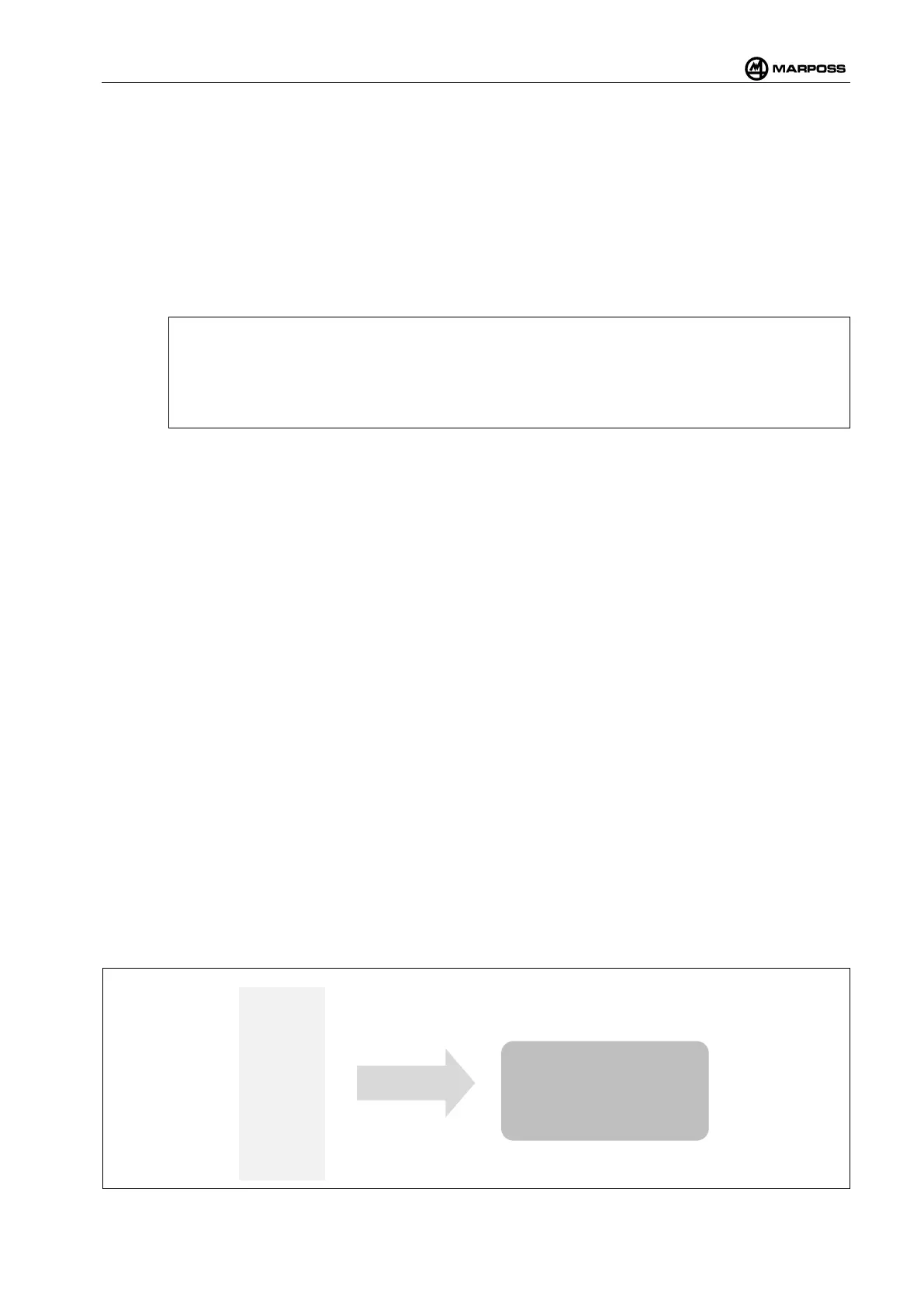
Figure 4-51. Sample measurement cycle.
. . . . .
. . . . .
Touch
. . . . .
. . . . .
Touch
. . . . .
. . . . .
Touch is a sub-routine that
handles all aspects of the
touch manoeuvre safe
positioning and actual
movement..



 To Next Page