ACCESS GATEWAY
System Administration 139
2.
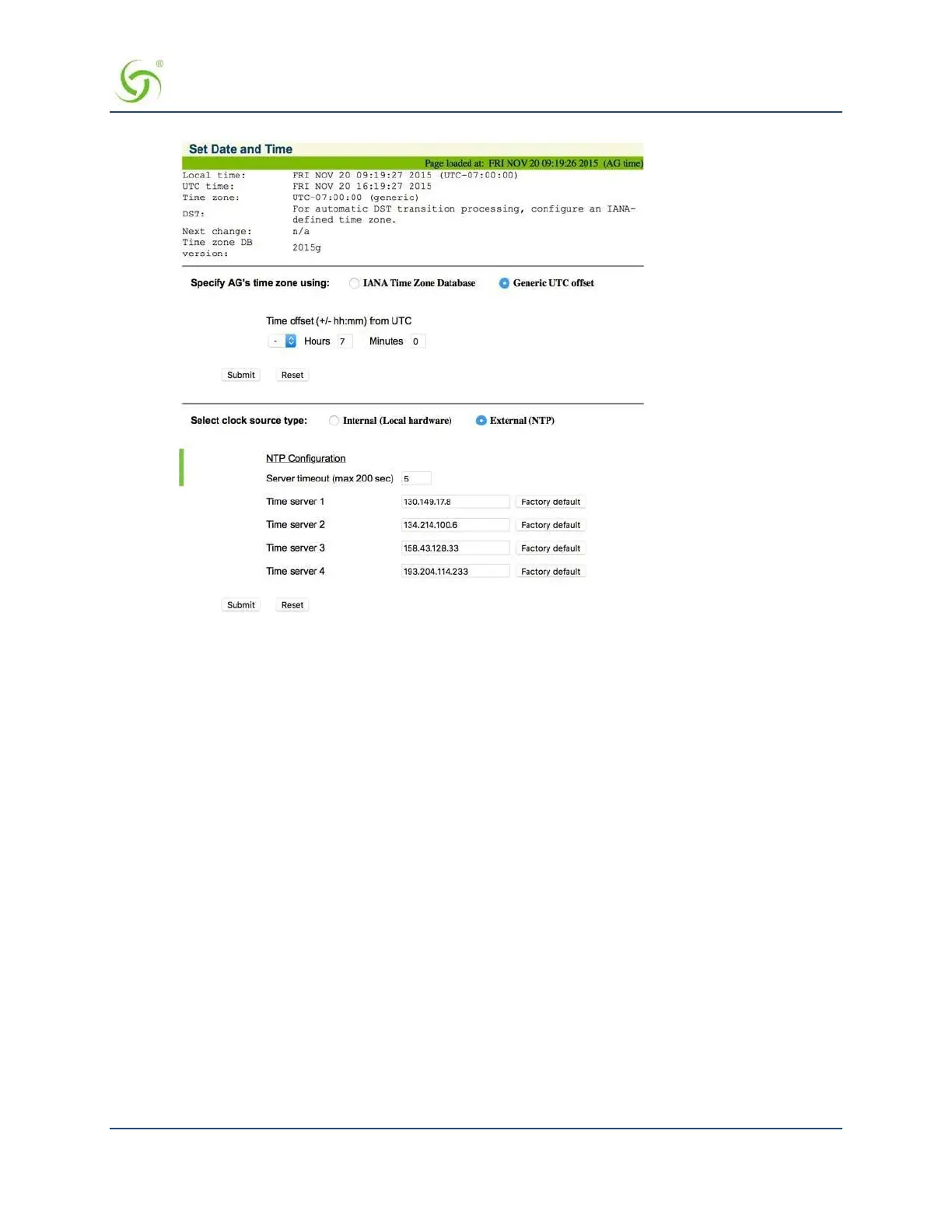
Select the method for time zone configuration; either IANA Time Zone Database or
Generic UTC
offset
. UTC is the Universal Coordinated Time, based on the ISO 8601 standard, and is used in
conjunction with RADIUS servers (for example, if the RADIUS server is setup for a time zone that is
different from the Access Gateway).
3.
Select the clock source; either Internal Time to use the local hardware time or External
(NTP)
if you
want to use NTP instead of the internal clock of the NSE.
If you select
Internal Time, confirm and (if necessary) adjust the date and time. After you click Save,
the system writes the information into its BIOS, then displays the new date and time.
If you select
External Time:
• In the
Server Timeout field, enter the number of seconds before the NSE gives up on receiving a
time response from the NTP server.
• In the Time Server 1-4 fields, enter up to 4 different NTP servers to query for the correct time.
4.
When finished, click Save to save your changes, or click Restore if you want to reset all the values to
their previous state.
Setting up Traffic Descriptors {Traffic Descriptors}
Traffic Descriptors are a dependency of creating rules for a Quality of Service Policy. The Traffic Descriptors
are how the Access Gateway identifies subscriber traffic. They are conditions or a group of conditions that are
linked to a description.
1.
From the Web Management Interface, click on Configuration, then Traffic Descriptor. The Traffic
Descriptor Settings screen appears:



 To Next Page