ACCESS GATEWAY
124 System Administration
5.
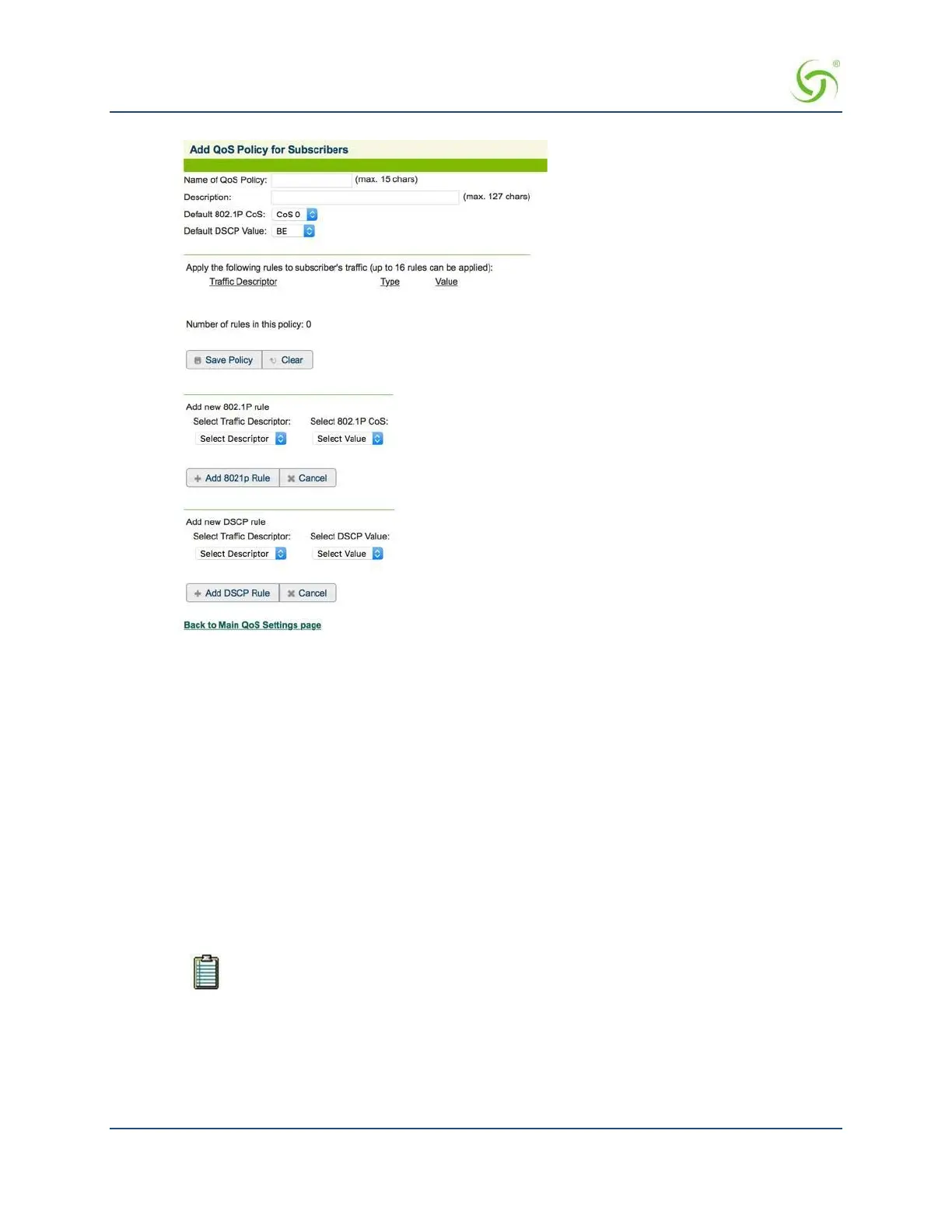
Enter a name for the policy in the QoS Policy field.
6.
Enter a brief summary about the policy Description field. The rule list displays a list of the rules that
have been defined for this policy.
7.
Click Save Policy to accept the parameters and rules defined and add the policy to the
policy list on
the main page.
8.
Provide default 802.1P CoS and/or DSCP values, as needed.
9.
Select a traffic descriptor and a Class of Service for the rule, and then click Add Rule.
Once added,
rules will be displayed in the list above.
You must have one or more traffic descriptors previously defined. See Setting up Traffic
Descriptors {Traffic Descriptors} on page 139.
Defining the RADIUS Client Settings {RADIUS Client}
The Access Gateway supports Remote Authentication Dial-In User Service (RADIUS). RADIUS is an
authentication and accounting system used by many Internet Service Providers.
The “Usernames” function must be enabled for a RADIUS login. See also Configuration
Menu on page 68.
Nomadix offers an integrated RADIUS client, allowing service providers to track or bill users based on the
number of connections, location of the connection, bytes sent and received, connect time, etc. The customer
database can exist in a central RADIUS server, along with associated attributes for each user. When a
customer connects into the network, the RADIUS client authenticates the customer with the RADIUS server,
applies associated attributes stored in that customer's profile, and logs their activity (including bytes
transferred, connect time, etc.).



 To Next Page