Cleaning crankshaft and cylinder block internal
passages
Cleaning of the lubricating oil passage should be made after all crankshaft
and cylinder block overhauling operations have been accomplished.
This cleaning can be carried out by using Diesel fuel or compressed air
blasted into the passages.
Checking crankshaft end play (Fig. 16).
This check is performed with a magnetic base comparator operating as
follows:
–place the magnetic base together with the comparator onto the crank-
case and then make the comparator feeler contact one of the crankshaft
ends.
–use a lever to move the crankshaft axially towards the comparator side
until the comparator hand stops moving.
–reset the comparator and push the crankshaft with the lever towards the
opposite side and then take the end play reading from the comparator
dial.
This reading should be 0.10 to 0.27 mm; if higher than specified, some
spacing half-rings with 0.10 to 0.20 mm oversize with respect to the
nominal thickness shall be fitted. These half-rings are regularly supplied
as spare parts.
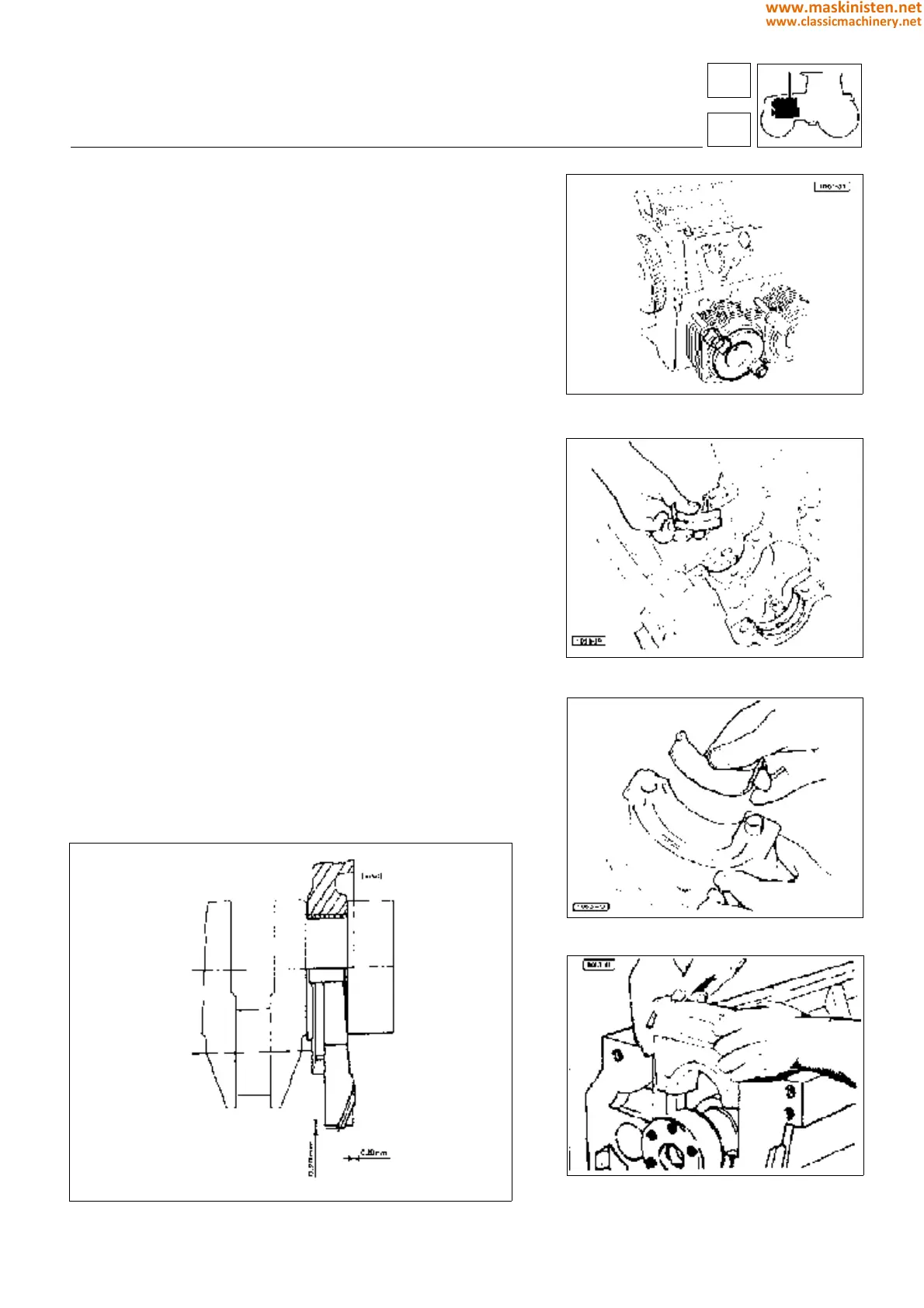
Triangular-section gaskets should protrude as shown in figure 17.
In its rear portion the crankshaft is provided with a 3x30° chamfer. In
addition the surface contacting the sealing ring has undergone a harde-
ning process.
The oil seal must be fitted using tool 5.9030.628.0.
Fig. 17 - Main bearing cap gasket installation.
Fig. 18 - Special fixture for piston positioning
during crankshaft installation.
Fig. 19 - Mounting one holed main bearing shell
into the cylinder block forging.
Fig. 20 - Fitting the one main bearing shell into
the main bearing cap.
Fig. 21 - Installing the crankshaft main bearing
caps.
engine
crankshaft
12
1
33
www.maskinisten.net
www.classicmachinery.net



 To Next Page