3.46
SEL-551 Relay Instruction Manual Date Code 20110408
Relay Elements and Logic
Demand Ammetering
Thus, the residual ground time-overcurrent element 51G1T operates with an
effective, less-sensitive pickup:
50G1P = 2.30 A secondary
The reduced sensitivity keeps the residual ground time-overcurrent element
51G1T from tripping on higher unbalance current I
G
.
Residual Ground Demand Current Goes Below Pickup GDEMP Again
When unbalance current I
G
decreases again, unbalance demand current
I
G(DEM)
follows, going below corresponding demand pickup GDEMP =
1.00 A secondary, and Relay Word bit GDEM deasserts to logical 0. This
results in SEL
OGIC control equation torque control setting 51G1TC being in
the state:
51G1TC = !GDEM + GDEM * 50G1 = NOT(GDEM) + GDEM * 50G1 =
NOT(logical 0) + (logical 0) * 50G1 = logical 1
Thus, the residual ground time-overcurrent element 51G1T operates on its
standard pickup again:
51G1P = 1.50 A secondary
View or Reset
Demand Ammetering
Information
Via Serial Port
See MET D Command (Demand Ammeter) on page 5.15. The MET D
command displays demand and peak demand ammetering for the following
values:
The MET RD command resets the demand ammetering values. The MET RP
command resets the peak demand ammetering values.
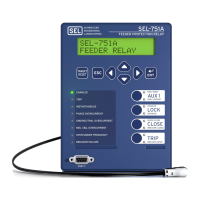
Via Front Panel
The information and reset functions available via the previously discussed
serial port commands MET D, MET RD, and MET RP are also available via
the front-panel {METER} pushbutton. See Figure 6.2.
Demand Ammetering
Updating and Storage
The SEL-551 updates demand values approximately every two seconds.
The relay stores peak demand values to nonvolatile storage once per day (it
overwrites the previous stored value if it is exceeded). Should the relay lose
control power, it will restore the peak demand values saved by the relay at
23:50 hours on the previous day.
Currents
I
A,B,C,N
Input currents (A primary)
I
G
Residual ground current (A primary; IG = 3I0 = IA + IB + IC)
3I
2
Negative-sequence current (A primary)



 To Next Page