MN.00356.E - 003 17
SIAE MICROELETTRONICA answer is based on the adoption Unified Product Architecture, a common Ether-
net hardware and software platform through all new generation products based on two main building
blocks:
• Ethernet Core unit based on powerful switching gear featuring 46Gbps switch fabric capacity, high
performance dual-core CPU and embedded IEEE1588v2 processor for advanced synchronization ca-
pability.
• SM-OS software, based on carrier-grade field proven highly interoperable protocol stack provides
complete MPLS services set and compliancy to CE2.0.
ALFOplus2 has been developed with this concept in mind: Unified Hardware and Software platform archi-
tecture
5.4 ALFOPLUS2 STRUCTURE
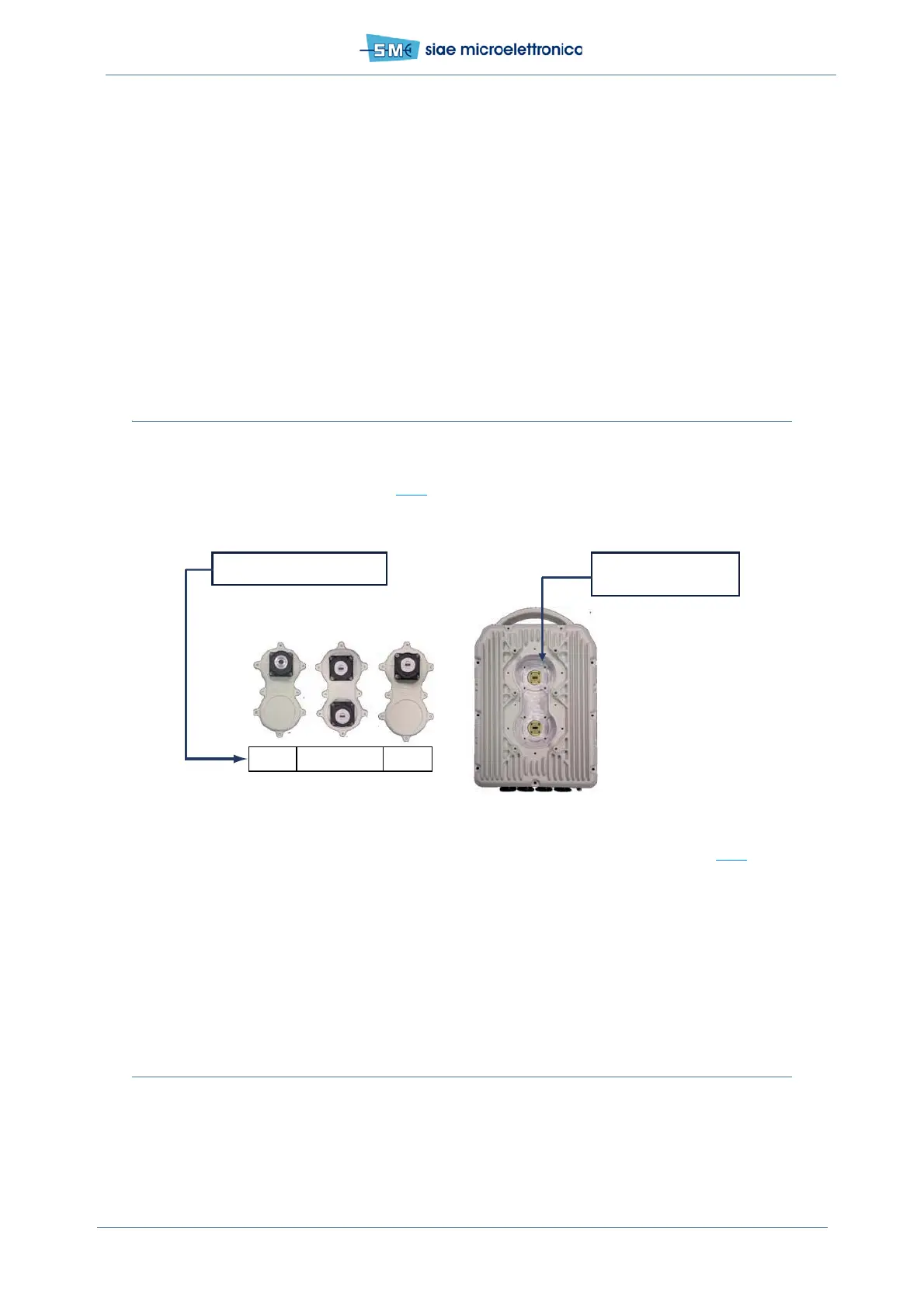
ALFOplus2 mechanical structure is made up by a main body and three possible additional antenna-interface
modules, lodged in the reserved bay (see Fig.7
).
The main body is common to all applications an presents 2 antenna ports.
Fig.7 - Composition of ALFOplus2 and interface modules
The antenna-interface module is specialized in accordance with the required application (see Fig.8
):
• OMT module: it contains an OMT element that combines the two antenna ports of the main body in
a unique antenna port for H/V integrated operations (Antenna Flange is circular)
• HYB module: it contains a HYB element that combines the two antenna ports of the main body to a
unique antenna port for frequency diversity operations (Antenna Flange is circular)
• PASSTHROUGHT module: it exposes both antenna ports (Antenna Flanges are rectangular).
5.5 LINK CONFIGURATION
Radio link configurations: single and dual equipment operation is possible.
3 kind of antenna interface modules
can be lodged in the main body bay
Main body bay lodges one of 3
antenna interface modules:
OMT,Pass-through or Hybrid
OMT
PASS-THROUGHT
HYBRID


 To Next Page