26 MN.00356.E - 003
5.8.4 Classification criteria
QoS refers to the ability of a network device to provide improved services to selected network traffic over
various underlying technologies, including Ethernet and wireless LANs.
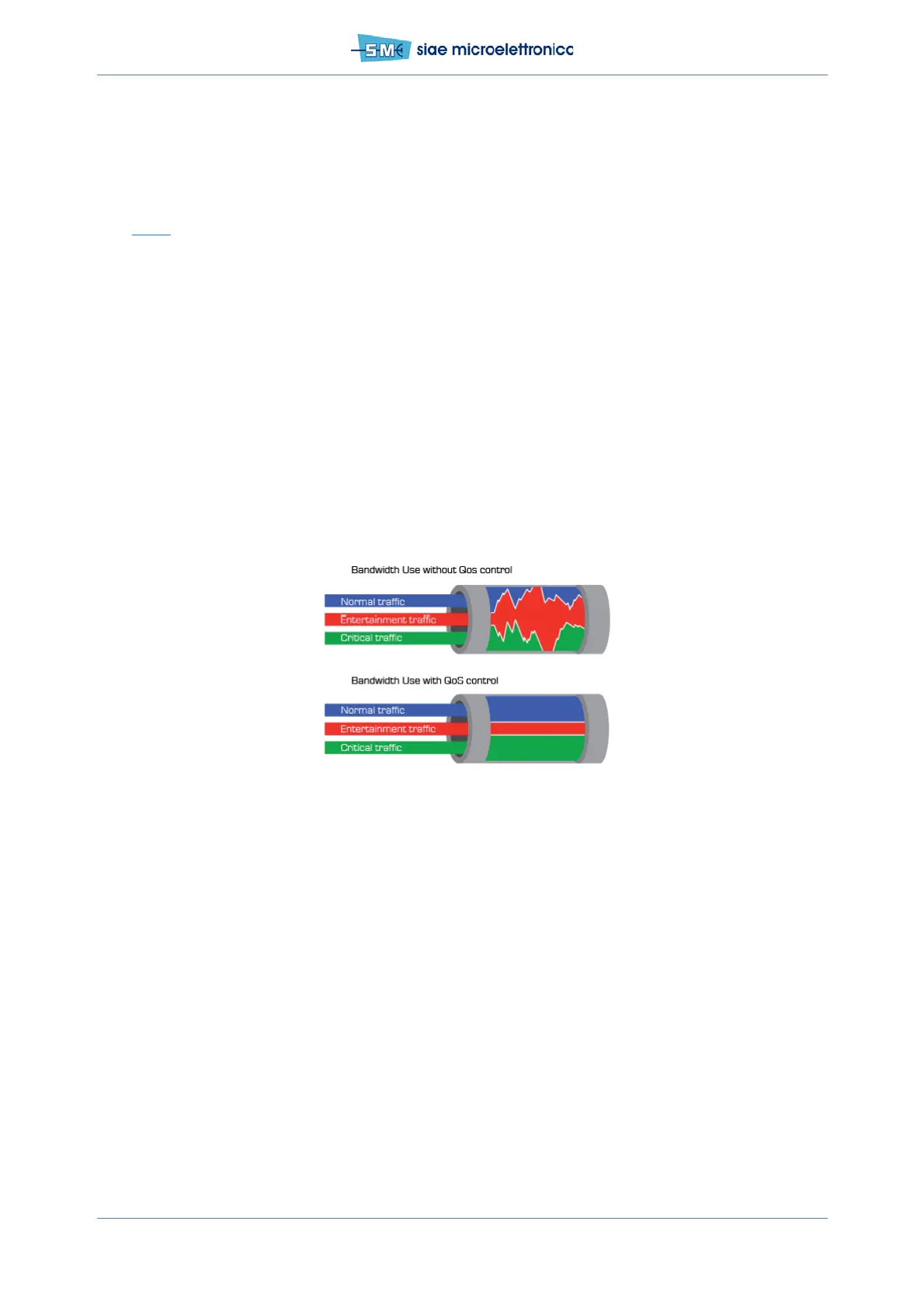
In particular, QoS feature provides an improved and more predictable network services, as follows (see
Fig.12
):
• improving loss characteristics
• avoiding and managing network congestion
• prioritizing services to different kinds of network traffic
• setting traffic priorities across the network
QoS is implemented in SIAE MICROELETTRONICA products in a multilevel approach:
• ingress port
• level 2 VLAN identifiers (802.1Q)
• level 2 priority bits (802.1P QoS)
• level 3 priorities IPv4 (ToS or DSCP) or IPv6 (TC)
• level 2 VLAN identifiers + Priority bits
•EXP bits MPLS
• DSCP in IP over MPLS.
Fig.12 - QoS example
5.8.5 Ingress Filter Policing
ALFOPLUS2 allows limiting the ingress traffic rate on the basis of:
• UNI Port Based (Bandwidth profile per UNI port): a different profile is defined for each LAN port
(VLAN ID and priority are not considered in this case by the rate limiting algorithm)
• EVC Based (Bandwidth Profile per C_VID): a different profile is defined for different VLANs (priority
is not considered in this case by the rate limiting algorithm).
• COS Based (Bandwidth Profile per CoS): a different profile is defined for each priority queue from
0 to 7 (i.e. internal switch priority). In this case, the Customer and Service VLAN IDs are not con-
sidered by the rate limiting algorithm and independently from the enabled QoS management
• C-TAG + C-PCP Based: (Bandwidth Profile per C_VID + CoS): a different profile is defined for dif-
ferent couples VLAN+priority queue
• S-TAG + S-PCP based: (Bandwidth Profile per S_VID+S-PCP): a different profile is defined for dif-
ferent couples Service VLANs – S.


 To Next Page