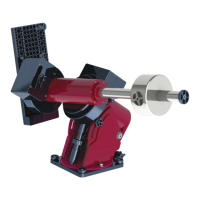
Paramount ME User’s Guide
23
Access to Fuses
and USB Port
This panel provides access to the USB port and fuses. See
“XAppendix E – USB Driver Installation and UseX” for details
about controlling the Paramount ME via USB. (Page X111X.)
See “XAuxiliary Port 1 and 2 Fuse ReplacementX” for details
about replacing fuses (Page X103X.)
This panel originally provided access to internal fuses and
DIP switches for the MKS 3200 and earlier control systems.
See “Visual Feedback” on page 34 for a description of the RA,
Dec and System LEDs.
Auxiliary port two. This is one of two “generic” ports that
can be used to supply power to the Instrument Panel’s
auxiliary ports for accessories such as dew heaters.
Please carefully read “XAux 1 and Aux 2 Port SpecificationX” on
page X25X for details about this port.
Auxiliary port one. This is one of two “generic” ports that
can be used to supply power to the Instrument Panel’s
auxiliary ports for accessories such as dew heaters.
Please carefully read “XAux 1 and Aux 2 Port SpecificationX” on
page X25X for details about this port.
25-pin parallel port. If your camera has a parallel port
interface, then plug the camera’s parallel cable into this port,
and then use a short parallel cable to connect the parallel
port on the Instrument Panel to the camera head.
Plug the 48-Volt power supply into this port (page X15X).
Plug the Joystick’s RJ11 (phone-type connector) into this
port.
This is the RS232 serial port that is used to communicate
with a personal computer or Windows Mobile device using a
standard serial port. Use the supplied RS232 cable (page
X15X) to connect this port to a standard male DB9 serial port
or USB to serial adaptor.
Do not use this port. This port will be used by future
firmware versions of the MKS 4000 and TheSky6
Professional Edition.
This port contains four general-purpose, high-powered,
driver outputs that can be used to drive a DC servomotor or
a stepper focus motor, or other device. There are also two
general-purpose pins that can be used as inputs or outputs.
We are currently looking at possible uses for these functions
such as an “abort slew” button, limit switch, or other use.



 To Next Page