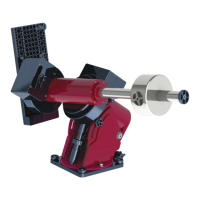
Paramount ME User’s Guide
52
Drift Method –
Azimuth Adjustment
Locate a star near the meridian (star should be greater than 15
degrees altitude and less than 85 degrees altitude). Determine if
the star drifts north or south. If the star drifts north, the polar
axis is too far west. If the star drifts south, the polar axis is too
far east. Make the appropriate adjustment and repeat the above
procedure until the star does not drift for several minutes.
Drift Method –
Elevation Adjustment
Locate a star near the eastern or western horizon (about 15
degrees altitude) at an hour angle of about 6. If the star is in the
east, drift to the north means that the polar axis elevation is too
high, while drift to the south means that polar axis elevation is
too low. If the star is in the west, reverse these. Continue
making adjustments until the star does not drift for 10-20
minutes.
Once you are familiar with TPoint, it provides the best analytical method for determining
polar alignment. However, until a TPoint model is established with all of the terms
necessary to achieve good pointing, the polar misalignment terms provided by TPoint can
be misleading. Again, using 20 or more stars distributed over at least half of the sky
should provide good estimates of the actual polar alignment.
Using a Calibrated Video Display
Although the Paramount ME wedge provides a very accurate means for adjusting the polar
axis, the feedback provided by a calibrated video monitor can be extremely valuable when
making minute adjustments (less than five arcminutes).
You can actually make polar alignment adjustments to the Paramount ME without
significantly loosening the locking knobs (altitude) or screws (azimuth).
When using video feedback for making polar alignment adjustments, pick a star near the
celestial equator within an hour of the meridian.
Paramount ME Initialization
This section describes the steps necessary to initialize the Paramount ME on the first night
of operation and on subsequent nights.
Discussions related to TPoint modeling, mount initialization, and parking
might seem daunting at first. However, these steps are required to
achieve consistent, accurate pointing from night to night.
In turn, accurate pointing allows enhanced functionality such as scripted
operation and imaging without the burden of re-centering objects.
Remember, if you wish to simply dead-reckon for an evening without
mapping, simply start the telescope and go! The Paramount ME’s
unmodeled pointing accuracy should exceed virtually every commercial
“go to” telescope.



 To Next Page