Paramount ME User’s Guide
51
Note the specific Paramount ME instructions on the dialog box. These calibrated
instructions for the Paramount ME appear only if the Telescope text on the Data >
Observing Parameters dialog box in TPoint reads Paramount ME (TPoint version 5.00.504
or later HTUwww.bisque.com/downloadUTH).
After you have carefully made the polar alignment adjustments, delete the TPoint model
and start over from Step 2. To remove the red Reference Lines that are created for each
mapping run, from TheSky6 Professional Edition, click Data > User-Defined Data and
then click Remove All.
In practice, using at least twenty stars distributed over half of the sky will provide enough
information for the first iteration. Note that TPoint generates a statistical model and the
values it generates for each of the terms is not an exact value and the correctness of each
term is dependent on the entire model. If, for example, there is a large non-
perpendicularity of the declination axis and the telescope axis and the CH term is not
turned on, the entire model will suffer.
The polar alignment errors are reported on the Polar Alignment Information dialog box in
TPoint. Click Model > Polar Alignment Information to display the dialog box.
The polar alignment error values can also be extracted from the Fit dialog box as explained
below.
The polar axis elevation value (ME) and the polar axis (EW) value (MA) provide an
estimation of the polar misalignment in arcseconds. Note that the MA value is the
distance in arcseconds at the pole. The actual azimuth angle will be greater as determined
by dividing by the cosine of the latitude. This computation is automatically done on the
Polar Alignment Information dialog box.
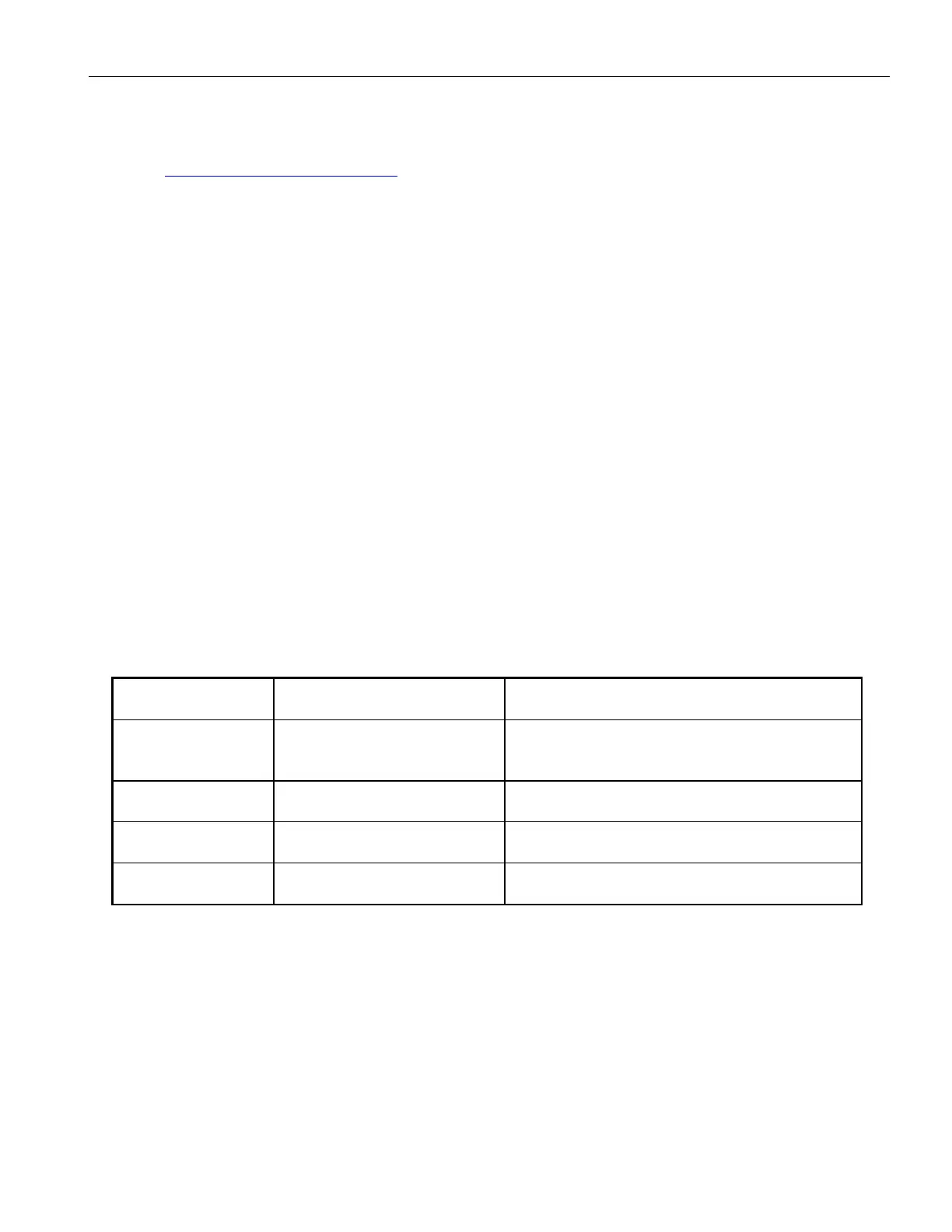
Axis is below celestial
pole.
Raise the elevation by turning the
altitude positioning device
counterclockwise.
Axis is above celestial
pole.
Lower the elevation by turning the
altitude positioning device clockwise.
Axis is east of celestial
pole.
Move the axis west (tighten the east
knob and loosen the west knob).
Axis is west of celestial
pole.
Move the axis east (tighten the west
knob and loosen east knob).
For most U.S. latitudes, the actual polar elevation target is not the north celestial pole but
rather a point about one arcminute above it to minimize the effects of refraction on longer
exposures. See the TPoint User’s Manual for a table that displays the offset based on your
latitude.
Polar Alignment – The Drift Method
The drift method is an alternative method to achieve polar alignment. Using this
procedure, you can achieve very good polar alignment in each axis, though it will probably
require considerably more time than using TPoint.



 To Next Page