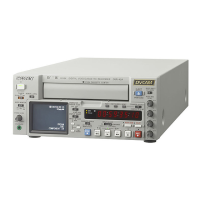
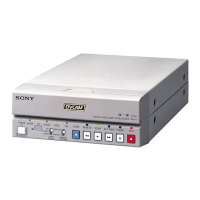
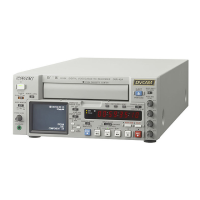
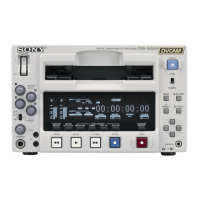
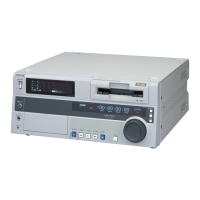
Location and Function of Parts
Chapter 1 Overview
10
Chapter 1 Overview
Playback compatibility with DV format
A DV cassette recorded on a DV format VCR can be
played back on this unit. (It is not possible, however,
to play back cassettes recorded in LP mode.)
Support for two cassette sizes
There are two sizes of DVCAM cassette: standard and
mini. You can use either size with this unit.
•The reel mechanism automatically adjusts to the size
of cassette inserted.
•The capacity of a standard cassette is 184 minutes of
recording/playback, and that of a mini cassette is 40
minutes.
Variety of Interfaces
Digital interfaces (options)
The unit can use the following digital interfaces
provided by optional interface boards (see page 12).
• SDTI (QSDI)
1)
This interface allows video, audio and timecode
signals in SDTI (QSDI) format to be transferred at
normal speed between this unit and the ES-7
EditStation. (Optional DSBK-150 board)
• SDI
2)
This interface allows the unit to input or output D1
(component) digital video and audio signals.
(Optional DSBK-160 board)
• i.LINK (DV)
3)
The DV input/output connector using i.LINK
technology allows the unit to input and output digital
video and audio signals in DV format. (Optional
DSBK-140 board)
Analog interfaces
A wide range of analog interfaces is provided,
allowing this unit to be connected to various video and
audio devices.
•Analog video: Composite and S-video interfaces are
provided. There is also a component interface option
(DSBK-170).
•Analog audio: There are two input channels and two
output channels. There is also support for microphone
input.
Full Functionality for More
Efficient Editing
This unit has a number of functions which assist in
efficient and precise editing.
Support for ClipLink function
This unit accepts instructions from an EditStation, to
transfer to the EditStation ClipLink log data held in the
cassette memory or index pictures recorded on the
tape. On the EditStation you can use these images and
data to carry out editing operations efficiently.
•Displaying ClipLink log data
•Changing ClipLink log data OK/NG status
•Cuing up to Mark IN and cue points provided by
ClipLink log data
•For cut editing, copying Mark IN data from ClipLink
log data
For an overview of the ClipLink function, refer to the
separate ClipLink Guide.
1) SDTI (QSDI): SDTI (Serial Data Transport Interface) is
the name of a standard interface established as SMPTE
305M.
This unit uses SDTI to transmit DV data, and the input/
output connectors are labled “SDTI(QSDI)”.
In indicator and menu indications, however, the
“SDTI(QSDI)” name is shortened to “SDTI”.
.........................................................................................................................................................................................
2) SDI: Serial Digital Interface is used for transferring video
signals in component digital format (D1).
3)
is a trademark of Sony Corporation and indicates that
this product is in agreement with IEEE1394-1995
specifications and their revisions.
Features
Chapter 1 Overview
Chapter 1 Overview
11
Internal timecode generator and reader
An internal timecode generator and reader enables
timecode compliant with SMPTE/EBU format to be
recorded and played back. This allows editing to single
frame precision.
Outputting or inputting timecode (LTC) to or from an
external device is also possible.
High-speed search function
You can carry out a picture search while playing back
in color within the range +32 to –32 times normal
speed
1)
.
When controlling the unit in shuttle mode from an
editor or remote control unit, you can search at any
speed in the range +32 to –32 times normal speed. In
jog mode a frame by frame search is possible. During
playback in the range +10 to –10 times normal speed,
high-speed audio playback is also possible.
Digital slow motion playback
Using the frame memory function, noiseless slow
motion playback is possible at any speed in the range
+
1
/
2
to –
1
/
2
times normal speed.
Jog audio function
When searching in jog mode at speeds between +1 to
+
1
/
30
and –
1
/
30
to –1 times normal speed, you can
monitor the audio playback. The audio signal is saved
in temporary memory, and replayed according to the
search speed. This allows searching on the sound
track.
Internal TBC (time base corrector)
This unit has an internal digital TBC, providing a
jitter-free video output even for analog editing. There
are also video output level, chroma signal output level,
setup level (for DSR-70), black level (for DSR-70P),
and chroma phase adjustments.
Other Features
Two-Input Video Recording
With the optional DSBK-180/180P Dual Video Input
Board installed, you can record, switching between the
composite video input to the VIDEO INPUT connector
and the composite video input to the REF. VIDEO IN
connector.
The ease of switching video inputs when recording
helps improve later editing efficiency.
Menu operations for functions and
operating settings
To make it easier to use this unit for any particular
purpose, various functions and operating settings are
provided in the menu system.
Superimposing function
Timecode, operating mode, error messages, and other
text information, can be superimposed on the color
liquid crystal display and the analog composite video
signal output.
Functions for easy maintenance
•Self-diagnosis and alarm function: This
automatically detects incorrect operations or
connections, operating faults, and so forth, and
displays details of the problem, the cause, and the
action to be taken, in the color liquid crystal display
and the time data display.
•Digital hours meter: This keeps four cumulative
counts of the powered on time, the drum rotation
time, the tape transport time, and the number of tape
threadings and unthreadings, and displays them in the
color liquid crystal display and the time data display.
1) The positive direction refers to forward movement of the
tape, and the negative direction to reverse movement.
.........................................................................................................................................................................................



 To Next Page