C-1
APPENDIX C: Mode Locking and GVD
Compensation
This appendix provides a brief discussion of mode locking. Also included is a
description of group velocity dispersion (GVD).
Mode Locking
Mode locking is the process by which a laser system can generate extremely short pulses
and correspondingly high peak powers without significantly changing the average
power out of the laser.
Mode locking occurs when a periodic loss mechanism is introduced to a laser resonator,
and the loss period is set to match the laser cavity round trip time of the laser light.
The laser pulses when the cavity loss is at a minimum. The resulting temporal pulse is
then narrowed on each successive round trip through the loss mechanism and other
nonlinear effects within the laser.
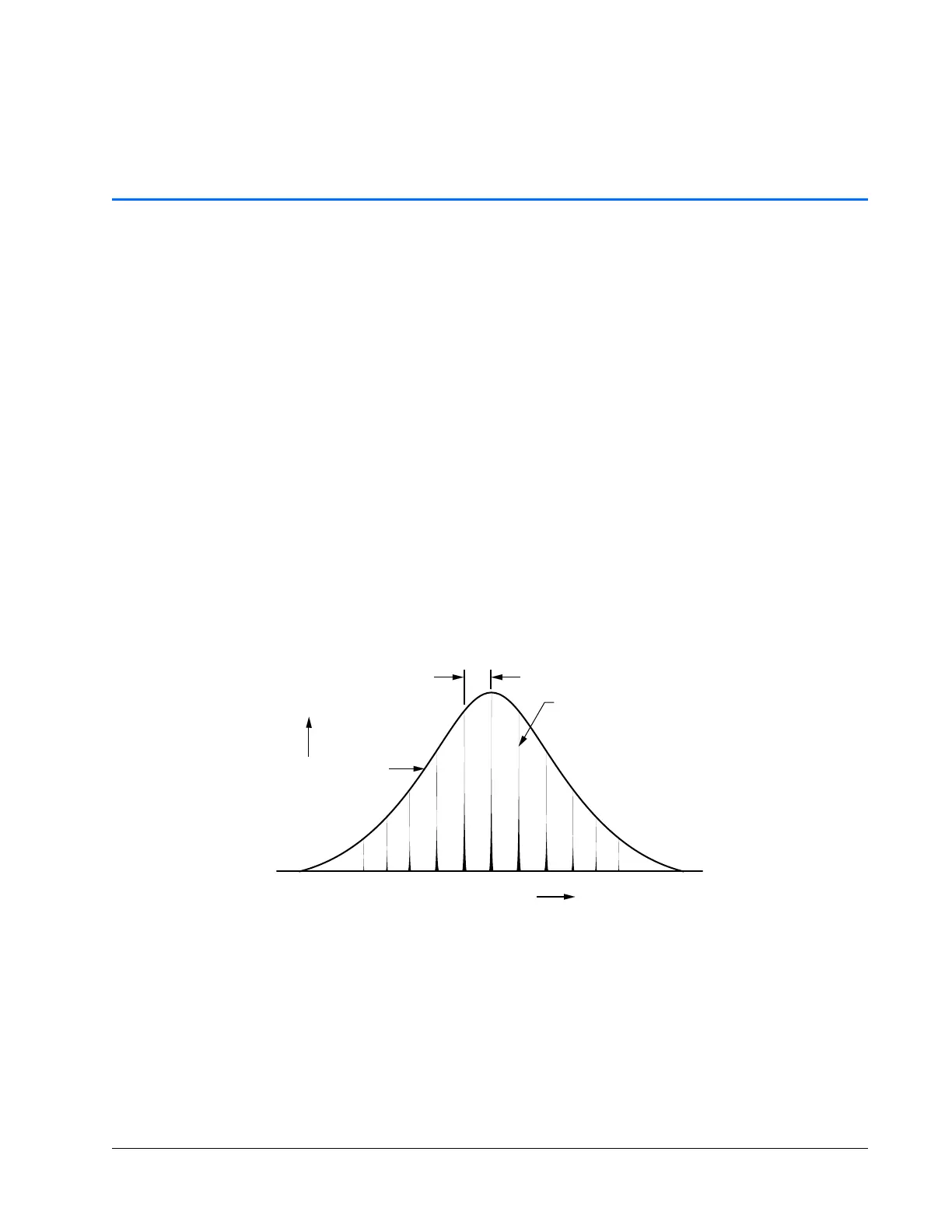
This results in the phase of all the optical frequencies, or longitudinal modes, being
locked together.
Figure C-1 Amplitude and frequency of longitudinal modes in mode-locked laser
This produces a series of ultra-short laser pulses at a frequency of
C
/2L, where L is the
laser cavity length. In the InSight
®
X3
™
laser, the resulting frequency is around 80 MHz
(see
Figure C-2). In the figure, L is cavity length and c is light velocity.
Longitudinal
Modes
Gain
Envelope
Frequency (ν)
Gain
Laser Repetition Rate =
c
/
2L
= 2ω
mL
c
/
2L


 To Next Page