Status LEDs and System Buttons
3-8
Stratus ftServer 2600, 4500, and 6300 Systems: Operation and Maintenance Guide
(R639)
Memory Fault LEDs
The memory fault LEDs light up only when the CPU element of the CPU-I/O enclosure
has failed and is out of service. The four LEDs are bracketed beneath the DIMM
NUMBER label on the enclosure front. The LEDs illuminate to indicate a number (from
1 – 12) that identifies the faulty DIMM (see Ta b le 5- 1 for details). The LED array
presents the digits in binary notation, using left-to-right, most-significant bit (MSB) to
least-significant (LSB) order.
Note the state of the LEDs before the powering off the
CPU-I/O enclosure.
When you power off the CPU-I/O enclosure, the memory fault LEDs will also go off.
However, if the CPU-I/O enclosure is powered down and there is no record of the LED
states, you may still be able to find the number of the failed DIMM in the Windows
System Event Log messages or in the Linux EMA log.
To replace DIMMs, see “Replacing and Adding DIMMs” on page 5-24. Table 5-1
describes the four-LED array that identifies the location of memory faults in the DIMMs.
Buttons on the CPU-I/O Enclosure
Two buttons are located on the front of each CPU-I/O enclosure: the ID button ( )
and the NMI button, as shown in Figure 3-2.
Pressing the system ID button once makes the three system ID LEDs blink: the ID
LEDs on the front and back of the enclosure and the one on the front panel (see
Figure 3-1). The front panel ID LED blinks blue when either one or both of the system
PSU Off Normal operation.
Yellow On Bulk power supply fault.
VLT Off Normal operation.
Yellow On DC voltage fault.
TEMP
†
Off Normal operation.
Yellow On Temperature fault.
† The LED state is maintained even when enclosure DC power is off.
Table 3-2. CPU-I/O Enclosure LEDs
(Continued)
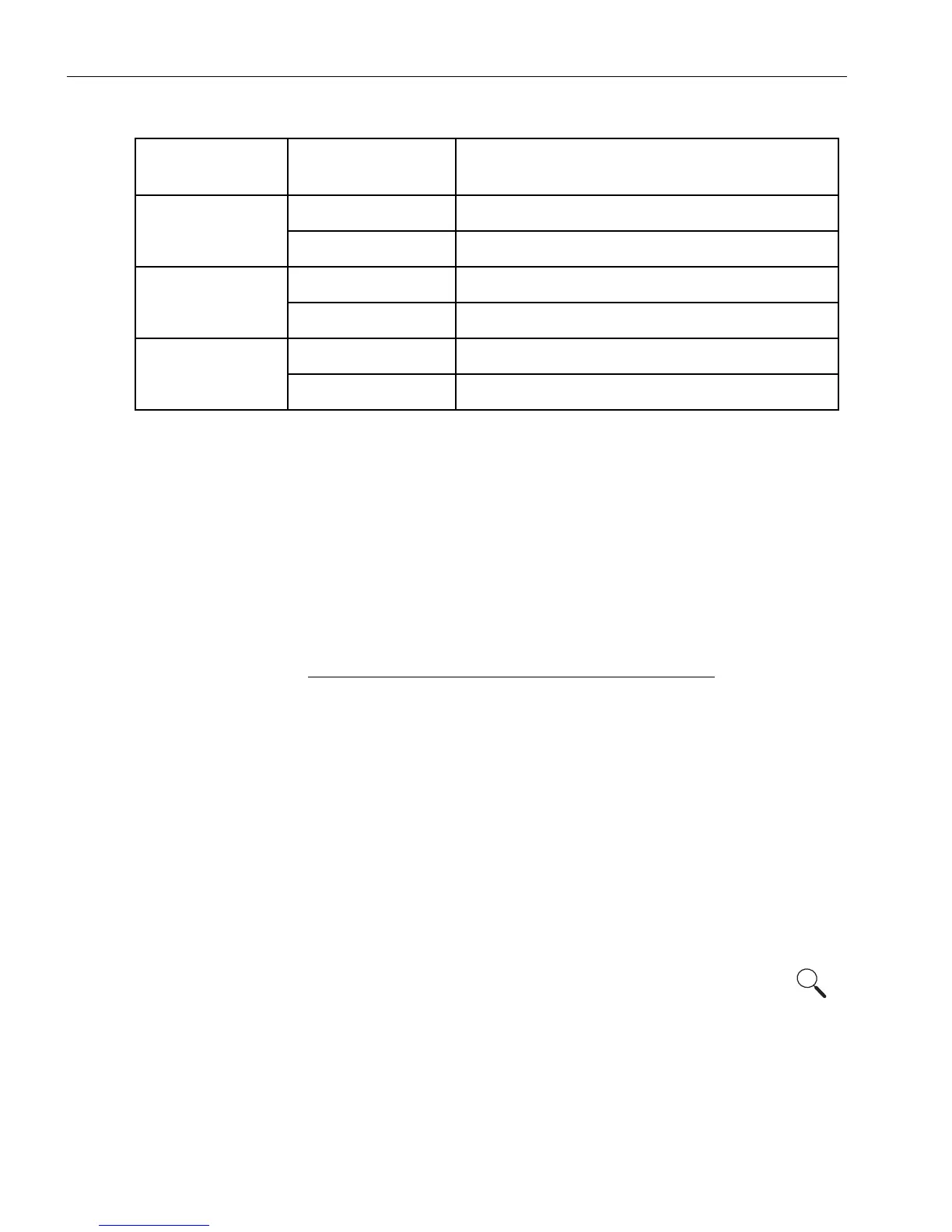
LED Label or
Icon State Description



 To Next Page