OPERATION OF THE MACHINE
MA6 / MA8 - 1. Operation of the Machine - Rev.05 07-06
1
6
1.1.4.1 Exposure Lamp
For the UV400 and UV300 exposure optics, the
standard exposure lamp is a 1000 W high pressure
mercury short-arc lamp in the LH1000.
1.1.4.2 Ellipsoidal Mirror
The exposure lamp is mounted inside an ellipsoidal
mirror in a way that the light source is exactly at its
first focal point. This mirror collects the radiation
emitted by the lamp and focusses it to the second
focal point. The ellipsoidal mirror can be the same
for all exposure optics. But very hight reflection is
available for standard UV400.
1.1.4.3 Cold Light Mirror
The cold light mirror splits the lamp radiation in the
not needed long wavelengths and the exposure
light. The long wavelengths pass through the mirror
and are absorbed by a heat sink. The exposure light
(cold light) is reflected 90° to the integrator optics. A
selective coating determines the reflected wave
-
lengths. This application range (e.g. UV400) is
marked on the mirror as well as the coated face (by
the tip of an arrow at the edge).
Because of the selective coating at least the cold
light mirror has to be exchanged when ahanging the
light application range.
Warning!
Mirror exchange must be done only by
trained personnel, who understand all
the risks associated with lamp replace
-
ment!
1.1.4.4 Fly’s Eye Lens
This lens disperses the light and directs it to the
condenser lens. The fly’s eye lens is made of optical
grade fused silica for all optical systems.
Alternatively for more intensity but with less unifor-
mity in the exposure area, a glass window (same
material) is available.
1.1.4.5 Condenser Lens
The condenser lens collimates the exposure light.
The position of this lens in the mirror house tube af
-
fects the intensity and uniformity of the exposure
light. A scale is mounted along the optical bench in
-
side the house tube. The position of the condenser
lens depends on the type of exposure optics. The
condenser lens is made of optical grade fused sili
-
ca.
1.1.4.6 Filters
The filter is located between the condenser lens
and the integrator block. Filters are used to select
more specific the exposure wavelength then the
cold light mirror can do it or reduce the intensity
(broad band intensity filter). All filters are made of
quartz glass.
1.1.4.7 Integrator Block
The integrator block has two lens plates with an ex-
actly defined distance to each other. For a good uni-
formity, each single light channel is super
positioned at the exposure plane.The material of
the lenses is optical grade fused silica.
1.1.4.8 Field Lens
For best uniformity and a maximum of intensity of
the exposure light, the field lens overlays each light
channel of the integrator in the exposure plane on
each other. The material of the lens is optical grade
fused silica.
1.1.4.9 Turning Mirror
It deflects the exposure beam to the exposure area.
The coated side of the mirror has to face the beam.
Mirrors with dielectric coating are marked with the
application range and a sign for the coated surface.
Metallized mirrors are broad band mirrors, but not
optimized to spectral areas.
1.1.4.10 Front Lens
This lens provides collimation and uniformity of the
exposure beam. The lens is specific for each wave
-
length range. For the UV 400 exposure optics the
front lens is fabricated of optical crown glass.
UV300 requires quartz glass.
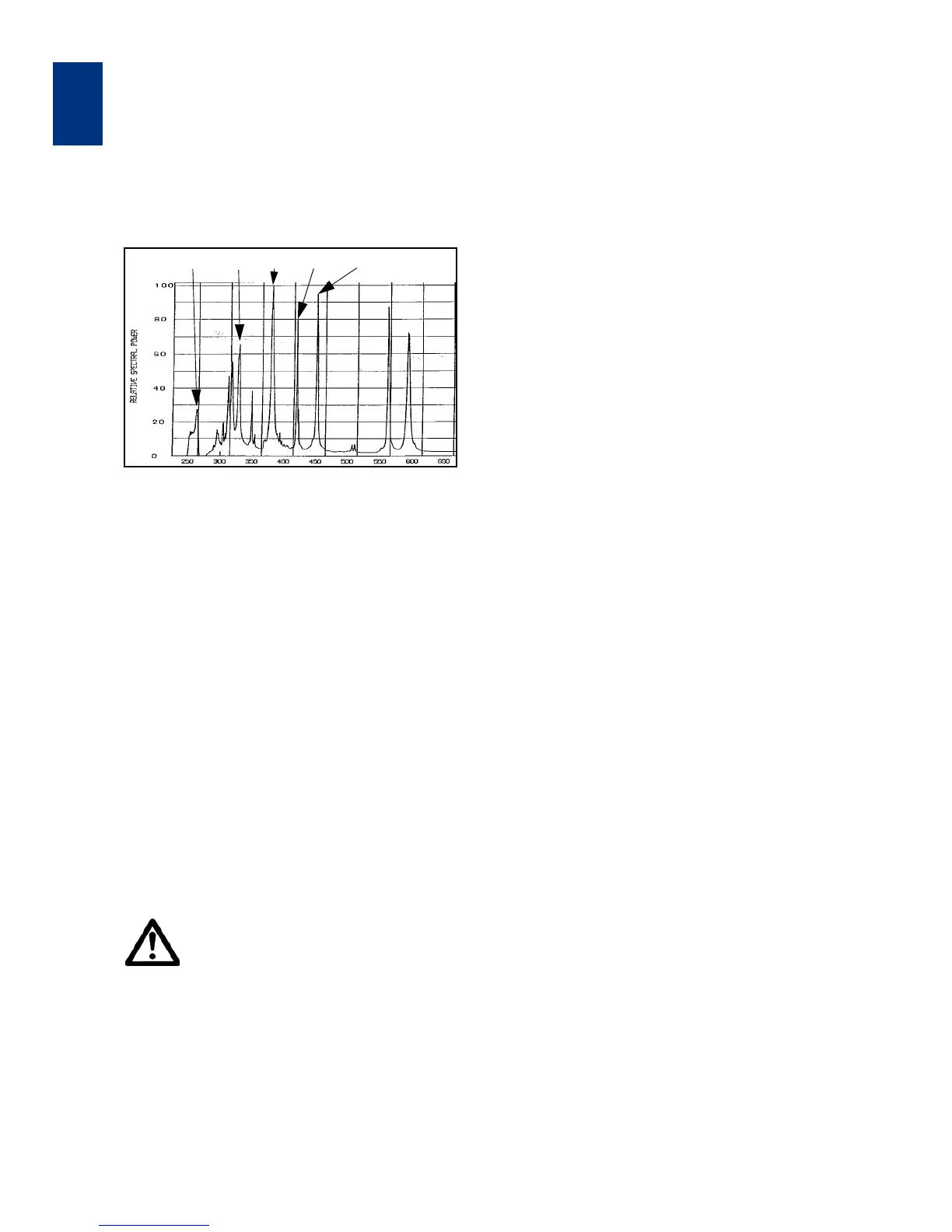
250 nm 313 nm 365 nm 405 nm 436 nm


 To Next Page