EasyManua.ls Logo

Tomberlin 2010 E-Merge - Discharge Test

Tomberlin 2010 E-Merge
151 pages
Print Icon
To Next Page IconTo Next Page
To Previous Page IconTo Previous Page
Loading...
Battery and Charger
MERGE 11-12
Chapter 11
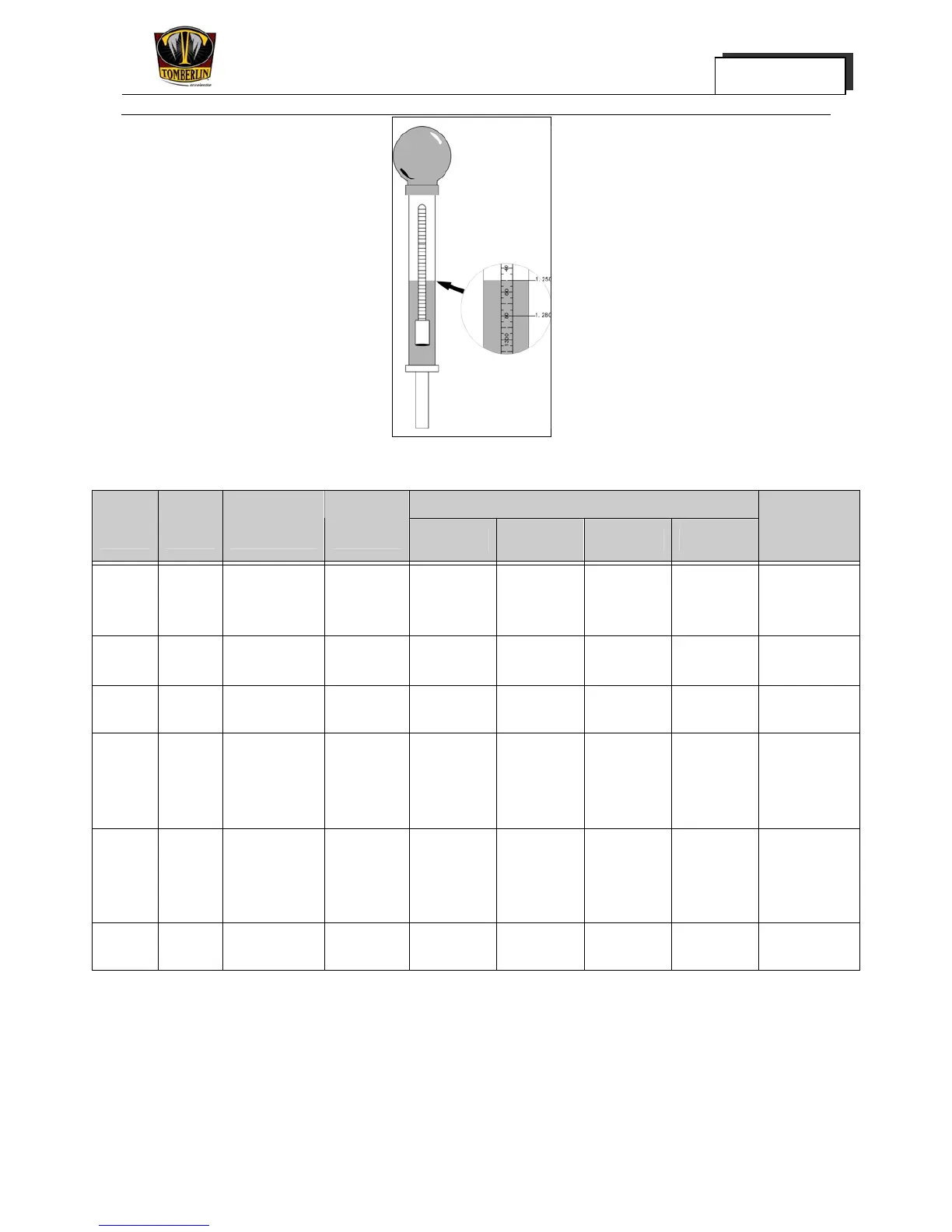
Fig 11-8: Hydrometer
Corrected specific gravity
Vehicle
number
Battery
number
Electrolyte
temperature
Correction
factor
Battery 1 Battery 2 Battery 3 Battery 4
Measures
should be
taken
12 1 20°F (-6.6°C) –.024
1.275 –.024
=1.251
1.280 –.024
=1.256
1.280 –.024
=1.256
1.280 –.024
=1.256
Normal
battery-fully
charged
35 6 90°F (32.2°C) +.004
1.155+ .004
=1.159
1.165+ .004
=1.169
1.160+ .004
=1.164
1.165 –.004
=1.169
Discharged
battery-charge
54 3 50°F (10°C) –.012
1.260 –.012
=1.248
1.200 –.012
=1.188
1.270 –.012
=1.258
1.270 –.012
=1.258
Defective battery
2
69 5 80°F (26.7°C) .000
1.250 – 0
=1.250
1.255 – 0
=1.255
1.230 – 0
=1.230
1.250 – 0
=1.250
Light current
battery
3-additional
charge
38 2
100°F
(37.8°C)
+.008
1.200+ .008
=1.208
1.180+ .008
=1.188
1.170+ .008
=1.178
1.180+ .008
=1.188
Discharged
battery-recharge
and
re-inspection
22 4 80°F (26.7°C) .000
1.240 – 0
=1.240
1.245 – 0
=1.245
Buoy
doesn’t float
1.250 – 0
=1.250
Rejected battery
3-replacement
Discharge test
In case no problem is identified after the above inspections, the discharge test should be conducted.
Simulate the operation mode of the vehicle to carry out the discharge test by reducing the battery output
current to voltage 42.0.

Table of Contents

Related product manuals