Need help?
Do you have a question about the VEMAG ROBOT HP7E and is the answer not in the manual?
Introduces the operating manual for the vacuum filler.
Emphasizes reading safety instructions before operating the machine.
Defines the intended use and versions of the vacuum filler.
Details correct and incorrect usage scenarios and environmental conditions.
Explains danger and warning symbols used in the manual.
Provides general safety guidelines for machine operation and maintenance.
Highlights specific safety precautions for various machine operations and components.
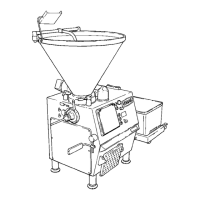
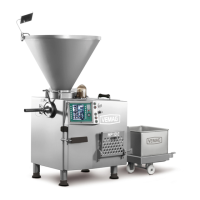
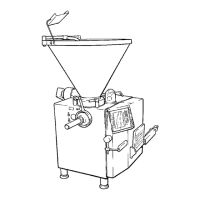
Provides an overview and labeled diagram of the machine components.
Describes key components like the hopper, feed screw, and double screws.
Describes standard and optional components for product ejection and linking.
Introduces the machine's controls, including main switch and equipment sockets.
Details the ON/OFF switches, UP/STOP/DOWN keys, vacuum display, and control valve.
Explains the knee lever for operation and the step for hopper access.
Provides instructions and safety warnings for transporting the machine using lifting equipment.
Details how to set up the machine, ensuring it is firm and level using adjustable feet.
Explains the electrical connection procedure and safety precautions.
Guides on how to check and ensure the correct direction of motor rotation.
Explains how to adjust the lifting/tipping device to ensure correct trolley height and levelness.
Outlines general steps for setting up the machine with appropriate components.
Details the procedure for fitting the double screw housing, including safety warnings.
Explains how to position and fit the double screws into the housing, with safety notes.
Guides on attaching the filling horn and its holder, with safety warnings.
Details how to attach and lock the optional linking gear, with safety precautions.
Explains how to fit the linking horn and grease its seal for proper function.
Covers inserting and tightening the linking horn, noting the left-hand thread.
Important operational setting for vacuum control.
Explains how to fit the scraper, especially for raw sausage processing, with safety warnings.
Guides on adjusting the knee lever for operator comfort and proper function.
Step-by-step guide for starting production, including safety checks and trolley handling.
Covers linking, program selection, vacuum setting, and shutdown procedures.
Explains how to operate the machine in provisional drive mode if the portioning computer fails, with safety warnings.
Introduces the control panel arrangement, screen layout, and keypad functions.
Describes the division of the screen into Header, Program, Parameters, and Footer areas.
Explains how status and error messages are displayed in the footer and their types.
Covers principles of operating the portioning computer, including program management and settings.
Details how to select, edit, copy, and delete filling programs and enter product names.
Explains how to import and export programs using a USB stick, including connection and action selection.
Guides on selecting mode groups, modes, and views for different applications and saving settings.
Explains how to select start/stop methods and associated attachments or options.
Covers how to adjust settings like language, date, time, and passwords for user access.
Details setting up userkeys with different access levels (Program locking, Advanced user, etc.).
Explains how to select mode groups, modes, and views for machine operation.
Describes various start/stop methods like Knee I, Knee II, Remote End, and Remote Stop.
Details fundamental parameters such as Weight and First Portion.
Covers supplementary parameters for various applications.
Details the 'Weight' parameter, including units, resolution, setting range, and application.
Explains the 'First portion' parameter for setting the initial portion weight and its behavior.
Details the 'Speed' parameter, its units, range, and how it's adjusted automatically or externally.
Explains the 'Vacuum control' parameter for automatic vacuum regulation during filling pauses.
Explains how to select the appropriate double screw type for HP series fillers.
Describes the Service pages providing general information on terminal, drive controllers, and operating hours.
Lists common messages, their causes, and recommended remedies for machine issues.
General information on daily cleaning requirements and safety precautions before cleaning.
Instructions for removing specific parts like the filling horn, linking gear, double screws, and hopper.
Provides a detailed schedule of cleaning tasks and recommends specific cleaning agents.
Details post-cleaning lubrication and reassembly steps, especially for the hopper.
General information on machine maintenance, recommending service contracts and outlining owner responsibilities.
Instructions on opening front door and service hatches for maintenance access.
Explains how to replace cartridges and operate the grease gun for lubrication.
Details the first-time maintenance tasks to be performed after specific operating hours.
Provides a detailed schedule of maintenance tasks based on intervals and operating hours.
Instructions for daily lubrication of feed unit seals using food-safe grease.
Details weekly lubrication of the feed unit drive and bearing using a grease gun.
Explains how to clean the air filter located in the rear service hatch weekly.
Details cleaning the air filter for the vacuum pump's intake line.
Guides on checking and replenishing the oil level in the double screw drive and checking seals.
Recommends checking feed unit seals and the hydraulic unit oil level.
Provides instructions for annual checks and oil changes for feed unit and hydraulic systems.
Details removing and maintaining the vacuum pump, with safety warnings about warm components.
Provides instructions for changing the oil in the double screw drive every two years.
Details changing the oil in the feed drive transmission every three years.
General advice on troubleshooting, including disconnecting attachments and following safety instructions.
Lists common faults, their causes, and recommended remedies for machine issues.
Provides general information on technical details, lubricants, accessories, and tools.
Lists detailed technical specifications for all ROBOT HP models, including filling rates, dimensions, and electrical data.
Provides dimensional drawings for different hopper configurations.
Lists components found in the electrical control panel located in the right-hand side service hatch.
Lists components of the drive controller for the ROBOT HP7E, located in the front door.
Lists components of the drive controller for the ROBOT HP10E/HP12E, located in the front door.
Lists components of the drive controller for the ROBOT HP15E/HP20E, located in the front door.
Provides a schematic diagram illustrating the hydraulic system of the machine.
Specifies oil/grease types, capacities, and qualities for various machine components.
Recommends specific double screws based on the product to be processed and provides order numbers.
Lists available filling horns for straight filling, categorized by diameter and with order numbers.
Advises selecting linking horns and lists other accessories with uses and order numbers.
Lists necessary tools for daily cleaning and machine maintenance, including their uses and scope of supply.
 General
| Manufacturer | VEMAG |
|---|---|
| Type | Portioning Machine |
| Application | Portioning |
| Control System | PLC control with touch screen |
| Power Supply | 400V/50Hz |
| Material Contact Parts | Stainless steel |
| Hygiene Standards | Complies with all relevant hygiene standards |

 To Next Page