Protective Elements
Temporarily Restraining (by
CT
saturation monitoring)
Beside the harmonic temporary restraining triggers, the protective device offers another trigger function - the
Transients Monitor (Gradient Monitor). This monitor supervises the current transformer saturation. This monitor will
be triggered by the behavior of the phase currents (their slopes, normalized derivative).
The normalized derivative is defined as:
is the peak value within a half cycle and
is the system frequency.
For a purely sinusoidal waveform, the normalized derivative should be equal to 1. Under CT saturation, m will be
greater than 1. The setting CT Satur Sensitvn should be set properly to identify effectively CT saturation but not to
generate a nuisance trigger.
When the CT saturation monitor is active, it will trigger the temporary restraining if m exceeds an internal threshold.
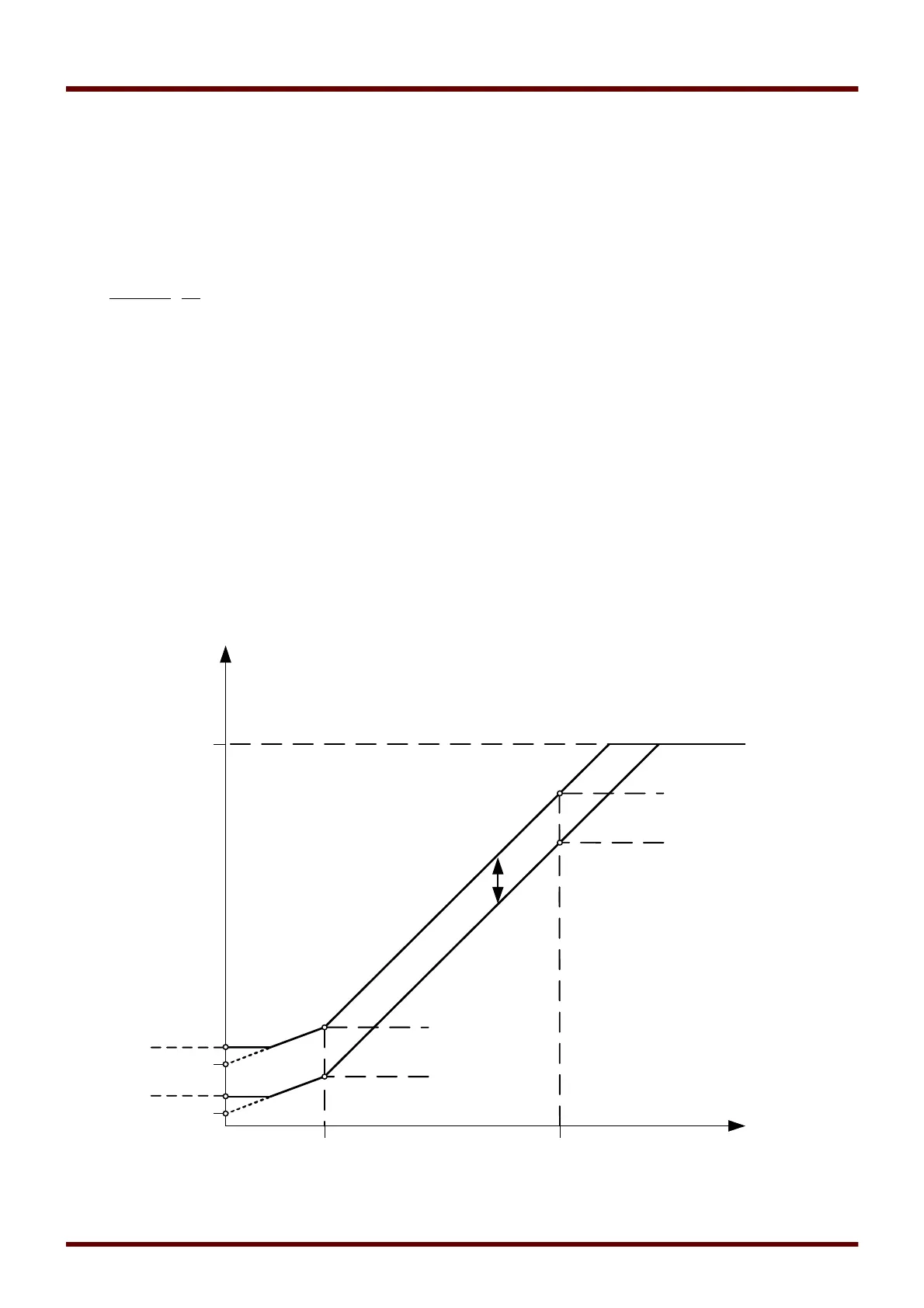
The temporary restraining, whenever effective, will essentially add a constant
to the fundamental
restraining. Graphically, the static tripping curve is temporarily raised by
which the sensitivity of the
differential protection function is reduced temporarily.
The internal threshold can be modified by means of the CT Saturation Sensitivn. The CT saturation monitor will
behave more sensitively the lower the setting value is set.
Temporary Dynamic Rise of the Static Tripping Characteristic.
640 MCDGV4 DOK-HB-MCDGV4-2E
IdH
Id[Is1]
Id[Is0]
Id[Is1]´
Id[Is0]´
Id[Is2]
Id[Is2]´
d[m]
Id min´
Id min
d
[H,m]
Is1= 2
x
Ib Is2= 10
x
Ib
Is/Ib
Trip Range
Operating Range
Id/Ib


 To Next Page