Protective Elements
f - Frequency [81O/U, 78, 81R]
Available elements:
f[1] ,f[2] ,f[3] ,f[4] ,f[5] ,f[6]
All frequency protective elements are identically structured.
Frequency - Measuring Principle
The frequency is calculated as the average of the measured values of the three
phase frequencies. Only valid measured frequency values are taken into
account. If a phase voltage is no longer measurable, this phase will be
excluded from the calculation of the average value.
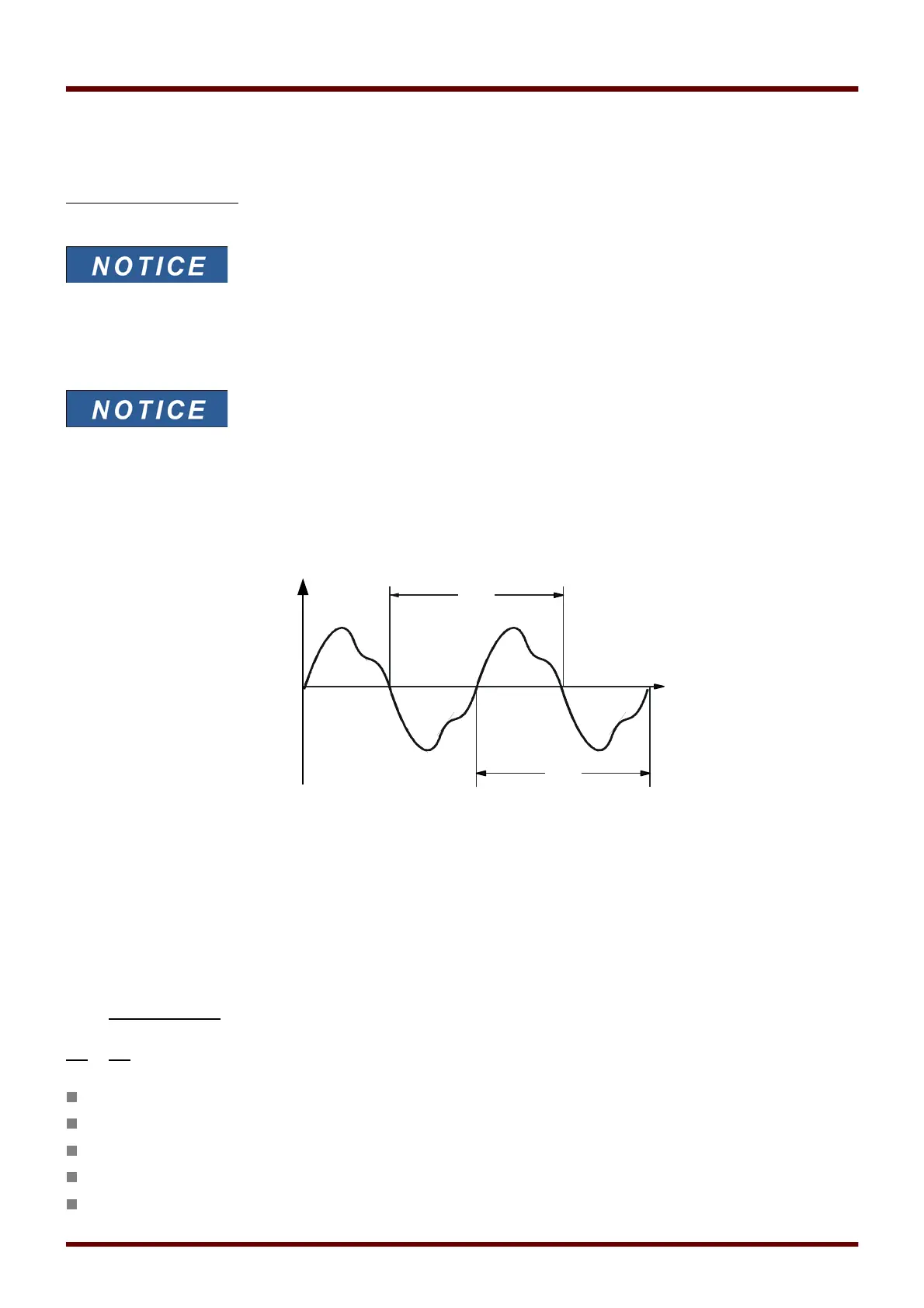
The measuring principle of the frequency supervision is based in general on the time measurement of complete
cycles, whereby a new measurement is started at each zero passage. The influence of harmonics on the measuring
result is thus minimized.
Frequency tripping is sometimes not desired by low measured voltages which for instance occur during alternator
acceleration. All frequency supervision functions are blocked if the voltage is lower 0.15 times Vn.
Frequency Functions
Due to its various frequency functions, the device is very flexible. That makes it suitable for a wide range of
applications, where frequency supervision is an important criterion.
In the
Device Planning
menu, the User can decide how to use each of the six frequency elements.
f[1]
to
f[6]
can be assigned as:
f< – Underfrequency;
f> – Overfrequency;
df/dt - Rate of Change of Frequency;
f< + df/dt – Underfrequency and Rate of Change of Frequency;
f> + df/dt - Overfrequency and Rate of Change of Frequency;
902 MCDGV4 DOK-HB-MCDGV4-2E


 To Next Page