SensyMaster FMT430, FMT450 THERMAL MASS FLOWMETER | OI/FMT430/450-EN REV. B 25
Device description
The SensyMaster FMT430, FMT450 works in accordance with the
measuring principle of a hot-film anemometer. This
measurement method allows for direct measurement of the gas
mass flow.
Taking into account the standard density, the norm volume flow
can be displayed without the need for additional pressure and
temperature compensation.
The transmitter is equipped with an analog / HART® output
(4 to 20 mA) and two fast digital outputs that can be configured
as pulse, frequency or binary outputs.
Optionally, the transmitter can be extended using plug-in cards
with further inputs and outputs as well as a Modbus® or
PROFIBUS DP® interface.
The SensyMaster FMT430, FMT450is used in the process
industry for the flow measurement of gases and gas mixtures.
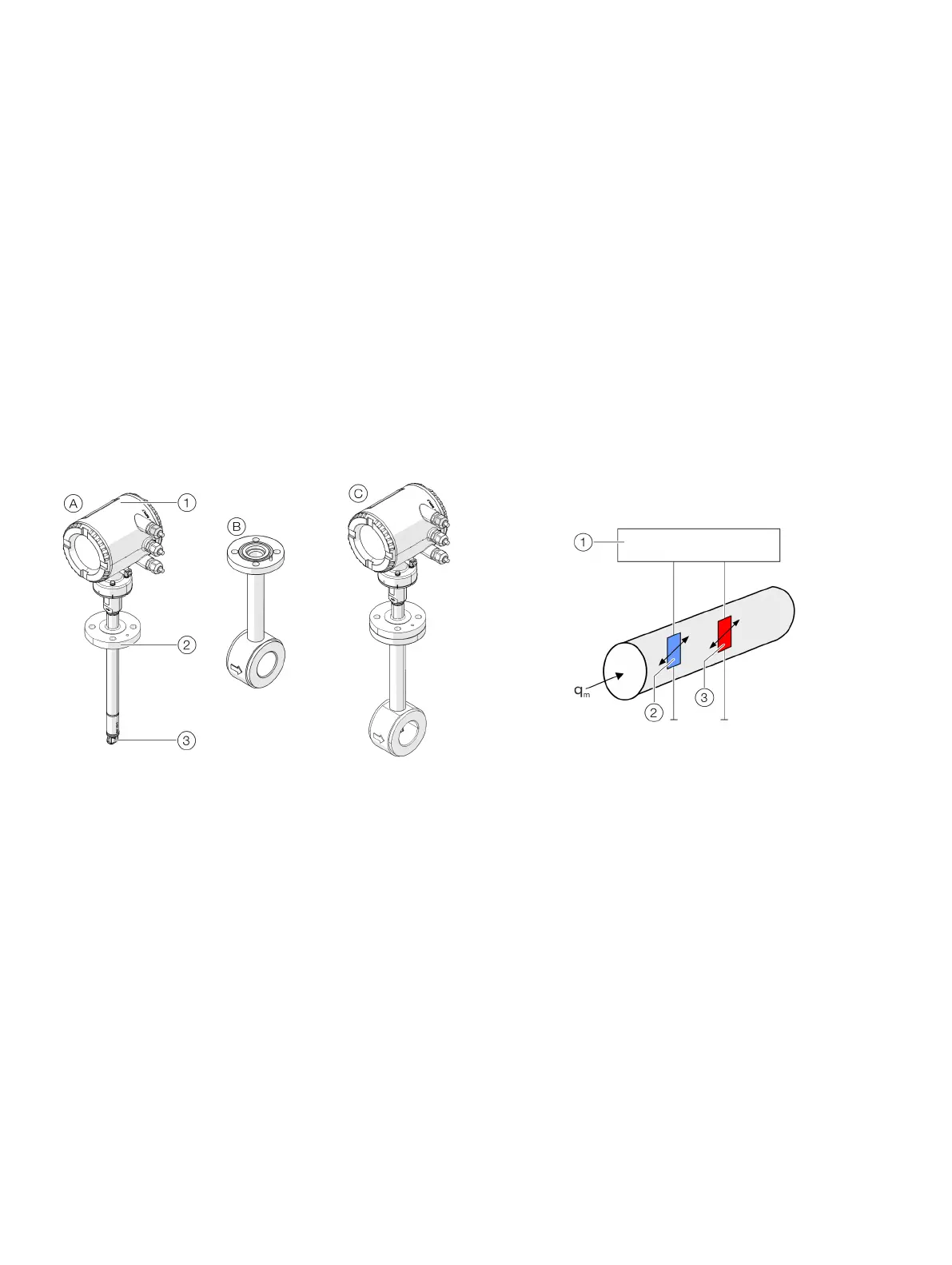
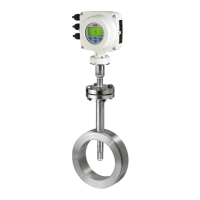
Sensor
Pipe component
Sensor with pipe component
Transmitter
Sensor connection
Thermal sensor elements
Figure 8: Sensor (example, wafer type design)
The SensyMaster FMT430, FMT450 is composed of the
components sensor and pipe component (process connection).
The pipe component can be delivered in various designs. In
addition, a weld-on adapter makes it possible to install the
flowmeter sensor in rectangular ducts or pipelines with any
diameter.
Measuring principle
Thermal flow metering procedures use different ways to
evaluate the flow dependent cooling of a heated resistor as
measuring signal.
In a hotfilm anemometer with constant temperature difference
control, the heated platinum resistor is maintained at a constant
overtemperature in relation to an unheated platinum sensor
inside the gas flow.
The heating power required for maintaining the
overtemperature depends directly on the flow rate and the
material properties of the gas. With a known (and constant) gas
composition the mass-flow can be determined by electronically
evaluating the heater current / mass-flow curve without
additional pressure and temperature compensation.
Together with the standard density of the gas this results
directly in the standard volume flow.
Considering the high measuring range dynamics up to 1:100, an
accuracy smaller than 1 % of the measuring value is achieved.
Transmitter
Gas temperature measurement
resistor
Heating resistor
Figure 9: Measuring principle (simplified)
The transmitter has three signals available. In addition to the
heating power, the temperatures of the measuring medium and
the heater resistance are included herein, which can be used to
compensate the temperature dependency of gas parameters.
By storing the gas data in the transmitter the optimal tailoring
can be calculated and performed at any operating point.




 To Next Page