Chapter 5 Explanations
Mini-Switch LB 471
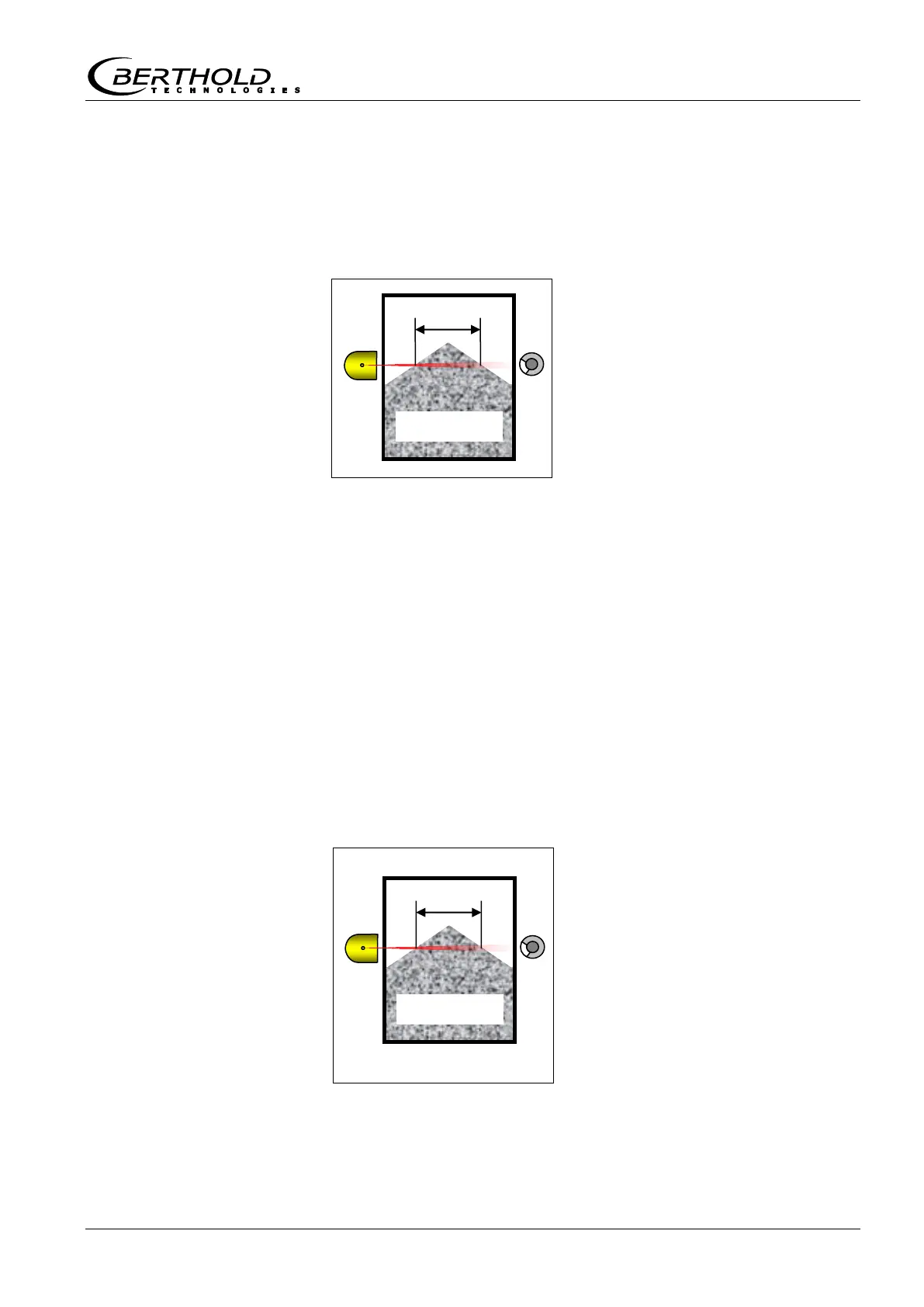
Simulate bulk cone with steel or lead plates
You need steel or lead plates causing the same absorption with
respect to Gamma radiation as the bulk cone. Since this is de-
pendent on the mass per unit area, the steel or lead plate must
have the same mass per unit area as the bulk cone.
The required thickness of the steel plate is determined as follows:
Product coal: 0.5 g/cm
3
Bulk cone diameter: 500 mm
Source: Cs-137
Steel density: 7.8 g/cm³
HVL=0.5x500/7.8=32mm steel
Alternative for lead plate:
HVL=0.5x500/11.3=19mm lead
You may also use several plates in order to get the required thick-
ness of the plate.
The container has to be empty to calculate the switch point, or the
cone end of the bulk cone must be below the monitoring level.
Now use the steel or lead plate and cover the sensitive part of the
detector, i.e. the scintillator. Hold the plate between detector and
container wall. The plate must have the following minimum dimen-
sions in order to cover the entire detector window or the complete
scintillator:
70 x 70 mm for NaI detector
200 x 200 mm for Super-Sens
While the plate is being held in front of the scintillator, read off the
count rate in code 11 and enter this value in code 18.
Calculating the count rate for the switch point
Example with coal
Bulk weight (rho): 0.5 g/cm³
Bulk cone diameter: 50cm
µ for Co-60 source: 0.04
(µ for Cs-137 source: 0.057)
Empty count rate: 300 cps
Full count rate: 40 cps
I
use
= I
empty
– I
full
I
use
= 300-40 = 260 cps
I = I
full
+ I
use
e
–(µ*rho*d)
I = 40+260*e
–(0.04*0.5*50)
= 136 cps
Input into code 18: 136
Determining the
plate thickness
Calculating the
switch point
Bulk density:
0.5 (g/cm³)
Bulk density:
0.5 (g/cm³)



 To Next Page