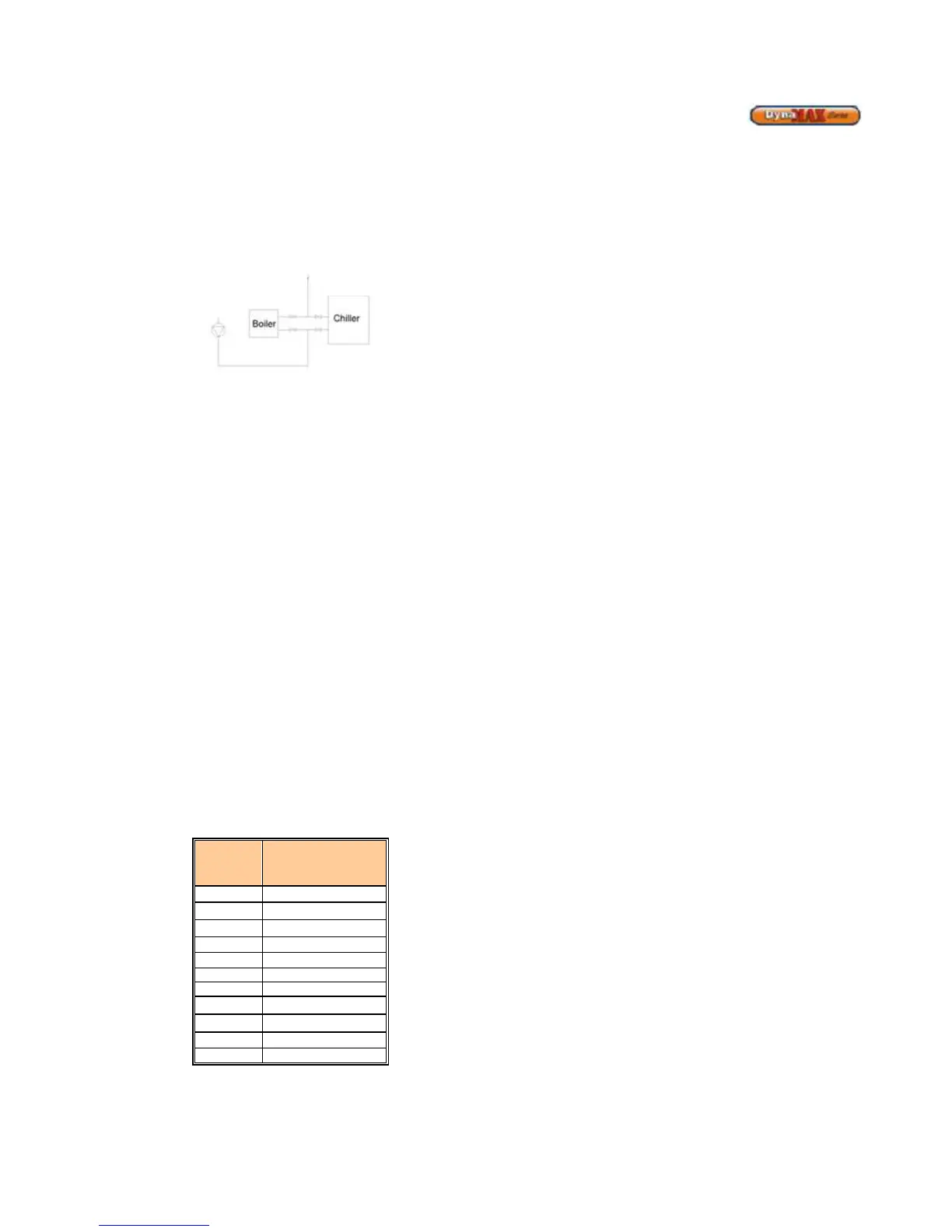
4.2 WARNING REGARDING CHILLED WATER
SYSTEMS
When an appliance is connected to an air conditioning
system where the same water is used for heating and
cooling, the chiller must be piped in parallel with the
appliance. Appropriate flow control valves; manual or
motorized must be provided to prevent the chilled water from
entering the appliance.
Figure 18: Chilled Water System
4.3 INLET AND OUTLET CONNECTIONS
• All water connections must meet
American National
Standard Pipe Threads (NPT).
• For ease of service, install unions on inlet and outlet of
the appliance. The connection to the appliance marked
“Inlet” on the header should be used for return from the
system. The connection on the header marked “Outlet”
is to be connected to the supply side of the system.
4.4 MINIMUM PIPE SIZE REQUIREMENTS
Minimum water pipe connections are as follows for DynaMax
single unit installations. The equivalent number of straight
feet of pipe for each valve and fitting in the connecting piping
must be considered to properly arrive at the total equivalent
feet of straight pipe in the field installed piping to the
appliance. Consult factory if longer piping distances are
required for a specific application. It is recommended to use
copper piping for all system piping to reduce the possibility of
the formation of deposits, which may result in heat
exchanger starvation.
System pipe size must be in accordance with Table 11, and
between supply and return lines, must not exceed 50 feet of
equivalent length. Connection sizes at the heater are given
in Tables 4 & 6. Any reduction in recommended pipe size
may decrease flow resulting in high temperature rise across
the heat exchanger, boiler noise, flashing to steam and non-
warrantable heat exchanger damage.
Table 10: Minimal System Pipe Size
Input
[BTU/hr]
Water Size, NPT* [in.]
80,000 1
100,000 1
150,000 1
199,000 1 1/4
250,000 1 1/4
299,000 1 1/2
399,000 2
500,000 2
600,000 2
700,000 2
800,000 2
* Equivalent length must not exceed 50 equivalent feet
4.5 HEAT EXCHANGER
This appliance uses precision formed stainless steel tubing
to maximize the heat transfer process and achieve 97%
steady-state efficiency. This heat exchanger is designed to
withstand 160 PSIG working pressure.
A factory installed circulating pump ensures proper water
flow during burner operation and creates enough velocity
inside the stainless steel tubes and headers that prevents
scaling.
4.6 LOW WATER TEMPERATURE SYSTEMS
In applications where the heating system requires supply
water temperatures below 110°F, connections may be made
directly to the DynaMax. At incoming temperatures of 80
o
F
or lower the DynaMax achieves maximum efficiency. Inlet
temperatures must not drop below 40
o
F to prevent freezing.
4.7 PIPING ARRANGEMENTS
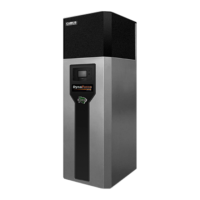
The DynaMax boiler when configured as a hydronic heating
boiler allows for 4 modes of operation and 3 modes of
operation as a hot water heater. For more details on each of
the operating modes refer to section 6.3 Central Heating
Modes and 6.4 Domestic Hot Water Modes.
4.7.1 Field Supplied Components
1) Boiler system piping
Boiler system piping MUST be sized according to
Table 11. Reducing the pipe size can restrict the
flow rate through the boiler, causing boiler damage
and will void the manufacturer’s warranty.
2) Isolation Valves
Use only full port ball valves. Failure to supply full
port ball valves may result in reduced flow rate
through the boiler, causing boiler damage and will
void the manufacturer’s warranty.
3) Anti-Scald Mixing Valve
An anti-scaled mixing valve is recommended when
DHW storage is above 120
o
F.
4) Unions
Recommended for ease of serviceability.
5) System Temperature Sensor (Cascade ONLY)
A system temperature sensor is to be installed in
the main header at a point to detect controlled
temperature and where it will not lead to short-
cycling of the boiler.
An instantaneous water heater is designed to deliver hot
water without the use of a storage tank. It is suitable for
applications with variable load such as restaurants,
condominiums, apartments and motels and typically used in
conjunction with tempering valves to achieve temperature
control.



 To Next Page