User Manual DEV 1951
Copyright DEV Systemtechnik GmbH 2004-2017 55
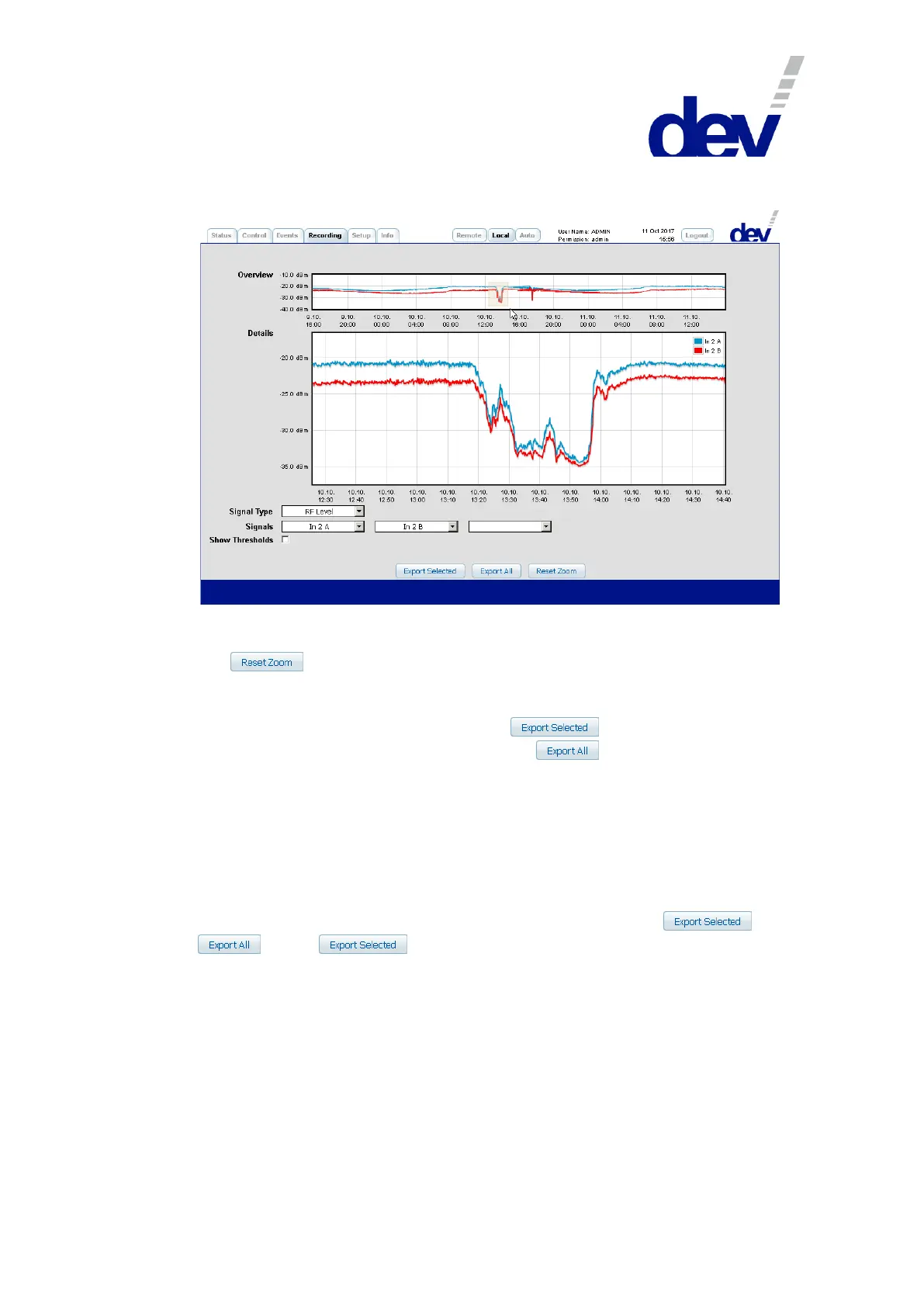
Directly after releasing the left mouse button, the zoomed area appears in the
"Details" diagram while the "Overview" diagram is highlighting the zoomed area:
Three buttons are located at the bottom of the Recording Tab:
If the recorded data of the selected items was zoomed as described above, the but-
ton resets the data representation to the initial state, i.e. all recorded
data for the selected signals is displayed in both diagrams.
The remaining two buttons provide the option to store the captured data externally
(without the possibly displayed thresholds). stores the recorded data
of the currently selected signals and the button stores all recorded data
of the device, i.e. the available data of all signals. After operating one of the but-
tons, a browser specific window pops up and suggests the storage of the data as
"recording.csv" and as "recording_all.csv", respectively. The csv (comma-separated values)
file format permits the data import e.g. into a MS Excel worksheet:
The csv-file is a text file modeling a table. Each line is interpreted as row containing
column information, here with the columns delimited by a semicolon (";") charac-
ter as the column separator.
The number of columns in the file depends on the export method ( vs.
). If the button is selected, the number of columns depends
on the number of signals currently presented. In any case, each signal consists of a
"Time" and of a "Value" column; the number of lines depends on the recording
duration (over 17000 lines e.g. within two days with the default ten seconds
recording interval).
The first line of the csv-file is the header line providing the column information. The
first entry is assigned to the first channel (e.g. "In 2 A", indicating the (default) port
name of the primary input port of the second sensing switch module, please refer
to chapter 5.5.4), concatenated with the "Signal Type" (i.e. here always "RF Level")
and with "Time". After the semicolon, the same entry is listed with "Values" instead
of "Time". This sequence is repeated for all columns that are part of the csv-file.


 To Next Page