TRANSIENT3000
83/162
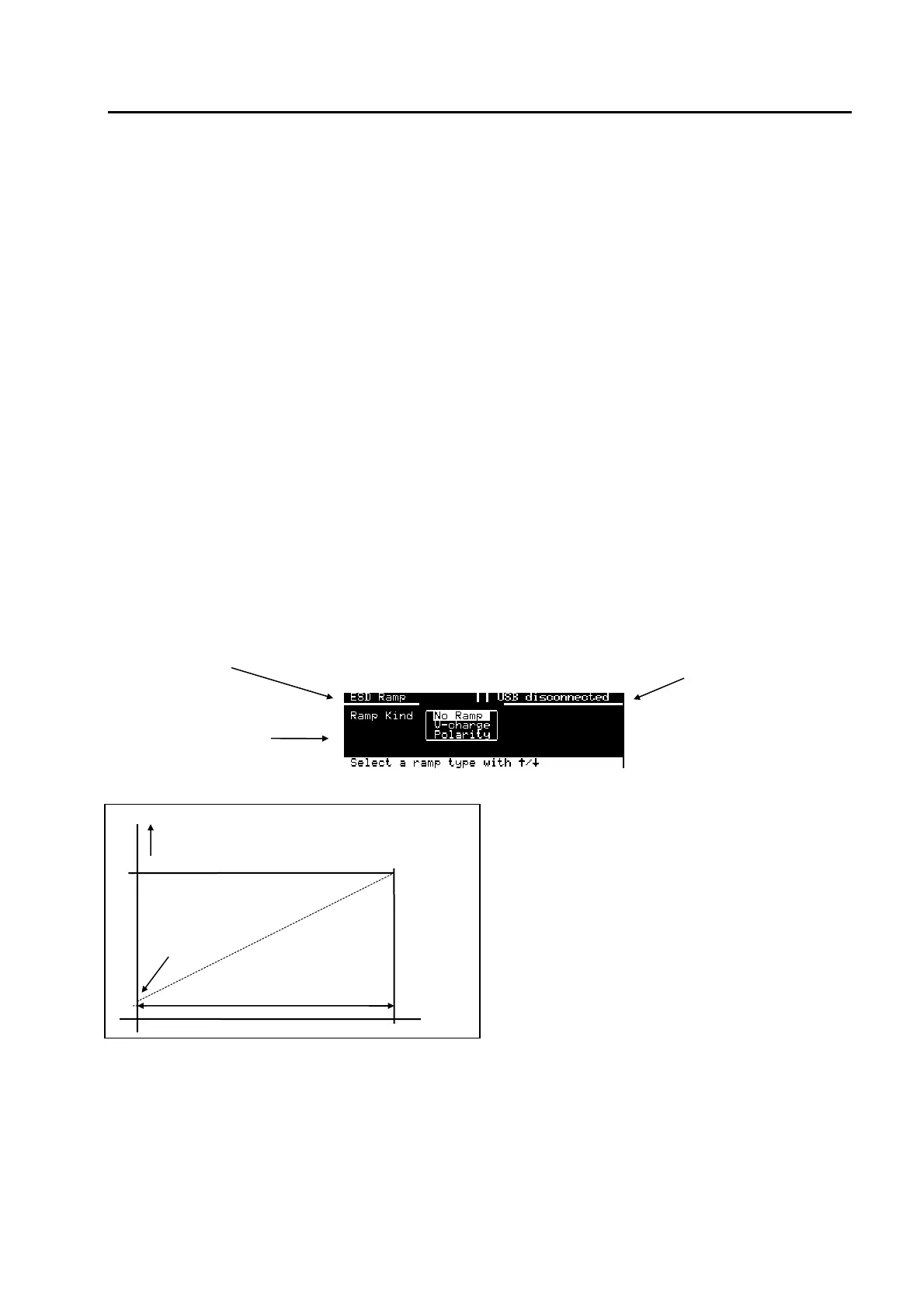
In the example in picture 6.2.3.1, the voltage will be increased from 500V to 1000 V in 20 seconds. The
steps or resolution of the ramp depend on the ramp time and on the voltage difference between V Nominal
and V-peak start.
Ramp: Spike frequency
The steps or resolution of the ramp depend on the ramp time and frequency difference between f nominal
and start frequency. The chosen number of spikes (=10) per Burst is constant. As a consequence the burst
duration decreases with increasing spike frequency. The energy content of one burst is constant. The
constant energy per burst simplifies the failure analysis. When a failure occurs at higher frequency the
failure relates to the frequency and not to the energy The burst duration is no longer applicable.
Ramp: Burst duration ramp
When analogue circuits are tested, the energy per burst is very important. With the burst duration ramp, the
number of spikes will be continuously increased and therefore also the energy. If RC networks e.g. filters,
are integrated into a circuit, the disturbance energy can be defined with this mode.
Ramp: Synchronisation angle
With this setting the synchronisation angle of synchro start is continuously adjusted from start angle to stop
angle.
6.2.3.2 ESD Ramp
loaded test EUT power v, i
possible ramps at ESD
6.2.3.2.1 Definition ramp
number of pulses
Start
Nominal V
V


 To Next Page