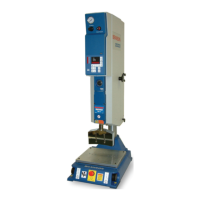
The device is the Branson L20 Metal Welding System, an ultrasonic welding system designed for joining metal parts. It comprises an actuator, a controller, and tooling (horns, tips, anvils, and converters) that deliver mechanical energy to the workpieces. Some systems may also include special fixturing and machine automation.
Function Description:
The L20 Metal Welding System uses ultrasonic energy to join metal parts. Electrical energy is transformed into high-frequency mechanical vibrations, which are then transferred to a welding tip through an acoustically tuned horn. The parts are "scrubbed" together under pressure at 20,000, 40,000, or 60,000 cycles per second. This high-frequency vibration, combined with force, disperses surface films and oxides, creating a clean, controlled, diffusion weld. This process results in a true metallurgical bond as atoms combine between the parts.
The system is designed for automated, semi-automated, and/or manual production operations. It is particularly suited for:
- Welding of non-ferrous metals
- Welding of copper to copper
- Welding of copper to aluminum
- Welding of aluminum to aluminum
- Termination of non-tinned wire to terminals
The system operates based on three primary variables:
- Time: The duration of applied ultrasonic vibration.
- Amplitude: The longitudinal displacement of the vibration, correlating to the scrubbing action at the weld interface.
- Force: The compressive force applied perpendicular (normal) to the direction of vibration.
The power required for vibration is defined as P = F x A (Power = Force x Amplitude), and energy is calculated as E = P x T (Energy = Power x Time). A well-designed system compensates for normal surface variations by delivering a specified energy value, allowing weld time to adjust to material conditions. Welding to energy is crucial for dealing with non-metallic oxides and contaminants, ensuring clean surfaces for reliable welds.
Important Technical Specifications:
Actuator:
- Slide Mechanism: Precision roller bearing slide for smooth operation and accuracy.
- Mechanical Stops: Two mechanical stops (down stop and up stop) limit horn travel. The down stop prevents contact between the horn and anvil if cycled without parts, with a recommended minimum gap of 0.004” (0.10 mm). The up stop limits upward travel to reduce cycle times and ease loading/unloading.
- Polar Shell & Ultrasonic Stack: The converter-booster-horn assembly (ultrasonic stack) is supported in a steel polar shell by two titanium diaphragm springs, acoustically tuned at 20 kHz, providing rigid mounting and efficient ultrasonic vibration transmission.
- Linear Encoder: Measures horn travel distance with an accuracy of ±0.05mm (0.002 in). Used for weld in height mode, energy with height compensation, and inspecting pre-height and post-weld height.
- Pneumatic System: Includes solenoid valves, an air cylinder, an electronic pressure regulator, and 4 flow control valves. Controls the ultrasonic stack's descent (Down Speed), return (Up Speed), and cooling air flow (Cooling Control valve).
- Air Supply: Requires "clean, dry and unlubricated" air (to a 5 micron level) with a regulated maximum pressure of 100 psig (690 kPa). Actuator operation requires 70-80 psi.
- Air Consumption (per inch of stroke length, each direction):
- 100mm Bore: 0.0118 CFM (10 PSI) to 0.0454 CFM (80 PSI)
- 63mm Bore: 0.0047 CFM (10 PSI) to 0.0180 CFM (80 PSI)
- Additional 0.034 CFM for converter cooling air per second of weld time.
- Maximum Stroke: 48mm / 1.9 inches.
Power Supply (Ultrasonic):
- Converts 50/60 Hz electrical current into high-frequency electrical energy (20 kHz, 40 kHz, or 60 kHz).
- Power Supply Overload (Ultrasonic): Automatically prevents system damage if power required to keep the stack in motion exceeds available power.
- Input Power Requirements:
- 20 kHz models (2200W, 3300W, 4000W): 200-230 V, 50/60 Hz, Single Phase. Current ratings: 14 Amp, 21 Amp, 25 Amp respectively.
- 30 kHz models (1500W): 200-230 V, 50/60 Hz, Single Phase. Current rating: 10 Amp.
- 40 kHz models (800W): 200-230 V, 50/60 Hz, Single Phase. Current rating: 5 Amp.
- 5500 W 3 phase 480V model also available.
- Environmental Specifications:
- Ambient Operating Temperature: +5°C to +50°C (41°F to 122°F)
- Storage / Shipping Temperature: -25°C to +55°C (-13°F to +131°F)
- Humidity: 30% to 90% (non-condensing)
- Operating Altitude: 1000 m (3280 ft)
- IP Rating: 2X
Usage Features:
- Weld Modes:
- Weld In Energy: Delivers ultrasonic energy until a predetermined amount of joules is dissipated.
- Weld In Height: Delivers ultrasonic energy until tooling reaches a predetermined height.
- Weld In Time: Delivers ultrasonic energy for a predetermined duration.
- Energy W/Height Compensation: Delivers energy, then adjusts further if the welded part size is outside the height window, up to 300% more energy.
- Amplitude Stepping: Allows changing the amplitude of the horn face during the weld cycle, useful for welding aluminum to increase strength and prevent sticking.
- Advanced Weld Settings: Includes Afterburst Time (short burst of energy after weld cycle), Afterburst Delay (time between weld completion and afterburst start), Squeeze Time (time between horn engagement and energy delivery), Preburst (short burst before pre-height capture, useful for magnet wire), and Hold Time (time components remain held after energy delivery).
- Presets: Stores and recalls specific weld parameter settings. Up to 1000 presets can be stored.
- Sequences: Groups of presets executed in a particular quantity and order. Up to 50 sequences can be stored.
- Quality Windows & Limits: Programmable values to compare actual process data, issuing an alarm if limits are exceeded.
- Maintenance Counter: Programmable device to alert personnel for tooling inspection/replacement or preventive maintenance.
- Safety Features: System Protection Monitoring (SPM) stops ultrasonics on overload or defective horns. A thermal switch disconnects power if the unit overheats. Emergency stops are present on the foot pedal.
Maintenance Features:
- Daily Maintenance:
- Drain water and contaminants from airline filters.
- Inspect machine tip and anvil for grinding, cracking, or galling.
- Check for loose material or debris in the welding cavity.
- Verify controller parameter settings.
- Every Tool Rotation:
- Inspect clamping surfaces of Tip, Tip Nut, and Horn for fretting.
- Vacuum and clean copper residue or dirt in the actuator.
- After 40k-50k Cycles Maximum (application dependent):
- Vacuum and clean inside the power supply.
- Calibrate pressure regulator.
- Clean and torque the stack interface.
- Calibrate amplitude.
- FSR Assembly (Air Filter/Separator/Regulator): Service after 1 year or when a 15 psi pressure drop is reached. Involves disconnecting air supply, cleaning filter and separator bowls, and replacing filter elements.
- Reconditioning the Stack: Involves disassembling the ultrasonic stack, cleaning mating surfaces of the converter, booster, and horn with an oilstone or 600-grit paper, and polishing diaphragm springs.
- Reconditioning Tip and Nut Clamping Surfaces: Polishing with 600-grit emery paper to remove burrs. Horn clamping surface burrs must be machined, removing no more than 0.020” of material.
- Lubrication Schedule:
- After 1 month of normal operation: Inspect actuator interior for grease discharge, re-lubricate slide until reservoir is full (min 0.6 CC), allow full travel, and cycle 10-20 times to re-circulate grease.
- After 3 months of normal operation: Repeat 1-month procedure.
- After 6 months of normal operation: Remove slide assembly, inspect for damage/wear, re-lubricate, use a setup rail to cycle the block, and re-assemble. More frequent inspections if grease is low, discolored, or dirty.
- Calibration: Encoder board calibration is factory set but may require adjustment if a new board is installed. Height Zero and Span Adjustment involves adjusting potentiometers (HGT ZERO, R40) on the actuator board. Height Calibration involves positioning shims and using the CALIBRATE function.
- Parts Replacement: Internal components (modules) are replaceable. Power supply cover is removable for cleaning. Circuit boards and modules are replaceable, noting ribbon cable and connector orientation.
- Troubleshooting Guide: Comprehensive guide for various issues including system not turning on, fuse failures, horn movement issues, no sonics, overloads, electrical shock, tooling overheating, low weld strength, excessive welding, and time/power/height errors.

 Need help?
 General

 To Next Page