16 DCM00003 REV. 07
2.2 Terminology
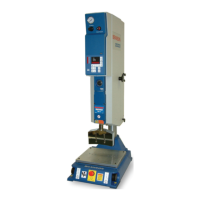
Actuator: A mechanical device which houses the converter/booster/horn (stack)
assembly in a rigid mounting and is utilized to move the stack up or down. This allows for
precise control of welding pressure for efficient while delivering mechanical vibrations
from the ultrasonic stack to the work piece(s).
After Burst: A short duration (burst) of ultrasonic energy that begins after completion of
the AFTER BURST DELAY. (Also See: AFTER BURST DELAY & AFTER BURST DURATION).
After Burst Delay: The amount of time, in seconds, between the completion of the
ultrasonic welding cycle and the start of the AFTER BURST. (Also See: AFTER BURST &
AFTER BURST DURATION).
After Burst Duration: The amount of time, in seconds, that AFTER BURST energy is
delivered. (Also See: AFTER BURST & AFTER BURST DELAY).
Amplitude: Amplitude is the peak-to-peak displacement of mechanical motion as
measured at the face of the horn tip. Amplitude is measured in thousandths of an inch or
in microns. (i.e. A standard 40 kHz converter produces approximately .0004” or 10
microns of amplitude), Inches x 25,400 = microns. -- With ‘Advanced Power Supply’ this is
adjustable depending on system frequency and application tooling.
Anti-Node: The anti-node is the area of the horn and booster that exhibits maximum
longitudinal displacement and where the internal dynamic forces are equal to zero. This
area is at the face and back surface on half-wave technology.
Anvil: A device specially designed to grip the lower component and hold it stationary
against the energy of vibration(s) which allows a weld to be created.
Baud Rate: A communications measure describing the speed at which signals are
transmitted serially (the number of signal events per second).
BBRAM: Nonvolatile random access memory (battery back-up random access memory).
Equipped with long life built in batteries, this memory area preserves weld parameters
and menu settings when the system is powered off. (also known as BBR).
Booster: The central component of an ultrasonic stack assembly. A device which transfers
mechanical energy from the converter to the ultrasonic horn. The booster will, depending
on design, increase, decrease, or maintain the specific energy (amplitude) as received
from the converter.
Calibration: The process of adjusting a device to a known position for purposes of
inspection and/or monitoring position, direction, speed, and/or velocity.
Clock: An electronic circuit that generates timing pulses to synchronize the operations of
various other circuits in a device(s).
Communications: Transmission of information between points of origin and reception
without alteration of the sequence and or structure of that information content.
Consumable Spare Tooling: The tooling portion of the ultrasonic system that wears and
requires replacement due to production use. This includes but is not limited to ultrasonic
horns, replaceable tips, anvil, and positioning mask. A Spare Tooling Specification Sheet is
included within the Operation Manual to document the spare tooling for a specific metal
welding application.
Continuous Sonics Mode: A system setting in which the power supply will deliver
ultrasonic electrical energy until the start signal is terminated.
Controller: The portion of the welding system that provides specific settings &
instruction(s) to the overall welding system.
Converter: A device which utilizes a lead-zirconate-titanate electrorestrictive element to
change high frequency electrical energy into high frequency mechanical energy.



 To Next Page