62 DCM00044 REV. 14
6.2.7 Torque Check
Proper tightness of tooling is critical to assure efficient transmission of ultrasonic energy
into the weld nugget. Please check the tightness of the following areas during a tool
change or whenever looseness is suspected.
6.2.8 Emergency Stop
The emergency stop is found on the red, top portion of the foot pedal. When engaged it
will prevent the actuator from running, and will also immediately terminate a weld cycle
and cause the actuator to return to its “Home” position. It does not remove power from
the system. The power supply will indicate that the system is in emergency stop mode and
emit a beep sound when the emergency stop is engaged. Push the emergency stop foot
pedal to reset the system.
6.2.9 Tool Gap Requirements
Tooling includes the Horn (or Horn Tip), Anvil and all surfaces that contact the weld nugget
during processing. The tooling should be inspected to confirm a gap as per the application
tooling set up sheet. If the tooling is in contact during the application of ultrasonic energy,
severe damage may result to the tooling and power supply.
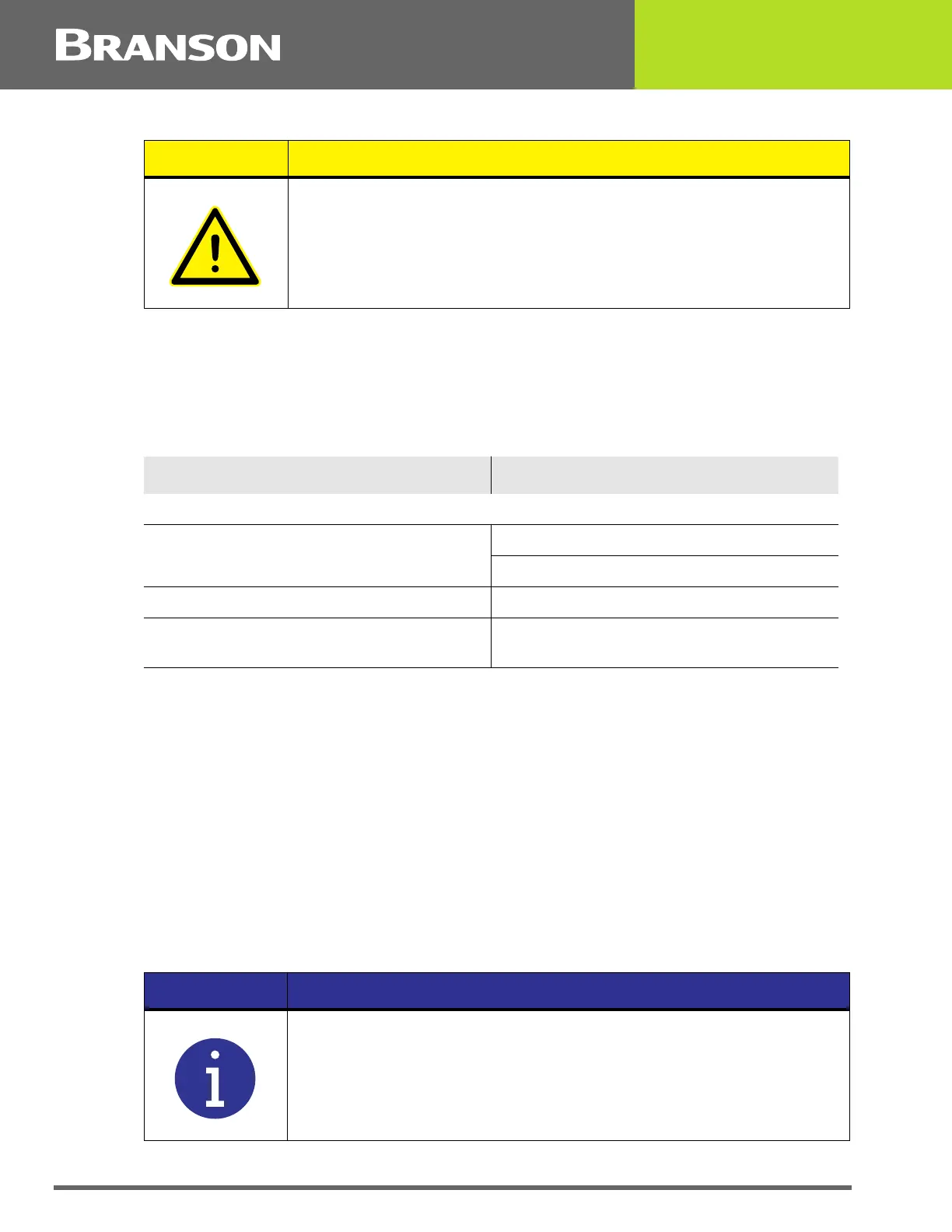
CAUTION General Warning
Increasing the Up Stop gap too much can result in an unsafe weld
condition (pinch point). The Up Stop travel distance should be kept to
an absolute minimum for safety reasons.
Table 6.1 Tooling Torque
Area Suggested Torque
Horn to Booster
Solid Blade Horn to Booster
Replaceable Tip Horn to Booster
80 ft/lbs (108 N.m)
100 ft/lbs (135 N.m)
Converter to Booster 55 ft/lbs (75 N.m)
Tip Nut (if used)
70 ft/lbs (95 N.m)
(Unless Otherwise Specified)
NOTICE
This test should be checked whenever the tooling is changed. Also
perform this test whenever you suspect tool contact.



 To Next Page