16 DCM00044 REV. 14
2.2.2 The Pneumatic System
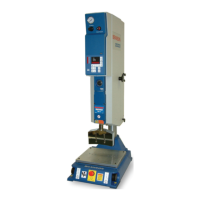
The pneumatic system included on the Ultraweld L20 Actuator consists of solenoid valves,
an air cylinder, an electronic pressure regulator, and 4 flow control valves. The ultrasonic
stack’s rate of descent and rate of return are controlled by the Down Speed and Up Speed
control valves, respectively, located at the back of the unit. The front nozzle air flow is
controlled by the Cooling Control valve, also located at the back of the unit. The converter
cooling flow is controlled by a flow control valve located inside the unit.
2.2.3 The Linear Encoder
The linear encoder is a sensing device that tracks polar block movement. The accuracy of
the encoder is ±0.002 in (±0.05mm).
2.2.4 Converter
The 20 kHz electrical energy from the power supply is applied to the transducer element
or converter, which transforms the high frequency electric current into high frequency
mechanical vibrations at the same frequency. The heart of the converter is a lead-
zirconate-titanate electrostrictive element that, when subjected to an alternating voltage
expands and contracts. The converter’s efficiency of changing electrical energy to
mechanical vibrations exceeds ninety-five percent.
2.2.5 Booster
A booster couples the converter to the horn and helps determine the amplitude of
vibration produced at the face of the horn. The booster is a resonant half-wave metal
device made of titanium or aluminum and is designed to resonate at the same frequency
as the converter with which it is to be used.
A booster has two functions:
• A rigid mounting for the converter/booster/horn stack
• An amplitude-of-vibration increaser or decreaser as ultrasonic energy is transmitted from the
converter through the booster to the horn. The ratio of input to output amplitude is called the
gain
2.2.6 Horn
The horn is a half-wave length resonant metal device that transfers the ultrasonic
vibrations from the booster to the weld tip. The horn is made of steel (titanium for
replaceable tip tooling) and is designed to resonate at 20 kHz. The acoustical efficiency of
steel and titanium helps to maintain constant amplitude throughout the operating
temperature of the welder.
Since the horn is a vital part of the ultrasonic assembly system, it should not be altered
without proper training and advice from Branson.
Depending upon the particular application at hand, the horn may be either a solid horn as
shown in Figure 2.1
, or a Horn with a replaceable tip that can be rotated or replaced.
2.2.7 Welding Tip (Replaceable Tip Tooling)
The welding tip is designed to grip the upper component of the part to be welded, and to
couple the ultrasonic vibrations through that element into the bonding area. Welding tips
are fabricated from high-speed tool steel and heat-treated to precise specifications to
provide maximum life. The tip is coated to further enhance tool life and to provide
corrosion resistance. The tip design offers multiple weld surfaces by indexing the tip on
the horn to a new weld area.



 To Next Page