EasyManua.ls Logo

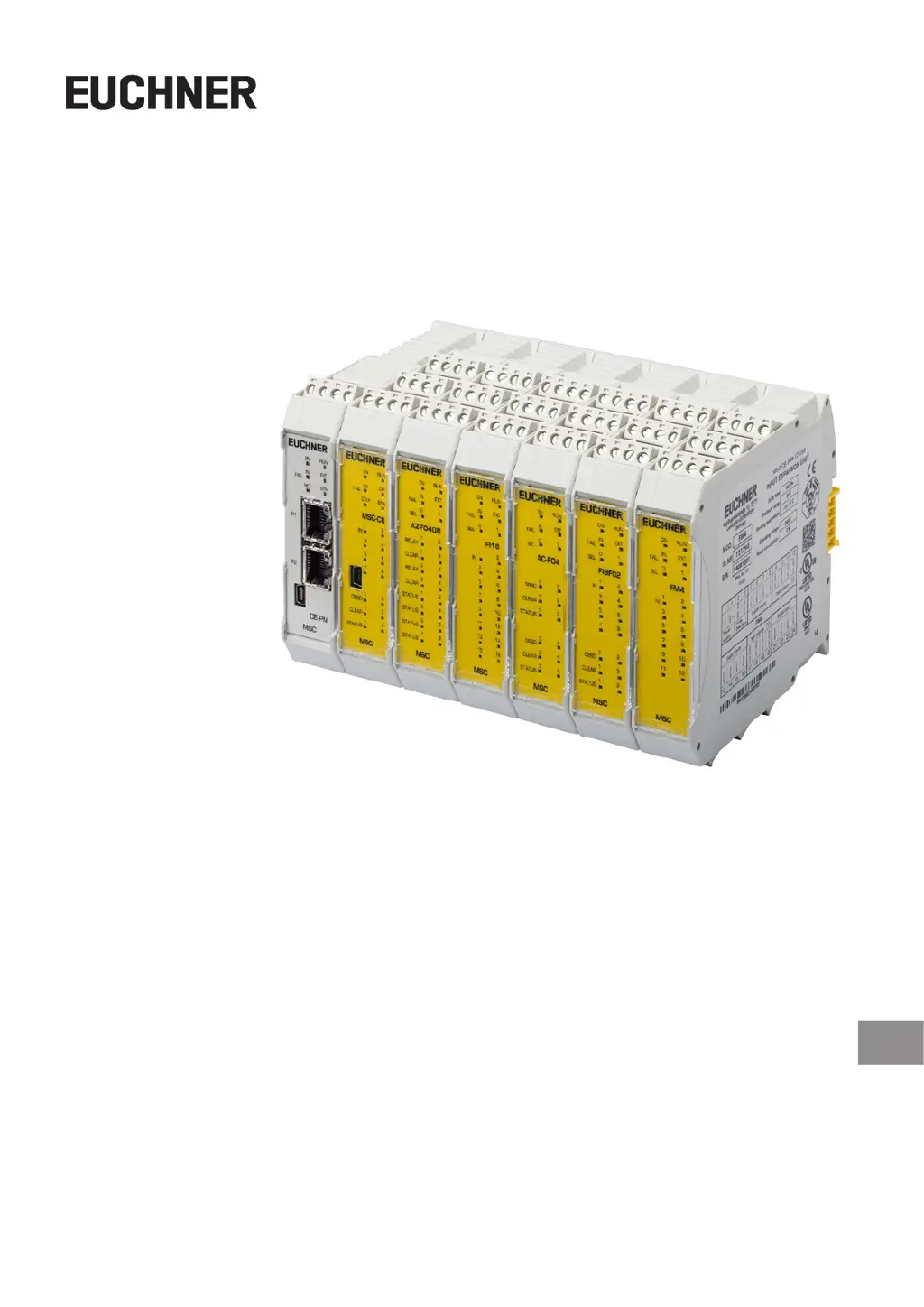
EUCHNER MSC - User Manual

EUCHNER MSC
174 pages
Print Icon
To Next Page IconTo Next Page
Loading...
EN
Operating Instructions
Installation and use
Modular Safety Control System MSC

Table of Contents

Other manuals for EUCHNER MSC

Questions and Answers

Summary

1. About this document

1.1. Scope

Defines the scope of the operating instructions for the MSC system.

1.2. Target group

Identifies the intended audience for the operating instructions.

1.3. Key to symbols

Explains the meaning of symbols used in the document.

1.4. Supplementary documents

Lists other documents relevant to the MSC system.

1.5. Exclusion of liability and warranty

States conditions that void liability and warranty.

2. Introduction

2.1. Contents of this manual

Lists the topics covered in this manual.

2.2. Important safety precautions

Highlights critical safety warnings and responsibilities for MSC system use.

2.3. Abbreviations and symbols

Defines abbreviations and symbols used in the manual.

2.4. Applicable standards

Lists European directives and standards the MSC system complies with.

3. Overview

4. Layout of the product

5. Installation

5.1. Mechanical fastening

Describes how to mount MSC system modules onto a 35-mm DIN rail.

5.2. Calculation of the safety distance for an item of ESPE connected to the MSC system

Explains how to calculate safety distances for connected protective equipment.

5.3. Electrical connections

Details the electrical connections for MSC system modules.

5.3.1. Information in relation to connecting cables

5.3.2. USB connection

Explains how to connect the MSC-CB base unit to a PC via USB.

5.3.3. MSC configuration memory (M-A1)

Describes the optional M-A1 memory card for configuration backup.

6. Flow chart

7. Signals

7.1. Inputs

Details the input signals for the MSC system, including MASTER_ENABLE and NODE_SEL.

7.2. Outputs

Describes the output signals like OUT_STATUS, OUT_TEST, and OSSD.

7.2.1. OUT_STATUS

7.2.2. OUT_TEST

7.2.3. OSSD (MSC-CB, FI8 FO2)

7.2.4. OSSD (AC-FO2, AC-FO4)

7.2.5. OSSD (AH-FO4 SO8)

7.2.6. Safety relays (AZ-FO4, AZ-FO4 O8)

8. Technical data

8.1. General system settings

Covers safety-related parameters and general system specifications.

8.2. Mechanical dimensions

Provides the physical dimensions of the MSC system modules.

8.3. Signals

Details the LED indications and dynamic signals for various modules.

8.4. Fault diagnostics

Provides a guide for troubleshooting MSC system errors using codes and LEDs.

8.1.1. Safety-related parameters

8.1.2. General data

8.3.1. Base unit MSC-CB (Figure 14)

8.3.2. Module FI8 FO2 (Figure 28)

8.3.3. Module FI8 (Figure 29)

8.3.4. Module FM4 (Figure 17)

8.3.5. Module FI16 (Figure 18)

8.3.6. Module AC-FO2 (Figure 19)

8.3.7. Module AC-FO4 (Figure 20)

8.3.8. Module AZ-FO4 (Figure 21)

8.3.9. Module AZ-FO4 O8 (Figure 22)

8.3.10. Module O8 (Figure 23)

8.3.11. Module O16 (Figure 24)

8.3.12. Modules SPM0, SPM1, SPM2 (Figure 25)

8.3.13. Module AH-FO4 SO8 (Figure 26)

8.4.1. Base unit MSC-CB (Figure 27)

8.4.2. Module FI8 FO2 (Figure 28)

8.4.3. Module FI8 (Figure 29)

8.4.4. Module FM4 (Figure 30)

8.4.5. Module FI16 (Figure 31)

8.4.6. Modules AC-FO2;AC-FO4 (Figure 32)

8.4.7. Module AZ-FO4 (Figure 33)

8.4.8. Module AZ-FO4 O8 (Figure 34)

8.4.9. Module O8 (Figure 35)

8.4.10. Module O16 (Figure 36)

8.4.11. Modules SPM0, SPM1, SPM2 (Figure 37)

8.4.12. Module AH-FO4 SO8 (Figure 38)

9. Software EUCHNER Safety Designer

9.1. Installing the software

Covers PC hardware and software requirements for installation.

9.1.3. EUCHNER Safety Designer is installed as follows

Step-by-step instructions for installing the software.

9.1.4. General

Provides general information about the software's desktop icon and starting procedure.

9.1.5. Default toolbar

Describes the function of each button on the default toolbar.

9.1.6. Menu bar

Explains the menu bar options available in the software.

9.1.7. Creating a new project (configuring MSCB system)

Guides users through the process of creating a new project.

9.1.8. Tool windows for ITEMS, OPERATOR, CONFIGURATION

Details the purpose of the main tool windows in the software.

9.1.9. Preparing the diagram

Explains how to build the logic diagram using drag-and-drop functionality.

9.1.10. Example for a project

Presents a practical example of configuring a project with safety components.

9.1.11. Password protection

Covers password levels for accessing and protecting the MSC system configuration.

9.1.12. Checking the system

Outlines the procedure for verifying the correct operation of the connected system.

9.1.1. PC hardware - requirements

9.1.2. PC software - requirements

9.1.7.1. Changing configuration (layout of the various modules)

9.1.7.2. Editing user parameters

9.1.9.1. Using the right mouse button

9.1.10.1. Project validation

9.1.10.2. Printing project report

9.1.10.3. Connecting to MSC

9.1.10.4. Sending the configuration to the MSC system

9.1.10.5. Downloading a configuration file (project) from MSC-CB

9.1.10.6. Configuration log

9.1.10.7. System layout

9.1.10.8. Disconnecting the system

9.1.10.9. Monitor (real-time I;O status - text form)

9.1.10.10. Monitor (real-time I;O status - text - graphic)

9.1.11.1. Password level 1

9.1.11.2. Password level 2

9.1.11.3. Password change

9.2. Item-specific function blocks

9.2.1. Output items

Explains output function blocks like OSSD, STATUS, Relay, etc.

9.2.2. Input items

Explains input function blocks like E-STOP, Interlock, Sensors, etc.

9.2.1.1. Safety outputs (OSSD)

9.2.1.2. Safety output (SINGLE_OSSD)

9.2.1.3. Signal output (STATUS)

9.2.1.4. Fieldbus sensor (FIELDBUS PROBE)

9.2.1.5. Relay [RELAY]

9.2.1.6. Usage of the automatic start (A) or manual start (B) (category 2)

9.2.2.1. Emergency stop (E-STOP)

9.2.2.2. Interlock (INTERLOCK)

9.2.2.3. Single-channel interlock (SINGLE INTERLOCK)

9.2.2.4. Guard locking monitoring (LOCK FEEDBACK)

9.2.2.5. Key-operated switch (KEY LOCK SWITCH)

9.2.2.6. Optoelectronic safety light grid or safety laser scanner (ESPE)

9.2.2.7. Safety footswitch (FOOTSWITCH)

9.2.2.8. Operating mode selection (MOD-SEL)

9.2.2.9. Light barrier (PHOTOCELL)

9.2.2.10. Two-hand control (TWO-HAND)

9.2.2.11. NETWORK_IN

9.2.2.12. SENSOR

9.2.2.13. Pressure sensitive mat (S-MAT)

9.2.2.14. Switch (SWITCH)

9.2.2.15. Enabling switch (ENABLING SWITCH)

9.2.2.18. Testable safety device (TESTABLE SAFETY DEVICE)

9.2.2.19. Semiconductor output (SOLID STATE DEVICE)

9.2.2.20. Fieldbus input (FIELDBUS INPUT)

9.2.2.21. LL0 - LL1

9.2.2.22. Comments

9.2.2.23. Title

9.3. Function blocks for speed monitoring

9.3.1. Speed monitoring (SPEED CONTROL)

Details the SPEED CONTROL function block for monitoring device speed.

9.3.2. Speed range monitoring (WINDOW SPEED CONTROL)

Explains the WINDOW SPEED CONTROL for monitoring speed within a defined range.

9.3.3. Standstill monitoring (STAND STILL)

Describes the STAND STILL function block for detecting zero speed.

9.3.4. Speed;standstill monitoring (STAND STILL AND SPEED CONTROL)

Covers function blocks for monitoring both speed and standstill.

9.4. Function blocks in the OPERATOR window

9.4.1. Logical operators

Details logical operators like AND, OR, NOT, XOR, etc.

9.4.2. Memory operators

Covers memory operators like Flip-Flops for data saving.

9.4.3. Guard lock logic (GUARD LOCK) (max. number = 4)

Covers the GUARD LOCK operator for monitoring guard locking.

9.4.4. COUNTER operators

Explains COUNTER operators for generating signals based on counts.

9.4.5. TIMER operators (max. number = 32)

Covers TIMER operators for generating signals for user-defined times.

9.4.6. The MUTING function

Explains the MUTING function for temporary interruption of safety devices.

9.5. Other function blocks

Covers serial output, network, reset, and interpage connections.

9.6. Simulator

Provides information on using the simulator for safety function design.

9.4.1.1. AND

9.4.1.2. NAND

9.4.1.3. NOT

9.4.1.4. OR

9.4.1.5. NOR

9.4.1.6. XOR

9.4.1.7. XNOR

9.4.1.8. Logical macro

9.4.1.9. MULTIPLEXER

9.4.2.1. D FLIP FLOP (max. number = 16)

9.4.2.2. T FLIP FLOP (max. number = 16)

9.4.2.3. SR FLIP FLOP (max. number = 16)

9.4.2.4. Manual restart (USER RESTART MANUAL) (max. number = 16, including other RESTART operators)

9.4.2.5. Monitored restart (USER RESTART MONITORED) (max. number = 16, including other RESTART operators)

9.4.2.6. Macro manual restart (MACRO RESTART MANUAL) (max. number = 16, including other RESTART operators)

9.4.2.7. Macro monitored restart (MACRO RESTART MONITORED) (max. number = 16, including other RESTART operators)

9.4.3.1. GUARD LOCK

9.4.4.1. Counter (COUNTER) (max. number = 16)

9.4.5.1. MONOSTABLE

9.4.5.2. MONOSTABLE_B

9.4.5.3. Passing make contact (PASSING MAKE CONTACT)

9.4.5.4. Delay (DELAY)

9.4.5.5. Delay line (DELAY LINE)

9.4.5.6. Clock generation (CLOCKING)

9.4.7. MUTING operators (max. number = 4)

9.4.7.1. Simultaneous muting (MUTING Con)

Details the Simultaneous muting operator.

9.4.7.2. MUTING L

Explains the MUTING 'L' operator.

9.4.7.3. Sequential MUTING

Describes the 'Sequential' MUTING operator.

9.4.7.4. MUTING T

Details the MUTING 'T' operator.

9.4.7.5. MUTING OVERRIDE

Explains the MUTING OVERRIDE function.

9.5.1. Serial output (SERIAL OUTPUT) (max. number = 4)

9.5.1.1. Network (NETWORK) (max. number = 1)

Explains the NETWORK operator for distributing STOP/RESET commands.

9.5.1.2. Reset (RESET)

Describes the RESET operator for generating system resets.

9.5.1.3. Interpage In;Out

Details the Interpage In/Out component for long-distance connections.

9.5.2. Special applications

9.5.2.1. Output delay with manual operating mode

Explains output delay configuration in manual operating mode.

9.6.1. Schematic simulation

9.6.2. Administration of the graphic simulation

9.6.2.1. Application example for the graphic simulation

Presents a graphic simulation example for a press application.

9.6.3. MSC error codes

9.6.4. Error log file

10. Ordering information and accessories

11. Inspection and service

12. Service

13. Declaration of conformity

Summary

1. About this document

1.1. Scope

Defines the scope of the operating instructions for the MSC system.

1.2. Target group

Identifies the intended audience for the operating instructions.

1.3. Key to symbols

Explains the meaning of symbols used in the document.

1.4. Supplementary documents

Lists other documents relevant to the MSC system.

1.5. Exclusion of liability and warranty

States conditions that void liability and warranty.

2. Introduction

2.1. Contents of this manual

Lists the topics covered in this manual.

2.2. Important safety precautions

Highlights critical safety warnings and responsibilities for MSC system use.

2.3. Abbreviations and symbols

Defines abbreviations and symbols used in the manual.

2.4. Applicable standards

Lists European directives and standards the MSC system complies with.

3. Overview

4. Layout of the product

5. Installation

5.1. Mechanical fastening

Describes how to mount MSC system modules onto a 35-mm DIN rail.

5.2. Calculation of the safety distance for an item of ESPE connected to the MSC system

Explains how to calculate safety distances for connected protective equipment.

5.3. Electrical connections

Details the electrical connections for MSC system modules.

5.3.1. Information in relation to connecting cables

5.3.2. USB connection

Explains how to connect the MSC-CB base unit to a PC via USB.

5.3.3. MSC configuration memory (M-A1)

Describes the optional M-A1 memory card for configuration backup.

6. Flow chart

7. Signals

7.1. Inputs

Details the input signals for the MSC system, including MASTER_ENABLE and NODE_SEL.

7.2. Outputs

Describes the output signals like OUT_STATUS, OUT_TEST, and OSSD.

7.2.1. OUT_STATUS

7.2.2. OUT_TEST

7.2.3. OSSD (MSC-CB, FI8 FO2)

7.2.4. OSSD (AC-FO2, AC-FO4)

7.2.5. OSSD (AH-FO4 SO8)

7.2.6. Safety relays (AZ-FO4, AZ-FO4 O8)

8. Technical data

8.1. General system settings

Covers safety-related parameters and general system specifications.

8.2. Mechanical dimensions

Provides the physical dimensions of the MSC system modules.

8.3. Signals

Details the LED indications and dynamic signals for various modules.

8.4. Fault diagnostics

Provides a guide for troubleshooting MSC system errors using codes and LEDs.

8.1.1. Safety-related parameters

8.1.2. General data

8.3.1. Base unit MSC-CB (Figure 14)

8.3.2. Module FI8 FO2 (Figure 28)

8.3.3. Module FI8 (Figure 29)

8.3.4. Module FM4 (Figure 17)

8.3.5. Module FI16 (Figure 18)

8.3.6. Module AC-FO2 (Figure 19)

8.3.7. Module AC-FO4 (Figure 20)

8.3.8. Module AZ-FO4 (Figure 21)

8.3.9. Module AZ-FO4 O8 (Figure 22)

8.3.10. Module O8 (Figure 23)

8.3.11. Module O16 (Figure 24)

8.3.12. Modules SPM0, SPM1, SPM2 (Figure 25)

8.3.13. Module AH-FO4 SO8 (Figure 26)

8.4.1. Base unit MSC-CB (Figure 27)

8.4.2. Module FI8 FO2 (Figure 28)

8.4.3. Module FI8 (Figure 29)

8.4.4. Module FM4 (Figure 30)

8.4.5. Module FI16 (Figure 31)

8.4.6. Modules AC-FO2;AC-FO4 (Figure 32)

8.4.7. Module AZ-FO4 (Figure 33)

8.4.8. Module AZ-FO4 O8 (Figure 34)

8.4.9. Module O8 (Figure 35)

8.4.10. Module O16 (Figure 36)

8.4.11. Modules SPM0, SPM1, SPM2 (Figure 37)

8.4.12. Module AH-FO4 SO8 (Figure 38)

9. Software EUCHNER Safety Designer

9.1. Installing the software

Covers PC hardware and software requirements for installation.

9.1.3. EUCHNER Safety Designer is installed as follows

Step-by-step instructions for installing the software.

9.1.4. General

Provides general information about the software's desktop icon and starting procedure.

9.1.5. Default toolbar

Describes the function of each button on the default toolbar.

9.1.6. Menu bar

Explains the menu bar options available in the software.

9.1.7. Creating a new project (configuring MSCB system)

Guides users through the process of creating a new project.

9.1.8. Tool windows for ITEMS, OPERATOR, CONFIGURATION

Details the purpose of the main tool windows in the software.

9.1.9. Preparing the diagram

Explains how to build the logic diagram using drag-and-drop functionality.

9.1.10. Example for a project

Presents a practical example of configuring a project with safety components.

9.1.11. Password protection

Covers password levels for accessing and protecting the MSC system configuration.

9.1.12. Checking the system

Outlines the procedure for verifying the correct operation of the connected system.

9.1.1. PC hardware - requirements

9.1.2. PC software - requirements

9.1.7.1. Changing configuration (layout of the various modules)

9.1.7.2. Editing user parameters

9.1.9.1. Using the right mouse button

9.1.10.1. Project validation

9.1.10.2. Printing project report

9.1.10.3. Connecting to MSC

9.1.10.4. Sending the configuration to the MSC system

9.1.10.5. Downloading a configuration file (project) from MSC-CB

9.1.10.6. Configuration log

9.1.10.7. System layout

9.1.10.8. Disconnecting the system

9.1.10.9. Monitor (real-time I;O status - text form)

9.1.10.10. Monitor (real-time I;O status - text - graphic)

9.1.11.1. Password level 1

9.1.11.2. Password level 2

9.1.11.3. Password change

9.2. Item-specific function blocks

9.2.1. Output items

Explains output function blocks like OSSD, STATUS, Relay, etc.

9.2.2. Input items

Explains input function blocks like E-STOP, Interlock, Sensors, etc.

9.2.1.1. Safety outputs (OSSD)

9.2.1.2. Safety output (SINGLE_OSSD)

9.2.1.3. Signal output (STATUS)

9.2.1.4. Fieldbus sensor (FIELDBUS PROBE)

9.2.1.5. Relay [RELAY]

9.2.1.6. Usage of the automatic start (A) or manual start (B) (category 2)

9.2.2.1. Emergency stop (E-STOP)

9.2.2.2. Interlock (INTERLOCK)

9.2.2.3. Single-channel interlock (SINGLE INTERLOCK)

9.2.2.4. Guard locking monitoring (LOCK FEEDBACK)

9.2.2.5. Key-operated switch (KEY LOCK SWITCH)

9.2.2.6. Optoelectronic safety light grid or safety laser scanner (ESPE)

9.2.2.7. Safety footswitch (FOOTSWITCH)

9.2.2.8. Operating mode selection (MOD-SEL)

9.2.2.9. Light barrier (PHOTOCELL)

9.2.2.10. Two-hand control (TWO-HAND)

9.2.2.11. NETWORK_IN

9.2.2.12. SENSOR

9.2.2.13. Pressure sensitive mat (S-MAT)

9.2.2.14. Switch (SWITCH)

9.2.2.15. Enabling switch (ENABLING SWITCH)

9.2.2.18. Testable safety device (TESTABLE SAFETY DEVICE)

9.2.2.19. Semiconductor output (SOLID STATE DEVICE)

9.2.2.20. Fieldbus input (FIELDBUS INPUT)

9.2.2.21. LL0 - LL1

9.2.2.22. Comments

9.2.2.23. Title

9.3. Function blocks for speed monitoring

9.3.1. Speed monitoring (SPEED CONTROL)

Details the SPEED CONTROL function block for monitoring device speed.

9.3.2. Speed range monitoring (WINDOW SPEED CONTROL)

Explains the WINDOW SPEED CONTROL for monitoring speed within a defined range.

9.3.3. Standstill monitoring (STAND STILL)

Describes the STAND STILL function block for detecting zero speed.

9.3.4. Speed;standstill monitoring (STAND STILL AND SPEED CONTROL)

Covers function blocks for monitoring both speed and standstill.

9.4. Function blocks in the OPERATOR window

9.4.1. Logical operators

Details logical operators like AND, OR, NOT, XOR, etc.

9.4.2. Memory operators

Covers memory operators like Flip-Flops for data saving.

9.4.3. Guard lock logic (GUARD LOCK) (max. number = 4)

Covers the GUARD LOCK operator for monitoring guard locking.

9.4.4. COUNTER operators

Explains COUNTER operators for generating signals based on counts.

9.4.5. TIMER operators (max. number = 32)

Covers TIMER operators for generating signals for user-defined times.

9.4.6. The MUTING function

Explains the MUTING function for temporary interruption of safety devices.

9.5. Other function blocks

Covers serial output, network, reset, and interpage connections.

9.6. Simulator

Provides information on using the simulator for safety function design.

9.4.1.1. AND

9.4.1.2. NAND

9.4.1.3. NOT

9.4.1.4. OR

9.4.1.5. NOR

9.4.1.6. XOR

9.4.1.7. XNOR

9.4.1.8. Logical macro

9.4.1.9. MULTIPLEXER

9.4.2.1. D FLIP FLOP (max. number = 16)

9.4.2.2. T FLIP FLOP (max. number = 16)

9.4.2.3. SR FLIP FLOP (max. number = 16)

9.4.2.4. Manual restart (USER RESTART MANUAL) (max. number = 16, including other RESTART operators)

9.4.2.5. Monitored restart (USER RESTART MONITORED) (max. number = 16, including other RESTART operators)

9.4.2.6. Macro manual restart (MACRO RESTART MANUAL) (max. number = 16, including other RESTART operators)

9.4.2.7. Macro monitored restart (MACRO RESTART MONITORED) (max. number = 16, including other RESTART operators)

9.4.3.1. GUARD LOCK

9.4.4.1. Counter (COUNTER) (max. number = 16)

9.4.5.1. MONOSTABLE

9.4.5.2. MONOSTABLE_B

9.4.5.3. Passing make contact (PASSING MAKE CONTACT)

9.4.5.4. Delay (DELAY)

9.4.5.5. Delay line (DELAY LINE)

9.4.5.6. Clock generation (CLOCKING)

9.4.7. MUTING operators (max. number = 4)

9.4.7.1. Simultaneous muting (MUTING Con)

Details the Simultaneous muting operator.

9.4.7.2. MUTING L

Explains the MUTING 'L' operator.

9.4.7.3. Sequential MUTING

Describes the 'Sequential' MUTING operator.

9.4.7.4. MUTING T

Details the MUTING 'T' operator.

9.4.7.5. MUTING OVERRIDE

Explains the MUTING OVERRIDE function.

9.5.1. Serial output (SERIAL OUTPUT) (max. number = 4)

9.5.1.1. Network (NETWORK) (max. number = 1)

Explains the NETWORK operator for distributing STOP/RESET commands.

9.5.1.2. Reset (RESET)

Describes the RESET operator for generating system resets.

9.5.1.3. Interpage In;Out

Details the Interpage In/Out component for long-distance connections.

9.5.2. Special applications

9.5.2.1. Output delay with manual operating mode

Explains output delay configuration in manual operating mode.

9.6.1. Schematic simulation

9.6.2. Administration of the graphic simulation

9.6.2.1. Application example for the graphic simulation

Presents a graphic simulation example for a press application.

9.6.3. MSC error codes

9.6.4. Error log file

10. Ordering information and accessories

11. Inspection and service

12. Service

13. Declaration of conformity

EUCHNER MSC Specifications

General IconGeneral
CategoryControl Systems
TypeSafety Controller
Protection degreeIP20
Operating Voltage24 V DC
Supply voltage24 V DC
Protection RatingIP20
CommunicationEthernet