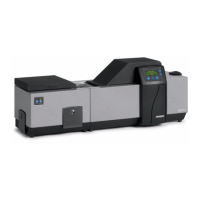
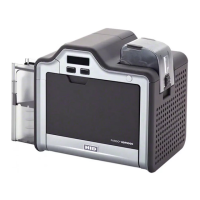
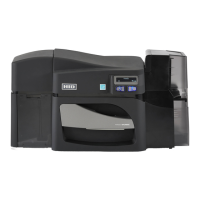
Do you have a question about the Fargo HDP5000 and is the answer not in the manual?
| Maximum resolution | 300 x 300 DPI |
|---|---|
| Print speed (color) | 7 card/h |
| Print speed (monochrome) | 14 card/h |
| Product color | Black |
| Internal memory | 16 MB |
| Total input capacity | 100 sheets |
| Compatible operating systems | Windows 2000 / XP / Server 2003 / Vista (32 bit) Mac OS X v10.4 / v10.5 Linux |
| Weight | 7300 g |
|---|---|
| Dimensions (WxDxH) | 313 x 235 x 292 mm |
Explains how to navigate and use the user guide effectively for quick lookup of procedures and components.
Provides critical safety instructions for handling the device, preventing personal injury, and avoiding equipment damage.
Details the step-by-step process of the HDP5000 printer's boot-up sequence.
Describes the dual-sided, full-color print job sequence with magnetic encoding.
Outlines the boot-up sequence for the card lamination module.
Details the sequence of operations for the card lamination module after printing.
Provides critical safety instructions for handling the device and preventing injury or damage.
Introduces the section covering regulatory, technical, and functional specifications for the HDP5000.
Presents a table comparing different HDP5000 series printer models and their features.
Lists the items included with the HDP5000 printer package.
Details compliance with CSA, FCC, and UL standards for the card printer.
Lists emissions and safety standards the printer complies with.
Explains compliance with FCC Part 15 rules for digital devices.
Details technical specifications like accepted card thickness, types, cleaning, and colors.
Continues technical specifications focusing on accepted card sizes and custom selections.
Details custom card size specifications and unit selection for inches or mm.
Covers technical specs like colors, dimensions, display, and encoding options.
Details specs for Fargo certified supplies, HDP film options, storage, humidity, and interface.
Covers memory, operating temperature, options, power supply, print area, and method.
Details print ribbon options, print speed, batch mode, and resolution.
Covers USB encoding options, software drivers, supply voltage, and supported models.
Details system requirements, warranty, and weight specifications for the printer.
Explains the two printing technologies used: Dye-Sublimation and Resin Thermal Transfer.
Describes components related to Resin Thermal Transfer and the USB interface port.
Details the LCD display and softkey control pad for printer operation.
Explains the Print Status Screen, Cancel button, and Pause button functions.
Describes the different types of print ribbons available and their letter codes.
Discusses accepted card sizes, designs, and surface requirements for printing.
Details the use and types of UltraCard stock recommended for best results.
Explains the card cartridge capacity and the card output/reject hoppers.
Introduces the optional card lamination module and its capabilities.
Describes the transfer roller controls, temperature adjustment, and new temperature settings.
Explains the importance of using Fargo certified overlaminates for printer life and card quality.
Details PolyGuard Overlaminate availability in standard CR-80 patch size.
Discusses available clear, holographic, and custom holographic overlaminate designs.
Provides critical safety instructions for installation procedures.
Introduces the guide for installing the Fargo HDP5000 Driver.
States the approximate time required for the software installation process.
Lists the minimum system requirements for installing the HDP5000 driver.
Guides on inspecting the printer carton for damage and unpacking included items.
Displays images related to printer unpacking and installation.
Displays images related to unpacking dual-sided and lamination module upgrades.
Provides guidelines for selecting an appropriate and safe location for the printer.
Warns about potential moisture condensation and how to prevent it.
Provides step-by-step instructions for loading the print ribbon into the printer.
Details the procedure for loading the HDP transfer film into the film cartridge.
Guides on how to remove and insert the card cleaning roller into the printer.
Provides steps for loading the overaminate rolls into the lamination cartridges.
Explains how to load blank cards into the card cartridge correctly.
Details the procedure for connecting the AC power cable to the power supply and printer.
Guides on installing the HDP5000 printer driver from the software installation CD.
Instructions on how to print a test image to verify printer functionality.
Provides critical safety instructions for accessory installation and handling.
Explains how to use the security lock slot for physical security of the printer.
Details the procedure for removing the output side upgrade cover of the printer.
Provides step-by-step instructions for installing the Flipper Module accessory.
Guides on installing the Lamination Module accessory to the printer or Flipper module.
Explains how to use the LCD error message tables for troubleshooting.
Provides critical safety instructions for troubleshooting procedures.
Introduces two tables for troubleshooting specific LCD and printer error messages.
Explains how to correlate PC error messages with LCD error messages for troubleshooting.
Lists common LCD error messages, their causes, and solutions.
Lists more LCD error messages, causes, and solutions including EEPROM and ejecting card errors.
Addresses errors like Empty Reject Bin, Failed To Initialize, and Film errors.
Details errors like Handler Startup, Internal Error, No Film, and Timeout.
Addresses errors related to Film, Flipper Jam, and Head Loading issues.
Covers Head Resistance, Head Sensor, Head Voltage, Headlift, and Heater errors.
Addresses Invalid Film, Password, Ribbon, and Job Data errors.
Lists Laminator-related errors such as Lam Card Jam, Check Card, and Com Error.
Details Laminator errors like Handler Startup, Internal Error, No Film, and Timeout.
Covers Laminator errors related to jams, low material, bad material, and film output.
Addresses errors like Lm1/Lm2 Headlift Err, Mag Encoder Paused/Startup, and Multiple Feed.
Covers errors related to E-card Encoder, No Film, No Flip Module, and desired lamination.
Addresses errors like No iClass/Mag/MiFare/Prox Encoder and No Ribbon.
Covers errors like No Smart Encoder, Printing Error, Reboot Required, and Reinsert Ribbon.
Details errors related to removing laminate material (Lam Mtl) and ribbon issues.
Addresses Ribbon Miscue, Out, Tension, Wrong Material, and System Fault errors.
Covers errors like Unable to Feed, Utility Error, Waiting for Data, and Wrong Film/Ribbon Installed.
Lists printer error messages like General Error, Card Not Found, Cover is Open, and Unable to Feed.
Details printer errors like Card Jam in different modules (Printer, Encoder, Flipper).
Covers Card Jam errors in the Flipper and Laminator modules.
Addresses Card Eject Error and Flipper Jam issues.
Covers errors related to No Flipper, Ribbon RFID Error, and Wrong Ribbon Installed.
Lists errors like No Ribbon Installed and Ribbon Out.
Covers Ribbon Break/Jam and Ribbon Sensor Error troubleshooting.
Addresses Invalid Ribbon errors specific to SecureMark printers.
Covers Invalid Ribbon errors and Ribbon errors.
Lists errors related to Magnetic Encoder, Headlift, and Invalid Password.
Covers Laminator errors like General Error, Check Power, Heater Off, and Heater Timed Out.
Addresses errors related to No/Wrong Laminator Film Installed and Laminator Film Out.
Covers Laminator Film Break/Jam, Sensor Error, and Remove Laminator Film.
Addresses Print Film Out, Not Installed, Sensor Error, and Wrong Print Film Installed.
Covers Invalid Print Film Installed and Print Film Error.
Provides steps to resolve communication errors with the printer.
Guides on opening the diagnostic tool and running self-tests for image printing.
Explains how to use the alignment self-test card to check image placement.
Details using the color bars self-test to confirm proper color reproduction.
Guides on viewing printer settings and counts using the device settings self-test card.
Explains using the YMCK self-test card to confirm proper image color reproduction.
Details the magnetic self-test for printers with a magnetic encoding module.
Guides on using a card to determine if the Resin Panel is printing properly.
Introduces the Ethernet option, including the port and internal printer server.
Lists system requirements for using the Ethernet option.
Outlines features of the Ethernet option like simultaneous printing and web pages.
Provides an overview of network services including Print Server and Web Page Server.
Explains the SNMP interface for managing network settings and the printer.
Guides on initiating a Telnet session to access printer services.
Describes available Telnet commands for printer management.
Lists Telnet commands for viewing printer information and network settings.
Details Telnet commands for managing print jobs and printer status.
Explains Telnet commands for system information and syslog configuration.
Details Telnet commands for managing user definitions and passwords.
Covers Telnet commands for network settings like IP address, mask, and gateway.
Lists Telnet commands for saving, loading, status, and cancelling print jobs.
Explains how to access printer web pages and the need for administrative rights.
Guides on how to log in to the printer's web interface using user name and password.
Details how to access the printer's home page via a network browser using its IP address.
Displays the HDP5000 home page, showing printer information and status.
Explains categories and fields on the home page like Serial Number and Firmware Version.
Guides on accessing the network settings page to view and change network configurations.
Displays the network speed supported by the printer.
Shows current active network settings, labeled as Dynamic or Static.
Provides steps to enable DHCP for automatic IP address assignment.
Details how to manually set static IP address, subnet mask, and gateway.
Explains how to use the Clear Changes button to delete stored settings in the network configuration.
Displays information about the installed Ribbon and Film, including type and remaining level.
Displays TCP/IP status for printer connections, which are not configurable.
Allows reviewing current printer status, print jobs, and device settings.
Displays and configures current system log settings for logging occurrences.
Guides on renaming default log names (log1, log2) from the system log page.
Explains how to select log types like Print Job Started and Printer Error.
Details how to specify log destinations such as None, Email, UDP, or TCP.
Provides steps to enable logging using email notifications for events.
Guides on configuring logging to a UDP Syslog program.
Details sending logging messages to a pre-existing IP connection via TCP port.
Displays current system information and allows changes to label, location, and contact.
Guides on changing the root password for accessing printer settings.
Explains how to reboot or reset the printer and enter upgrade mode.
Allows uploading new firmware to the printer via the upgrade page.
Continues firmware upgrade steps, including rebooting into upgrade mode.
Details selecting Administration and Upgrade options for firmware updates.
Guides on browsing, selecting, upgrading firmware files, and rebooting.
Allows viewing and changing TCP port numbers used for printer communication.
Displays help information accessible from the web interface.
Explains how to find and interpret the Ethernet status LEDs on the back of printers.
Provides a table detailing the meaning of Green and Amber Ethernet LEDs.
Guides on upgrading firmware using the Fargo Workbench Printer Utility.
Details accessing the Upgrade Firmware window and performing the upgrade.
Explains how to revert user names and passwords to default settings.
Guides on changing the DHCP setting to enable or disable automatic IP assignment.
Details changing the Auto Negotiation setting for Ethernet interface configuration.
Explains how to save current network settings (IP, GW, SN Mask) as stored settings.
Guides on resetting user passwords to default empty strings.
Provides steps to access and identify the printer's IP address via the LCD screen.
Outlines procedures for troubleshooting Ethernet printer connection and printing issues.
Guides on ensuring the printer has a valid network connection and checking LEDs.
Details checking the LCD for a valid IP address and network configuration.
Explains how to use the ping command to test PC access to the printer.
Checks PC/Printer network connection and settings.
Instructions for printing a test page from Printer Driver properties.
Covers FAQs on Ethernet installation, PC OS compatibility, and network connection.
Addresses FAQs on finding IP address, printing to multiple printers, and network segments.
Covers FAQs on upgrading printer firmware and default user names/passwords.
Addresses FAQs on lost printer passwords and changing printer IP addresses.
Covers FAQs on reconfiguring PC printer drivers and verifying IP addresses.
Addresses FAQs on configuring printer IP settings and choosing static IP addresses.
Covers FAQs on Ethernet connection LEDs and printing test pages from Windows.
Provides critical safety instructions for printer adjustments.
Recommends evaluating card stock selection for optimizing HDP print process.
Lists card selections to choose from in the HDP printer driver.
Details custom settings, Custom 1/2 options, and tape adhesion tests for card stock.
Explains how to conduct tape adhesion tests for card stock and HDP film transfer.
Guides on uninstalling existing drivers and installing updated versions from the website.
Guides on setting up the printer driver for Windows 2000/XP/2003 operating systems.
Explains how to use the Card tab to control specific printer functions.
Details selecting card options like CR-80 or Custom sizes for printing.
Guides on selecting the appropriate card type based on its composition.
Explains custom card type options for saving dwell time and temperature settings.
Guides on selecting Portrait or Landscape orientation for card printing.
Details how to specify the number of copies to be printed, with limits.
Explains how to launch the diagnostic tool for printer checks.
Guides on sending a test PRN file to the printer for verification.
Opens a dialog with copyright, driver version, and date code information.
Directs to the Toolbox section for more information and procedures.
Describes the use of the Device Options tab for printer settings.
Explains using the Supplies checkbox for auto-detection of consumables.
Details behavior when the Supplies checkbox is checked or unchecked.
Guides on selecting the correct ribbon type from the dropdown menu.
Explains how to select the appropriate film type for HDP film loading.
Explains Dual Sided group checkboxes and when they are grayed out.
Details using the Print Both Sides option for automatic duplex printing.
Explains splitting ribbon panels for economical dual-sided printing.
Details using this option for printing the first page on the backside or resin black on smart cards.
Guides on printing only onto the backside of preprinted cards or for encoding.
Describes the functions available under the Options group.
Guides on rotating printed images for magnetic stripe or smart chip alignment.
Explains disabling printing while allowing encoding or lamination.
Details dual pass and invert F-panel image options for fluorescent ink and color inversion.
Explains how to adjust color properties like sharpness, contrast, and gamma.
Guides on selecting color matching options like None or System Color Management.
Explains adjusting Dye-Sub Intensity for overall print darkness and lightness.
Details adjusting Resin Heat for resin black text and barcodes.
Guides on using the Default button to reset Image Color tab settings.
Explains selecting dither methods for graphics or photos with resin printing.
Guides on accessing the Advanced Image Color window for detailed adjustments.
Details using slider controls for sharpness, contrast, and gamma adjustments.
Explains using slider controls for yellow, magenta, and cyan balance adjustments.
Guides on using the Default button to reset Advanced Image Color settings.
Explains how to adjust image position, transfer dwell time, and temperature.
Guides on adjusting horizontal and vertical image position using controls.
Details how positive/negative values affect image movement relative to card position.
Explains controlling transfer dwell time and temperature based on card type.
Details transfer temperature settings for different card types.
Guides on resetting settings to defaults or adjusting for custom card types.
Explains options for controlling magnetic stripe encoding processes.
Guides on specifying magnetic encoding standards like ISO or Custom Encoding.
Details Custom Encoding options and their active/inactive functions.
Explains Raw Binary Encoding selection and its active/inactive functions.
Provides a detailed procedure for performing RAW encoding tests.
Details JIS II Encoding selection and its effect on track options.
Guides on selecting coercivity and magnetic track options for encoding.
Explains the Shift Data Left option for magnetic data positioning.
Guides on customizing ISO encoded data format for magnetic stripe tracks.
Displays Magnetic Track Options for customizing data formats.
Details customizing ISO encoded data format for each magnetic stripe track.
Guides on customizing character data size (bits per character) for encoding.
Explains customizing ASCII Offset for encoding magnetic data.
Guides on customizing Bit Recording Density (Bits per Inch) for encoding magnetic data.
Explains customizing LRC Generation Mode for encoding magnetic data.
Guides on customizing the Encoding Mode for encoding magnetic data.
Shows ISO 7811-2 magnetic stripe track locations for encoding.
Details sending magnetic track data in text strings from application software to the driver.
Provides sample strings for track data, including start/end sentinels and separators.
Lists ASCII codes and their corresponding characters for data encoding.
Guides on using the Default button to reset defaults for the current Track tab.
Explains controlling the printer's lamination process via the Lamination tab.
Guides on adjusting the horizontal position of the PolyGuard Overlaminate.
Details controlling lamination dwell time and temperature for card throughput.
Guides on selecting lamination sides: No Lamination, Front, Back, Both, or Opposite.
Compares lamination module unit capabilities with and without a Flipper module.
Guides on selecting lamination types like Clear Film or PolyGuard based on media.
Explains how to adjust the transfer temperature for the lamination process.
Guides on using the Default button to reset lamination settings.
Explains adjusting card size, travel direction, and resin black panel usage.
Details scroll controls for changing area size and location on the card grid.
Explains using click and drag for changing area size and location, and selecting measurement units.
Guides on using Add/Delete buttons to define or remove areas on the card grid.
Explains using the Full Card option to print resin black across all image areas.
Guides on selecting Defined Area(s) to print resin black only in specified regions.
Explains selecting Undefined Area(s) to print resin black in spaces outside defined areas.
Guides on activating the card grid and defining areas for resin black printing.
Explains how to measure the total card area and enter dimensions for defining areas.
Guides on measuring and positioning defined areas on the card using X and Y boxes.
Explains printing YMC under K for color background transitions or Print K Only for sharpness.
Allows viewing information about installed Ribbon, HDP Film, and Laminate.
Provides guidelines for viewing ribbon, film, and lamination levels and reorder numbers.
Guides on accessing the Toolbox window and its various tabs.
Explains how to select printer features, events to monitor, and display language.
Details how optional printer features like Dual Sided and Laminator are detected.
Displays low supply messages for Ribbon, Laminate, and Film.
Explains the Laminate Low message box and how to suppress it.
Explains the Film Low message box and how to suppress it.
Guides on choosing or changing the LCD language for the printer.
Guides on calibrating the laminator, ensuring cartridges are out and cover is closed.
Details calibrating the film, ensuring cartridge installation and cover closure.
Guides on calibrating the ribbon, ensuring cartridge removal and cover closure.
Explains how to initiate the printer cleaning routine using the Clean Printer tab.
Details options for printer cleaning notifications like Clean Now and Remind Me.
Guides on adjusting internal printer settings saved in the printer's memory.
Explains columns for settings, default values, current values, and applying changes.
Explains setting image darkness by adjusting printhead heat.
Guides on aligning the leading edge of the print with the card's edge using TOF settings.
Details adjusting print LOF and image density using the edge alignment grid.
Explains shifting the starting point for magnetic track data encoding on the card's stripe.
Details entering negative/positive values to shift magnetic data start point.
Explains setting the Flipper position for card path levelness after a flip.
Guides on locating and adjusting the printhead setting number if the board or printhead is replaced.
Guides on setting Transfer TOF and printing alignment card self-tests.
Explains adding an offset to transfer roller temperature for matching LCD goal.
Controls color ribbon tension during printing to prevent wrinkles.
Explains adjustments affect image length, flash, and smudge.
Adjusts resin black text and barcodes for brightness and darkness.
Adjusts time until printer stops energizing transfer roller to conserve energy.
Explains blush point as compensation during printing for dye transfer.
Guides on adjusting the brightness of the LCD panel.
Explains changing the number of cleaning passes.
Controls the printer's compensation for environmental temperature.
Controls the transfer roller cooling fan speed for printing process.
Enables extra pixels to help with ribbon wrinkle during printing.
Changes the location of patches over the card length.
Changes card backup distance after lam pressure is applied.
Dictates card length, should not be adjusted.
Describes the error displayed when no printer is connected or driver cannot communicate.
Explains error messages displayed when typing values outside the allowed range.
Provides critical safety instructions for cleaning procedures.
Guides on cleaning platen and card feed rollers approximately every 1000 prints.
Details steps for cleaning the printer interior using compressed air or cleaning pads.
Guides on cleaning the printer casing using a cleaning pad.
Provides instructions for cleaning the printhead to maintain print quality.
Guides on replacing the card cleaning roller, recommended every time the print ribbon is changed.
Details cleaning the magnetic encoder head using an alcohol wipe.
Shows how to access the Fargo Workbench Printer Utility via the Card tab.
Displays the Fargo Workbench Printer Utility interface.
Guides on configuring data printed with the fluorescent panel of an YMCFK ribbon.
Details setting the ribbon for YMCFK and ensuring Workbench parameters are correct.
Guides on using the Security Imaging applet to enable secure imaging.
Explains adding and positioning Secure ID boxes onto the template.
Guides on adding and positioning Logo boxes onto the template.
Details selecting Logo File source and using "Fit to Frame" option.
Guides on adding Text boxes onto the template and moving/sizing them.
Explains right-clicking on Text box for options like Font, Rotate, and Edit.
Guides on saving the template and closing Workbench.
Details checking Dual Pass and Invert F-Panel Image options for specific print effects.
Provides specific packing procedures for the HDP5000 printer for transport.
Provides information on internal software/firmware and how to update it.
Guides on launching the Fargo Support page to select the printer for firmware download.
Details downloading, saving, and unzipping firmware files.
Guides on selecting Upgrade Firmware from the Actions menu.
Details selecting the desktop, .frm file, and clicking Open/Upgrade to complete the process.
Provides procedures for contacting Fargo Technical Support for assistance.
Explains how to determine the printer's manufacturing date from its serial number.
Defines terms related to color depth, electrical current, and standards.
Defines terms related to barcodes, power supply, BIOS, bit, bitmap, and boards.
Defines terms like Cache, Calibrating, Cleaning Roller, CD, DMA, Centronics, Coercivity, Color matching, Compressed air, Contrast, Control panel.
Defines card dimension standards (CR-79 to CR-100), cursor, darkness, DB-9, DC Motor, Default, Defrag, DIP switches.
Defines terms like Dither, Dongle, Dot, Dot pitch, Download, DPI, DRAM.
Defines Driver, Dual Pass option, Duplex Printing, Dwell Time, Dye Migration, Dye-Sublimation, E-card, E-card Docking Station.
Defines Edge-to-Edge, ECP Mode, EE Memory, EEPROM, Encoder, Engine, EOF, EPP.
Defines EPROM, Escape sequence, ESD, Ethernet, Film, Firmware, Flash Memory, Font, FPGA.
Defines Full bleed, Gamma, Glossy/Matte, Glossy PVC, GDI, Gray Scale, Halftoning, Hard Drive, Hardware, HDP.
Defines Head, Heat Seal, Heat sink, HiCo, HTML, HTTP, IC, ID, IEEE 1284, Image.
Defines Input, Input Hopper, Intermediate Transfer Media (InTM), Invert F-Panel option, ISO, JIS II.
Defines Landscape, LCD, LED, Media, LoCo, LPT Port, Mag encoding, Mag stripe, Mag Track, Mag Verify.
Defines MB, Memory, Menu, Monochrome, Network, Oersted, Offset, O-Ring, OS, Output, Output hopper, Overlay.
Defines Oversized Cards, Overlaminate, Parallel, Parallel Port, PC, PCB, Peel, Peel-Off, Peripheral.
Defines Pinch Roller, Pixel, Platen, PET, Port, PolyGuard Overlaminate, Portrait, Potentiometer, Print Driver, Print Job, Print Server.
Defines Printhead, PVC, Queue, Proximity Card, Prox Card Encoder, RAM, Rasterize, Reboot, Registration, Resin.
Defines Resolution, RFI, RFID, RGB, Ribbon, Ribbon cable, RibbonTraq, RMA number, Roller, RS-232.
Defines Saturation, Self-test, Sensor, Serial communications, Serial interface, SIMM, Simplex, Smart Card, Software, Spooler.
Defines Spooling, SS (Start Sentinel), Stacker, Stepper Motor, String, Surface mount, Surge Protector, Switch Box, TAC, Temp file, Test Print, Thermistor.
Defines Thermocouple, Thin Film Overlaminate, Through-hole, Timeout, TOF, Track, Troubleshooting, TrueType, UltraCard, UltraCard III, Update.
Defines UPS, USB, Virtual Memory, Wrinkle, and various YMC color designations.
Loading...