179
(see "Settings" in the "Vehicle mode"
paragraph in the "Multimedia" section).
In addition to the acoustic warning, the
system indicates the presence of an
obstacle in the rear area by displaying a
single arc in one of the possible areas,
in accordance with the distance of the
object and the position in relation to the
vehicle.
If several obstacles are detected
simultaneously in the rear area,
the display will show all of them,
regardless of the area in which they
were detected.
The colour on the display depends on
the distance from and position of the
obstacle.
Operation with trailer
The operation of the sensors is
automatically deactivated when the
plug for the electric cable for the trailer
is inserted in the vehicle tow hook
socket. The sensors are automatically
reactivated when the trailer's cable plug
is removed.
VERSIONS WITH 14/16
SENSORS
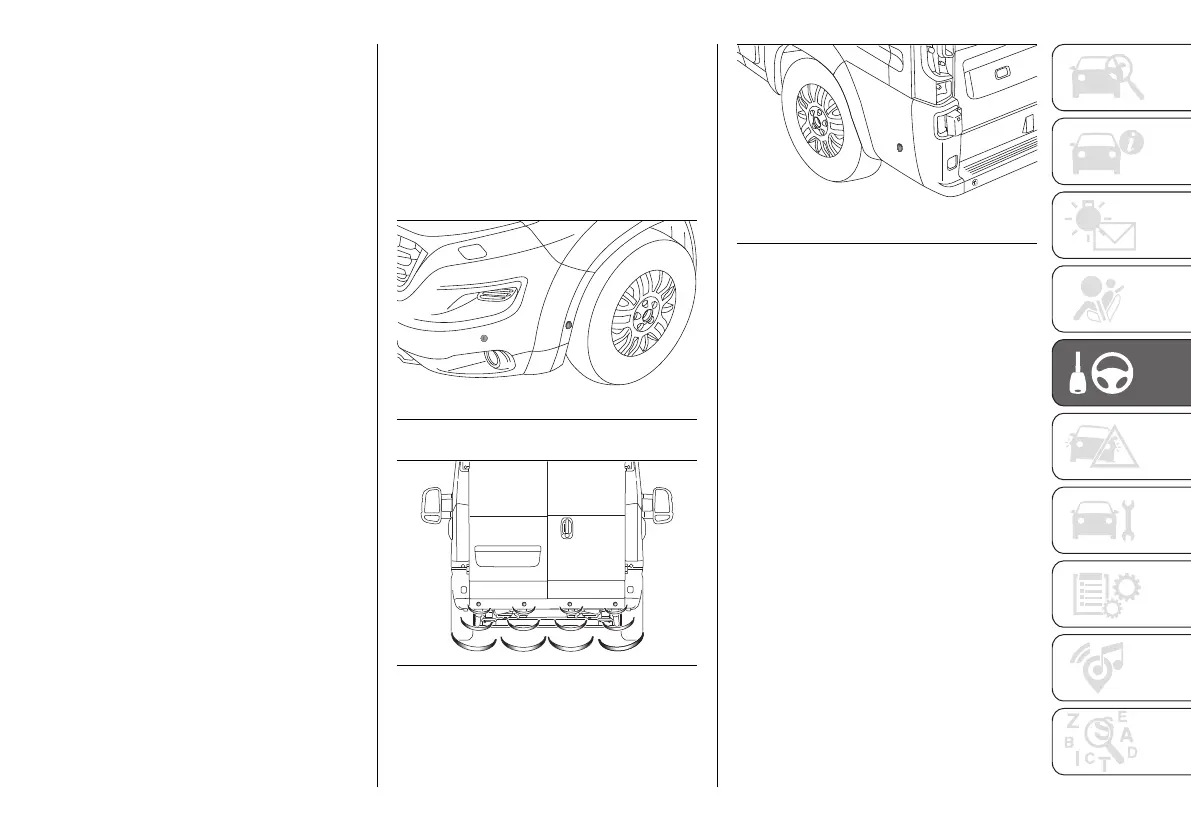
The parking sensors, located in the
front bumper fig. 216, rear bumper
fig. 217 and on the sides fig. 218 are
used to detect the presence of any
obstacles in the vicinity of the vehicle
(the system may not be able to cover
the entire surface of the sides of the
vehicle and some signals may be
delayed).
The sensors warn the driver about the
presence of obstacles with acoustic
signal and, where provided, also with
visual indications on the instrument
panel display.
216 F1A0701
217 F1A0134
218 F1A0702
On/off
To disengage the system press button
(A) fig. 219.
When the system passes from
engaged to disengaged and vice
versa, it is always accompanied by a
dedicated message on the instrument
panel display.
The LED on the button is off when
the system is switched on by the
driver. The LED is on if the system
is deactivated by the user, faulty or
temporarily deactivated.
If the button is pressed with a system
failure, the LED flashes for about 5
seconds, then it stays on constantly.
After the ParkSense
®
system
has been disengaged, it will stay
in this condition until the following
engagement, even if the starter switch
passes from MAR to STOP and then
again to MAR.










 To Next Page