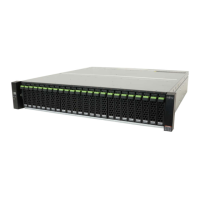
11.1 ETERNUS CS800 Replication Overview
partition (see "Replicating a Share or Partition" on page 353
Fujitsu Technology Solutions recommends that you always replicate a new share or
partition immediately after creating it.
This establishes the initial data structure on the target system and greatly increases
the speed of the first replication.
6. Choose one of the following methods to regularly replicate the new share or partition:
l (Recommended) Use the Scheduler page to set up a schedule for performing
replication automatically after backups complete (see "Scheduling a Share or
Partition for Replication" on page 266).
l Manually perform replication at frequent intervals (see "Replicating a Share or
Partition" on page 353).
After replication, a snapshot is sent to the target system. You can use the snapshot to
recover the replicated share or partition on the target system (see "Task Overview:
Recovering a Replicated Share or Partition" on page 346) or restore the share or partition
to its original location on the source system (see "Task Overview: Performing a Share or
Partition Failback" on page 347).
CAUTION!
If you do not configure a replication schedule or manually replicate the share or
partition on a regular basis, your data is not protected. While the ETERNUS CS800
continually sends data to the target system in the background to optimize the
replication process, a snapshot that preserves the complete structure of your data is
sent to the target system only when a scheduled or manual replication job occurs. If
you do not regularly and frequently replicate your data as described in Step above, it
cannot be restored at a later time.
To limit the amount of network bandwidth used for replication, enable a
constant throttle (see "Enabling System Throttling" on page 257), or schedule
replication throttling (see "Scheduling Replication Throttling" on page 266).
Task Overview: Setting Up and Performing Directory/File or Cartridge Based Replication
To automatically replicate files or cartridges from a source system and immediately
recover them for use on a target system:
1. Perform the following steps on the target system:
a. Add the source system to the list of allowed replication sources (see "Adding a
Replication Source" on page 259).
b. Create a new share or partition with deduplication enabled (see "Adding a NAS
Share" on page 190 or "Adding a VTL Partition" on page 206).
c. Enable Directory/File or Cartridge Based Replication for the new share or partition
and specify the Sync ID (see or "Configuring Directory/File or Cartridge Based
Replication" on page 351).
ETERNUS CS800 345



 To Next Page
 Loading...