176 Chapter 8
Measurement Theory
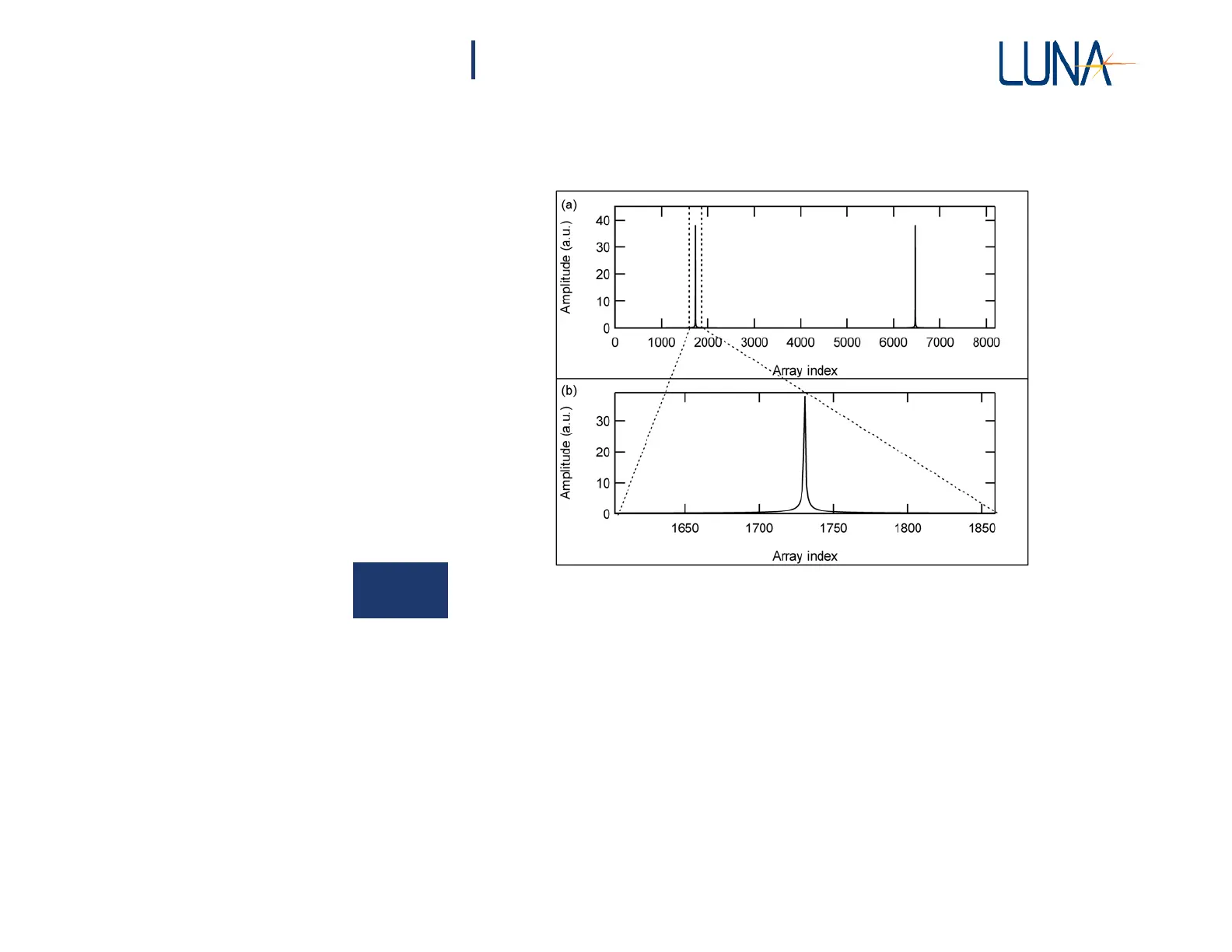
segment that contains the device information. Because the initial data was acquired
as a function of optical frequency,
ω , the transformed data is a function of time.
For this reason, the transformed data is referred to as time domain data.
Figure 8-3. (a) The Fourier transform of interference fringe
s.
(b) The segment of the time domain data that contains device in
fo
rma
t
ion.
If there are multiple reflecting interfaces within the device under test, each interface
will contribute a term to the interference pattern and a peak in the time-domain
located at the corresponding delay.
In order to more easily locate the source of reflections within a device, the time-
domain data can be scaled in units of length, using the speed of light and the group
index of the DUT.
To arrive at a measure of the frequency response of the device, an inverse Fourier
transform is performed on only the section of the time-domain data that contains
the device response. The OBR software allows the user to select any portion of the
time-domain data so the response due to different optical paths or interfaces can be
separated and measured independently.


 To Next Page