General Information Chapter Two: Overview
21
Chapter Two: Overview
General Information
Typical Flow Control System Configuration
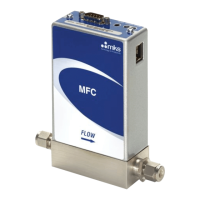
The MFC is used in a wide variety of control systems, most of which share several characteristics. The
control system consists of four basic parts:
Mass flow transducer
Control electronics
Control valve
Flow system (whose flow is being controlled by the MFC.)
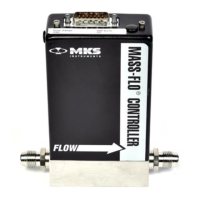
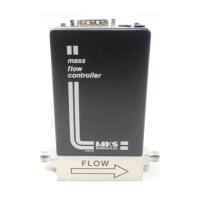
The MFC provides the first three components. The mass flow transducer is a patented MKS thermal sensor
design. The MFC instrument contains the electronics necessary for flow control and communications to the
flow system host controller. The control valve included in the device is a proportional control valve. The flow
system can be any process whose flow you need to control. In addition, the MFC is capable of metering the
mass flow of the gas during the flow control operation.
Flow Measurement Overview
The MFC measures the mass flow rate of a gas and controls the flow rate according to a given setpoint. The
accuracy from 20% to 100% of Full Scale (F.S.) is
± 1% of Setpoint relative to the calibration gas. For
setpoints between 2% and 20%, MFC Mass Flow Devices have an accuracy of ±0.2% FS.
Flow Path
Upon entering the MFC, the gas stream passes first through the metering section of the instrument for its mass
flow to be measured. The gas moves on through the control valve, which regulates the flow rate according to
the given setpoint and in response to the device’s control system, and then exits the instrument at the
established rate of flow.
The metering section consists of one of the following:
A sensor tube for Full Scale ranges < 10 sccm (N
2
equivalent)
A sensor tube and parallel bypass for ranges > 10 sccm (N
2
equivalent)
The geometry of the sensor tube, in conjunction with the specified full scale flow rate, ensures fully
developed laminar flow in the sensing region. The bypass elements are specifically matched to the
characteristics of the sensor tube to achieve a flow splitting ratio which remains constant throughout each
range.
Flow Control Range
The MFC can control flow over a range of 2 to 100% of full scale flow. This means that a MFC with a 1000
sccm Full Scale configuration can control flow from 20 to 1000 sccm, whereas an MFC with a 100 sccm Full
Scale configuration can control flow from 2 to 100 sccm.
Measurement Technique
The flow measurement is based on differential heat transfer between temperature sensing heater elements
which are attached to the exterior of the sensor tube. This senses the thermal mass movement which is
converted to mass flow via the specific heat, C
p
, of the gas.



 To Next Page