Chapter Two: Overview How the MFC Works
22
Control Circuitry
The controller employs the above measurement technique and utilizes a control circuit that provides drive
current for the proportioning control valve. The flow controller accepts a setpoint signal, compares it to its
own metered flow signal, and generates an error voltage. This error signal is then conditioned so that it can
reposition the control valve, thus reducing the control error to zero.
In the normally closed control valve, the MFC instrument lifts the armature and plug assembly from the seat
to regulate the gas flow rate.
Control Valve
The control valve is a specially constructed solenoid valve in which the armature (moving valve mechanism)
is suspended. The arrangement ensures that no friction is present and makes precise control possible.
How the MFC Works
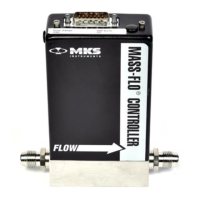
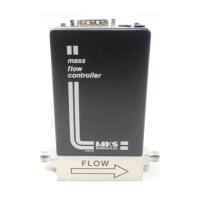
The MKS MFC includes technology improvements in functionality and performance to help users increase
tool throughput and reduce overall system costs. Real-time accurate flow control is provided through
advanced digital algorithms. Enabling real-time control of process gas flow, accuracy and repeatability are
significantly improved over conventional PID based digital MFC’s. For optimum control performance, the
user can (should) specify the inlet pressure to the device through the Ethernet User Interface.
The MFC compares the flow reading to the setpoint, and positions the valve to maintain, or achieve, the
setpoint rate. The controller functions as a model based, pressure insensitive flow controller.
Example
Assume that your MFC is positioned upstream of the process chamber. The MFC is positioned before the
chamber so it will regulate the flow rate of the gas entering the process chamber.
When the actual flow rate reading is less than the setpoint value, the MFC opens the valve to increase the
amount of gas entering the system. As the valve opens, assuming adequate differential pressure across the
flow controller, gas enters the process chamber, so the flow rate rises to meet the setpoint value.
When the actual flow rate reading is more than the setpoint value, the MFC closes the valve to decrease the
amount of gas entering the system. As the valve closes, there is a reduced flow of gas entering the process
chamber, so the flow rate decreases to meet the setpoint value.
Note
The MFC must have sufficient differential pressure from inlet to outlet to achieve the setpoint.
If the device does not reach setpoint for lack of differential pressure, either increasing the inlet
ressure or decreasing the outlet pressure may be necessary.
Note
For optimal control performance, the user should specify the inlet pressure provided to the MFC
through the Ethernet user interface.
Operation of the MFC with Gases other than Nitrogen
The G-Series MFCs are unique in MKS flow control technology in that it they have pre-stored gas parameters
that allow the user to easily configure the device for gases other than Nitrogen simply using a computer with a
standard web-browser without the need for special software. The current MKS library of gases and functions
is in excess of 90 in number and includes most gases in common usage. Consult MKS Applications
Engineering for a list of the currently stored gases.



 To Next Page