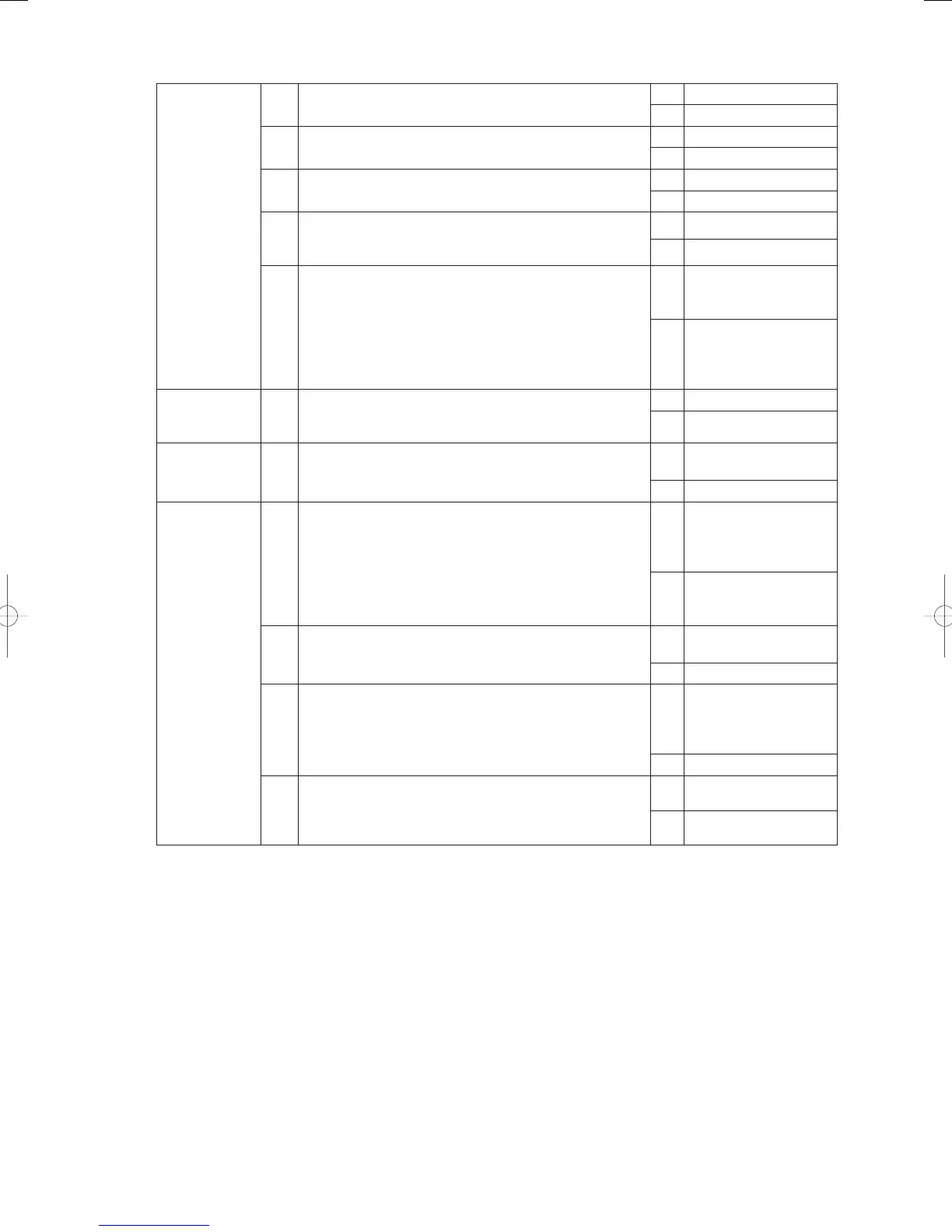
IV–42
3
Remote
controller wires
(wires linking
the remote
controller to
the water heat
exchanger unit)
3-1
Is the indoor/outdoor operation wiring severed (connectors,
terminals disconnected)?
Yes Repair severed wires
No 3-2
3-2 Is the indoor/outdoor operation wiring short-circuited?
Yes Correct the short circuit
No 3-3
3-3 Is the indoor/outdoor operation wiring grounded?
Yes Correct the ground
No 3-4
3-4
Is voltage being applied to the indoor/outdoor operational
wiring? (If no, the fuse (F001) on the outdoor unit’s main
board has blown.)
Yes 3 - 5
No 4-1
3-5
Repair the wiring properly so that no electrical voltage is
applied. Is the water heat exchanger unit’s control board
2P-13 already in use?
Yes
Replace the water heat
exchanger unit’s control
board
No
Reverse the water heat
exchanger unit’s control
board connectors (2P-12
→ 2P-13)
4
Outdoor unit
breakdown
4-1 Has the outdoor unit broken down?
Yes Repair the malfunction
No 5-1
5
Noise
5-1 Is a source of noise located nearby?
Yes
Set up noise
countermeasures
No 6-1
6
Water heat
exchange unit’s
control board
and surrounding
area
6-1 Is AC200V ±10% being applied between R and S on TB1?
Yes
Proceed to 6-2 after
having confi rmed that
the wiring and terminals
are normal around TB1
No
Request improvements
to the power facility
manager
6-2 Is the varister (VA1) grounded or severely deteriorated?
Yes
Replace the varister
(VA1)
No 6-3
6-3 Is the power switch (SW1) on?
Yes
Proceed to 6-4 after
having confi rmed that
the wiring is normal
around SW1
No Set SW1 to ON
6-4
Are suitable DC voltages being applied to CN1 (6P-1)?
(Suitable DC voltage = approximately 5V between
TP1 and 2, approximately 7V between TP3 and 4, and
approximately 5V between TP5 and 6)
Yes 6 - 8
No 6-5
GHPtroubleshooting.indbIV‒42GHPtroubleshooting.indbIV‒42 2012/11/2611:20:092012/11/2611:20:09



 To Next Page