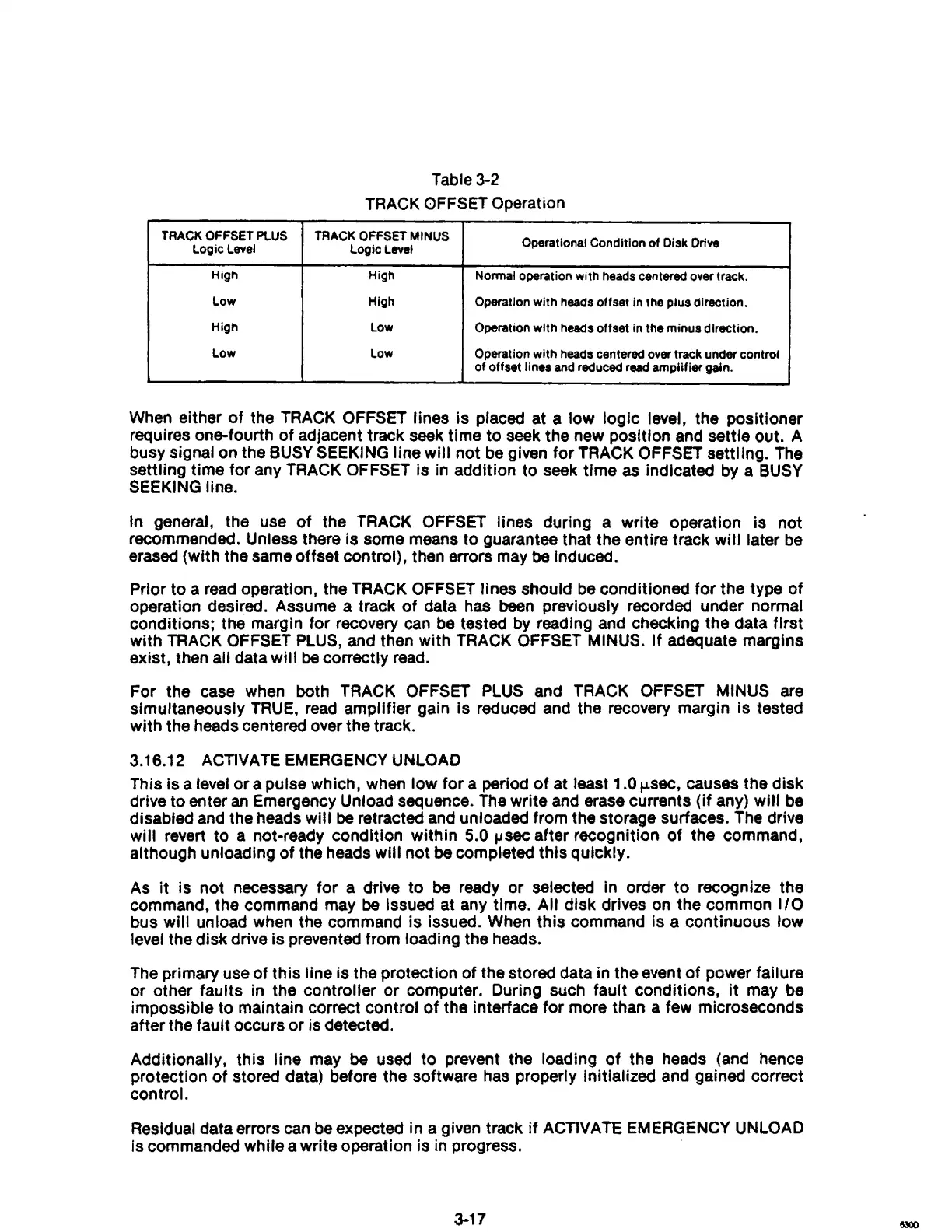
Table 3-2
TRACK OFFSET Operation
TRACK OFFSET PLUS
TRACK OFFSET MINUS
Operational
Condition
of
Disk Drive
logic
Level
Logic
Level
High High
Normal
operation
with
heads centered over track.
Low
High
Operation
with
heads
offset
in the
plus
direction.
High
Low
Operation
with
heads
offset
In
the
minu8 direction.
Low
Low
Operation
with
heads centered over track under control
of
offset lines and reduced read amplifier gain.
When either
of
the TRACK OFFSET lines
is
placed at a
low
logic level, the positioner
requires one-fourth
of
adjacent track seek
time
to
seek the new position and settle out. A
busy
Signal on the BUSY SEEKING line
will
not
be given
for
TRACK OFFSET settling. The
settling time
for
any TRACK OFFSET Is in addition
to
seek
time
as indicated by a BUSY
SEEKING line.
In
general, the use
of
the TRACK OFFSET lines during a write operation is
not
recommended. Unless there
is
some means
to
guarantee that the entire track
will
later be
erased (with the same
offset
control), then errors may be Induced.
Prior
to
a read operation, the TRACK OFFSET lines should be conditioned
for
the type
of
operation desired. Assume a track
of
data has been previously recorded under normal
conditions; the margin
for
recovery can be tested by reading and checking the data
first
with TRACK OFFSET PLUS, and then with TRACK OFFSET MINUS.
If
adequate margins
exist, then
all data
will
be
correctly read.
For the case when both
TRACK OFFSET PLUS and TRACK OFFSET MINUS are
simultaneously TRUE, read amplifier gain
Is reduced and the recovery margin Is tested
with the heads centered over the track.
3.16.12
ACTIVATE EMERGENCY UNLOAD
This
is
a level
or
a pulse which, when
low
for
a period
of
at least 1.0
jJ.sec,
causes the disk
drive
to
enter
an
Emergency Unload sequence. The write and erase currents (If any)
will
be
disabled and the heads
will
be retracted and unloaded from the storage surfaces. The drive
will revert
to
a not-ready condition within 5.0 ..,sec after recognition
of
the command,
although unloading
of
the heads
will
not
be
completed
this
quickly.
As
it
is
not
necessary
for
a drive
to
be ready
or
selected in order
to
recognize the
command, the command may
be
Issued at any time.
All
disk drives on the common 110
bus
will
unload when the command
is
issued. When
this
command
is
a continuous
low
level the
disk
drive is prevented from loading the heads.
The primary use
of
this line
is
the protection
of
the stored data in the event
of
power failure
or
other faults in the controller
or
computer. During such fault conditions,
it
may be
impossible
to
maintain correct control
of
the interface
for
more than a few microseconds
after the
fault occurs
or
is detected.
Additionally,
this
line may be used
to
prevent the loading
of
the heads (and hence
protection
of
stored data) before the software has properly initialized and gained correct
control.
Residual data errors can be expected in a given track
if
ACTIVATE EMERGENCY UNLOAD
is
commanded while a write operation
is
in progress.
:),17



 To Next Page