Overview
1
7
Polyend Tracker Mini Manual
6
Polyend Tracker Mini Manual
Overview
1
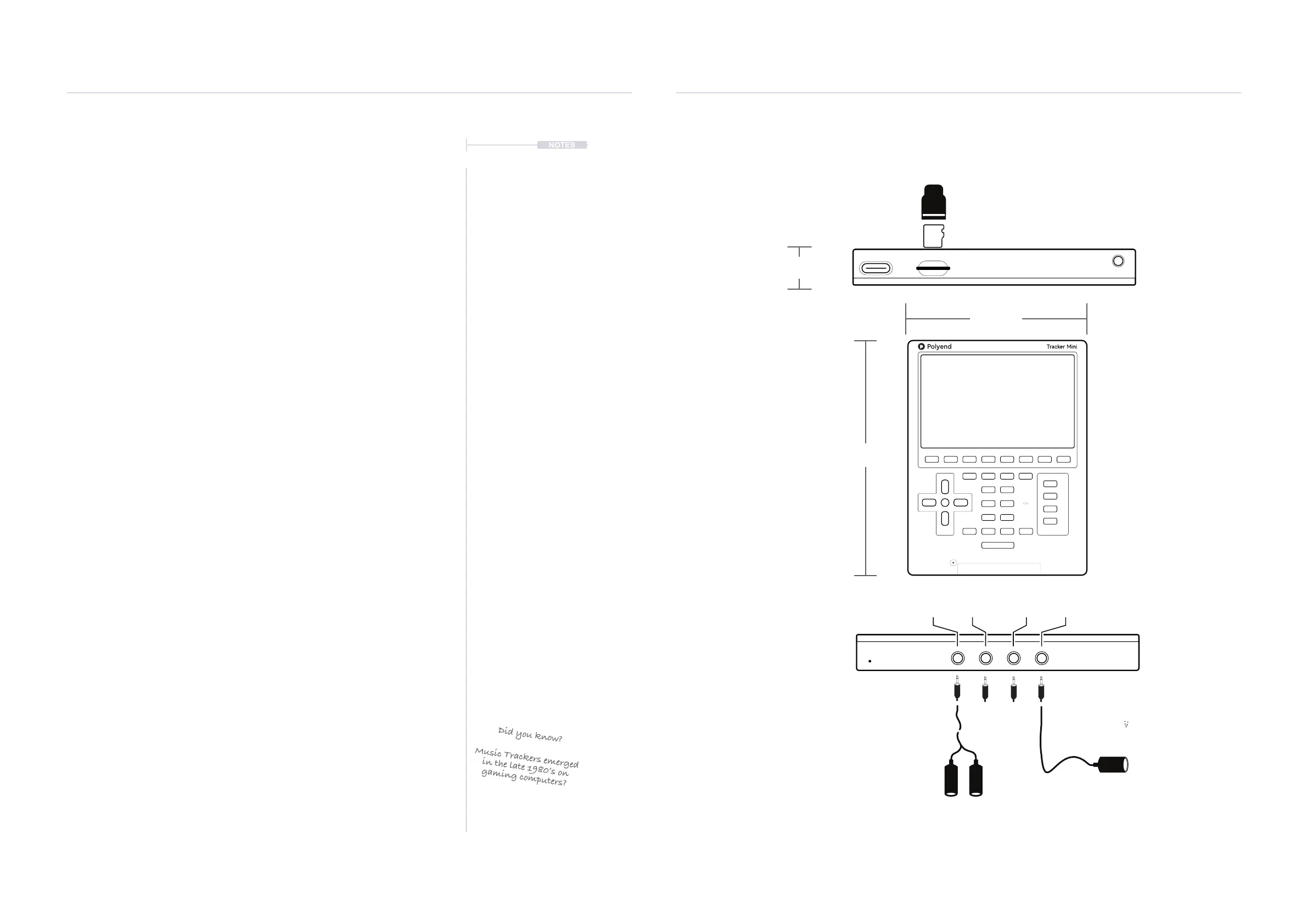
On / Off ButtonUSB Power Charge Input
USB-C to USB-A Cable Supplied
Line In Line Out MIDI In MIDI Out
Stereo audio output also
serves as headphone out.
Micro SD Card Slot.
Pins facing to the front panel.
16GB Micro SD Card & Adapter Supplied
3.5mm Male Stereo TRS Jack
to 2 x 6.3mm TR Mono Female.
Adapter supplied.
3.5mm Jack to 5 Pin MIDI.
Adapter (Type B) supplied
1.1 How to Use This Notebook
Sections are laid out to cover the full workow with walkthroughs, step by
step guides and tips. Some pages carry a wide margin and some are
intentionally blank enabling you to make your own notes.
Control conventions.
(Enter)
D-Pad for navigation options are shown with rounded parentheses. These
represent the 5 physical direction buttons. These include, (Up), (Down),
(Right), (Left) as well as the central (Enter) button.
[+] / [-]
The Master [+] & [-] buttons navigate and for some parameters adjust it’s
values. The outer buttons make changes in larger increments. Also used to
adjust the master volume level.
[Function]
Square parentheses contain general functions that are selectable by one of
the other 15 physically dedicated buttons - either as a primary or secondary
function. Examples are [Rec], [Play], [Shift]. .
When using the [Menu] button, the pop-up menu will open while the button
is held. Highlight the specic menu option by navigating with the D-Pad
Navigation buttons while holding [Menu]. Options with multiple pages are
shown by the dots underneath the option text. The currently highlighted
option is selected when the [Menu] button is released.
[Function] + [Option]
Functions which require multiple button selections simultaneously are
shown with a + symbol between each required button. An example is the
[Shift] + [Copy] command.
[Dynamic Screen Key]
The 8 dynamic screen buttons located directly under the display will be
written using italic text. The actual function that each button serves will
change depending on the current context. The function it serves will be
labelled on the screen label above each button on the device. Currently
unavailable options will show on the screen as dimmed text. Dynamic
screen key examples include [Create Project], [Up] or [Down] options.
1.2 Hardware Overview
Your Notes Can be written here Here
Did you know?
Music Trackers emerged
in the late 1980’s on
gaming computers?
130 mm
170 mm
20 mm
NOTES


 To Next Page