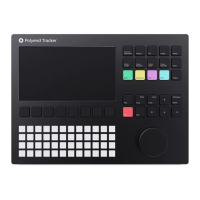
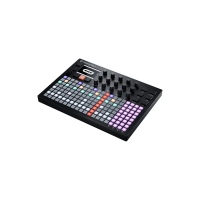
In the language of Tracker Mini, an instrument
is the part of a step that generates sound and
is essentially based on an audio sample.
Instruments are loaded into the instrument
pool to be accessible in a project (explained in
the project section). A maximum of 48
instruments can be loaded to a project. At its
core an instrument has a sample or part of a
sample along with a set of dened settings.
The sample parameters set the conguration
of the sample itself and also the integration
within the Tracker Mini instrument feature set.
A sample can be sliced for example to be used
as beats in a drum kit. It can form the central
audio source for the wavetable and granular
engines. These operate like synthesizers. It
can also simply be a pure stand alone sample.
Building of instruments and their application in
Tracker Mini is an essential foundation for
sound design. MIDI instruments also exist and
the application of these is covered in the MIDI
section. There are a variety of things that can be
done to create an instrument. Working with
instruments clearly has a cross over between
the practical, process orientated tasks and the
creative, inspirational parts. Both are equally
important and often it is worth dedicating time
purely to sound design and instrument creation.
Building a library of say, percussion, drums,
bass, leads, or pads and textures, and so forth is
good practice. This can make the track design
and full song production workow smooth and
simple, helping to switch the focus on the
assembly and creation of patterns. Instruments
are stored as ‘.pti’ les and can be used across
projects and can be distributed and shared with
others. Tracker Mini provides an all in one
solution for music making and having a
collection of instruments readily available makes
this music making process faster and more
effective.
Instruments
6
103
Polyend Tracker Mini Manual
102
Polyend Tracker Mini Manual
NOTES


 To Next Page