129
Polyend Tracker Mini Manual
128
Polyend Tracker Mini Manual
NOTESNOTES
Instruments
6
Instruments
6
Optimising Wavetables
The best approach to operating with wavetable synthesis is to use WAV
les that have been created for wavetable use. This will adhere to the frame
and sample conventions stated. Also the audio samples will be created with
smooth rather than stepped transitions between waves. There are many
pre-prepared wavetables available for download but also check out the
online sheets of sound creator and Modbap Modular OsirisEdit to learn
more about wave creation.
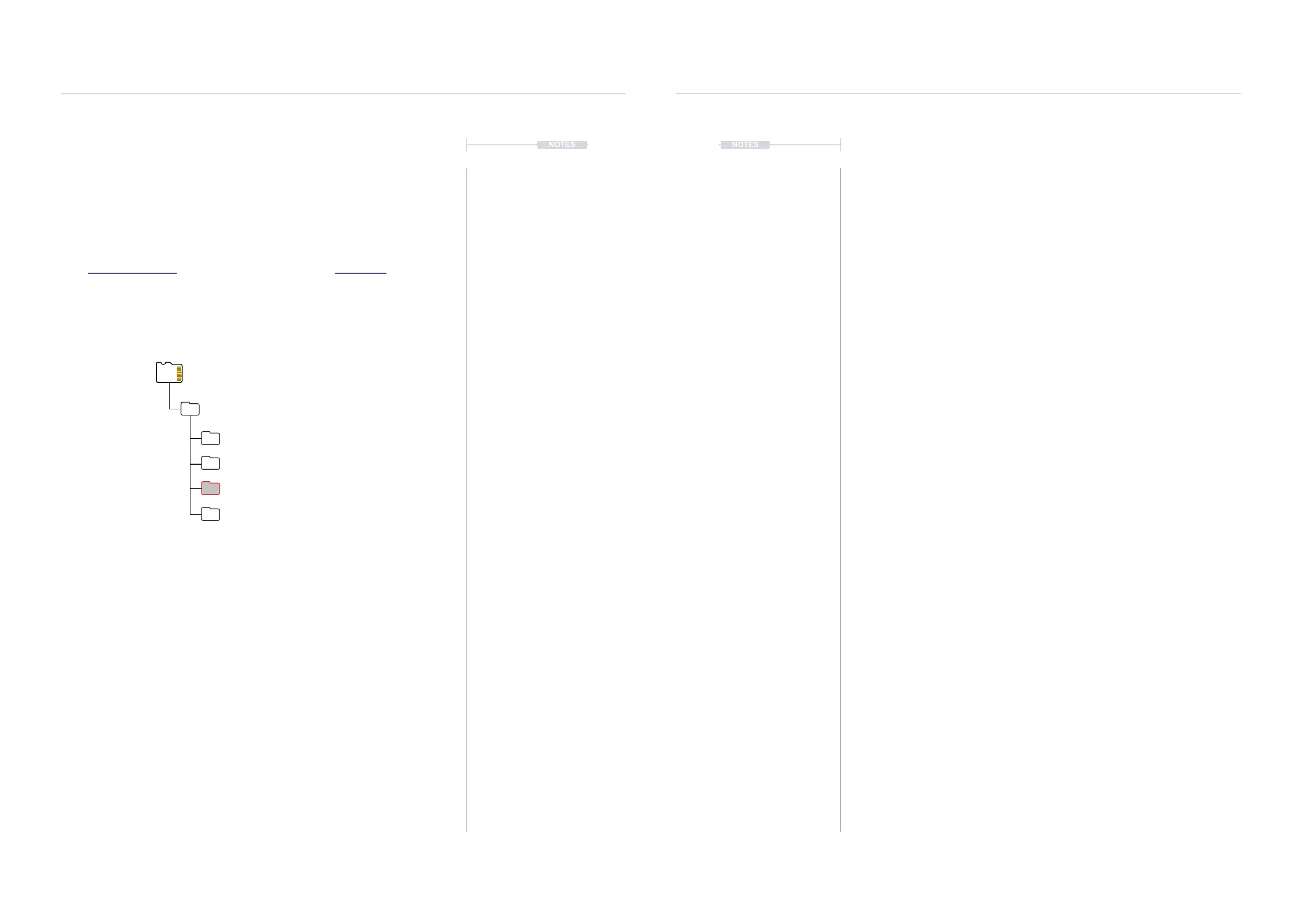
Tracker Mini’s factory wavetable les are located in the samples folders on
the SD Card.
There are many freely available wavetable samples online. Standard
samples can be used but wavetable formatted WAV les provide better and
smoother performance. The most common standard is 2048 Samples /
Frame (256 Frames). This applies to XFer Serum, U-He Hive, Dune, but
others may also exist. Ableton Live Wavetable uses 1024 samples and
down samples when a 2048 format is applied.
Standard audio les may sound ‘stepped’ when navigating the position.
Tracker Mini has an on-board optimisation tool, WT Smoother which will
process a standard sample and helps to smooth the sound and give better
performance. This effectively converts the le to a more suitable format for
Tracker Mini’s Wavetable Synth. Navigating a processed audio wave will
sound smoother in the transition across positions.
▌ USING WT SMOOTHER TO OPTIMISE SAMPLES
1. Ensure the sample is loaded to the instrument list and selected as
currently active. Note that samples in the instrument list are copied into
the onboard memory from the SD Card.
2. Press [Menu] and navigate to select ‘Sample Editor’. Operations in the
‘Sample Editor’ are performed destructively to the sample in memory.
However the original le is retained intact on the SD Card.
3. Edit the audio le [Start], 1
st
Screen button and [End], 2
nd
Screen Button
selects the marker. Press (Up) or (Down) or [+] / [-] to adjust the
positions to select part of the sample to process.
4. Press the 7
th
or 8
th
Screen button to navigate to ‘WT Smoother’.
5. Press [Select effect], 6
th
Screen button to select WT Smoother.
6. Press [Window Num], 1
st
Screen button in the WT Smoother application.
This selects frames. The 256 default is a typical setting to use. Press
(Up) or (Down) or [+] / [-] to adjust.
7. Press [Window Len], 2
nd
Screen button in the WT Smoother application.
This selects sample length. The 2048 default is a typical setting to use.
Press (Up) or (Down) or [+] / [-] to adjust.
8. Press [Preview], 7
th
Screen button to audition the audio while editing.
This will need to process the audio before playing. Press [Stop], 7
th
Screen Button again to stop preview.
9. Press [Apply], 8
th
Screen button to apply and render the new audio le.
This converts to a wavetable which can be used in the wavetable play
mode as a smoother more rened option.
10. Save the project to also save the edited instruments in the project
folder. Hold [Shift] + [3] then Press [Save], 5
th
Screen Button. Saving the
project also automatically saves the instruments in the instrument
subfolder. These can be accessed from other projects.
Root
Wavetable_2048
/Samples


 To Next Page