16 Appendix
Precision Pulse Output Description
Introduction
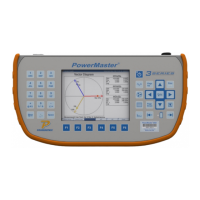
The PowerMaster
®
incorporates a high accuracy pulse output which can be driven by any of the
following quantities:
Active Power (P): Pa: active power computed in the time domain ( once per cycle).
Includes DC and all frequency components up to 3 kHz.
P1: active power computed in the frequency domain ( once every four
cycles). Includes only the fundamental frequency component.
Pt: active power computed in the frequency domain ( once every four
cycles). Can include up to the 50
th
harmonic. The maximum
number of harmonics to include are user selectable. A threshold
(as a percent of the fundamental) can also be set to exclude
harmonics with very low amplitudes.
Reactive Power (P): Qa: reactive power computed in the time domain ( once per cycle).
Includes DC and all frequency components up to 3 kHz.
Q1: reactive power computed in the frequency domain ( once every four
cycles). Includes only the fundamental frequency component.
Qt: reactive power computed in the frequency domain ( once every four
cycles). Can include up to the 50
th
harmonic. The maximum
number of harmonics to include are user selectable. A threshold
(as a percent of the fundamental) can also be set to exclude
harmonics with very low amplitudes.
Apparent Power (P): Sa: reactive power computed in the time domain ( once per cycle).
Includes DC and all frequency components up to 3 kHz.
S1: reactive power computed in the frequency domain ( once every four
cycles). Includes only the fundamental frequency component.
St: reactive power computed in the frequency domain ( once every four
cycles). Can include up to the 50
th
harmonic. The maximum
number of harmonics to include are user selectable. A threshold
(as a percent of the fundamental) can also be set to exclude
harmonics with very low amplitudes.
Rev 1.5 155


 To Next Page
 Loading...