Getting Started GM300 Radio Service Software Manual
2-8
6880902Z36-B October, 1996
Understanding Computer Basics
2
2.4.3 Understanding Computer Storage Systems
The computer can store large amounts of data (software programs, code, data, files) in several places.
Some of these places are:
❏
Random-Access Memory (RAM)
❏
Read-Only Memory (ROM)
❏
Hard disk
❏
Diskettes.
The RAM, ROM, hard disks and diskettes all vary in function and all have certain size limits (memory).
They all store data in terms of bytes; a byte equals approximately one character as typed on the keyboard.
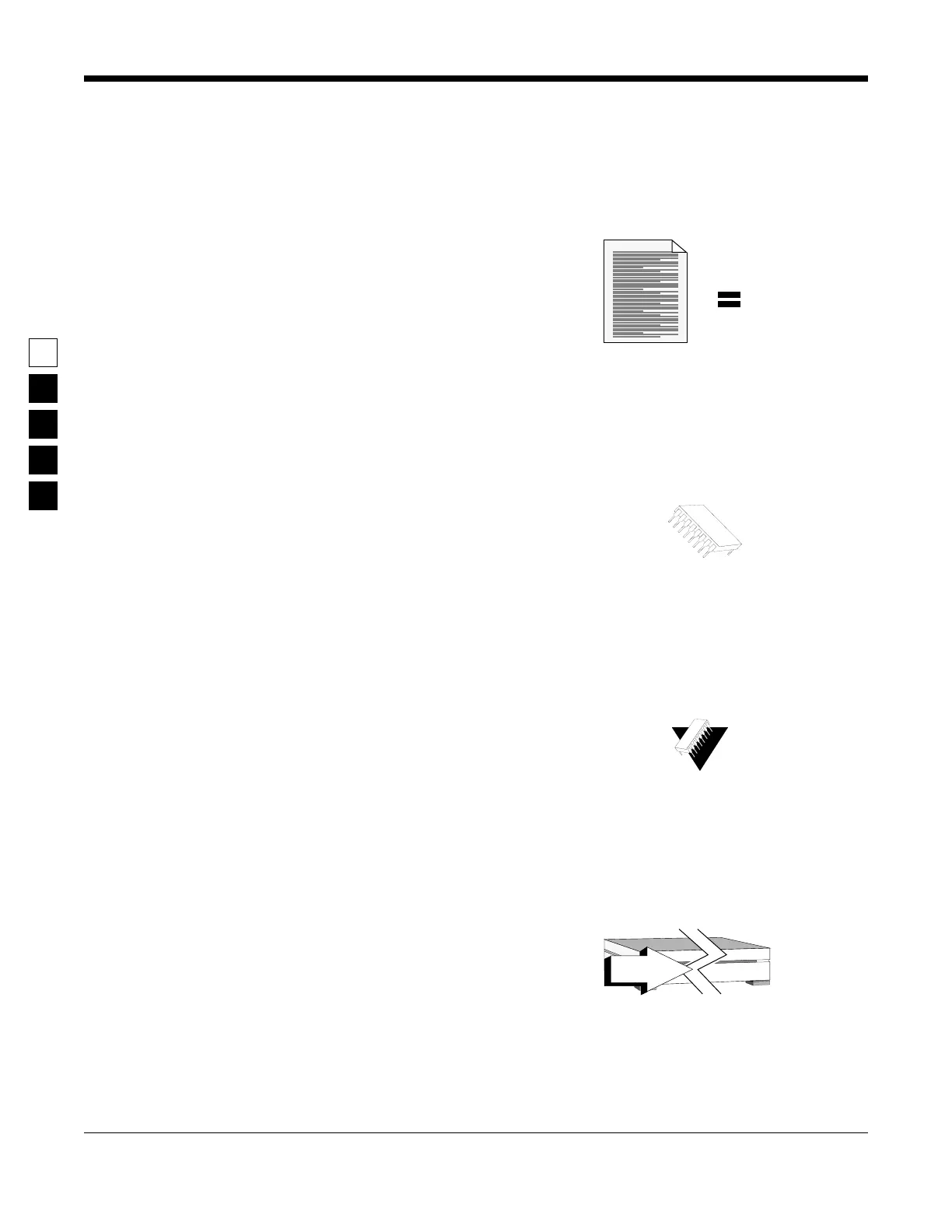
1,024 bytes equals one kilobyte, or 1K. For comparison purposes, one page of double-spaced, typed text
equals approximately 2K.
1.
RAM
The Random Access Memory (RAM) is a storage
area in the system unit used to run programs and
operating systems. The amount of RAM varies from
computer to computer, and it directly affects which
programs will run on your computer. With more
RAM, you can run larger programs. Most programs
indicate how much RAM is required to run RSS. We
recommend at least 2 MB of RAM to run the RSS
program. The Radius radios also have RAM
embedded in them.
2.
ROM
The Read Only Memory (ROM) is a storage area in
the system unit used by the computer for start-up
and Power-On Self-Test (POST) purposes. The
ROM is “read-only”, which means a user cannot
write or save data to it, over it, delete it, or in any
other way destroy it by using the keyboard keys.
The program in the ROM is hard-coded into the
ROM chip, and as such is protected from user
errors. The Radius radios also have ROM embed-
ded in them.
3.
Hard Disk and Hard-Disk Drive
A hard disk is a storage area inside the hard disk
drive, both within the system unit. Hard disks store
a user's programs and files (data). The hard disk
drive accesses the hard disk data the same way a
record player accesses the music (data) on a record,
or a CD player accesses the music on a CD. Both the
disk and the disk drive are needed to store (write or
save) or retrieve (read) any data. The data stored on
a hard disk can originate from data the you gener-
2K
Inside unit


 To Next Page