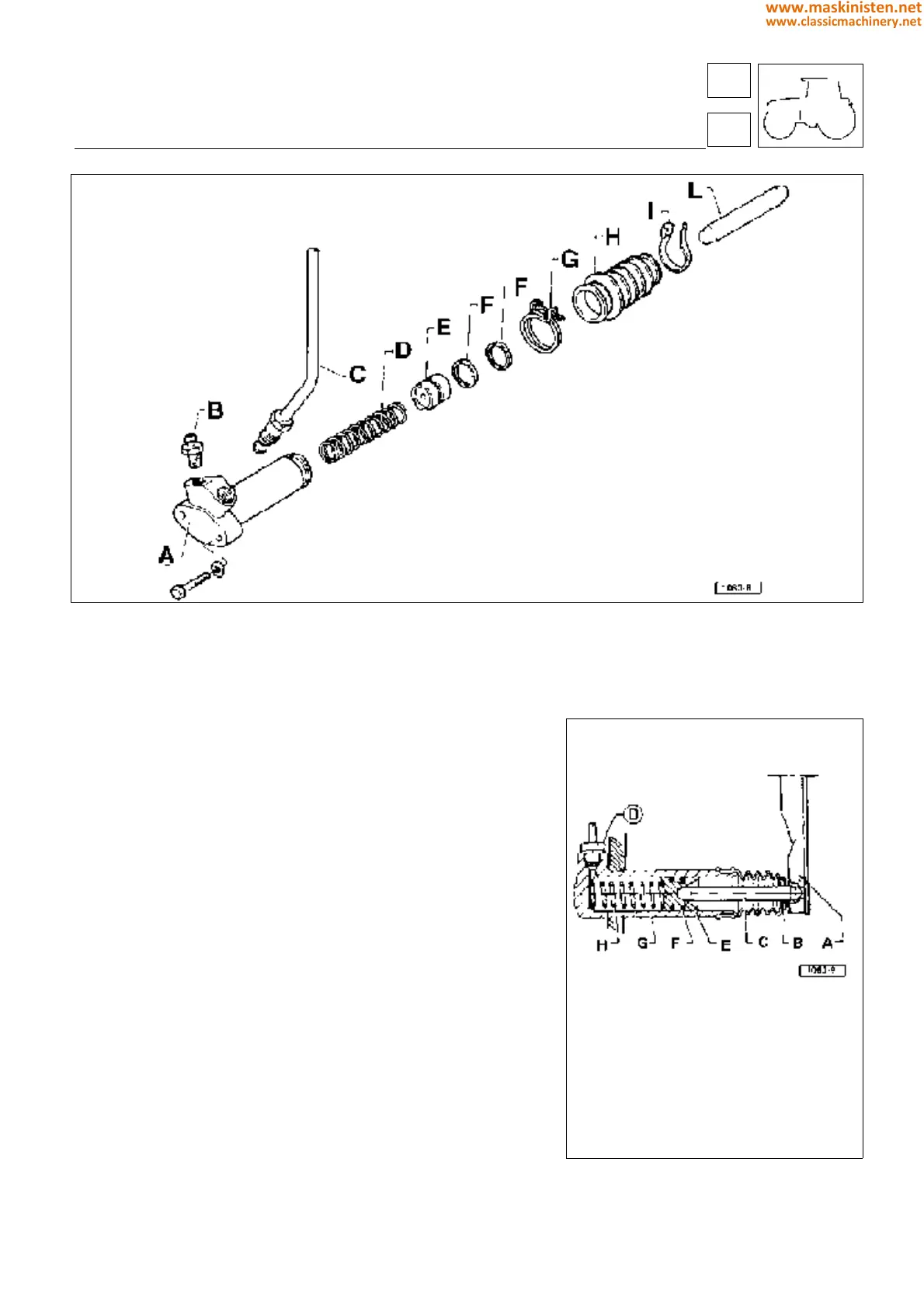
Fig. 11 - Clutch operating cylinder.
Stripping the slave cylinder (Fig 11)
Loosen the clip G and remove together with the boot H. Withdraw
the piston carefully from the cylinder, blasting with compressed air
at low pressure to assist removal. Remove the spring D from the
cylinder and loosen the bleed screw B.
Remove the seals F fom the piston E.
CAUTION: When cleaning the components of the cylinder, use
only specifically formulated brake and clutch fluids (see page 110).
Do not use petrol, paraffin or other mineral oils as these will
damage parts in rubber.
Inspections
— Check both internal and external piston surfaces for scratching.
Replace if required.
— Make sure the seal ring grooves are duly clean; blow the
grooves with compressed air if necessary.
— Inspect seal ring, dust boot conditions as well as spring effi-
ciency, worn-out parts should be replaced.
— Ensure the air bleeding hole is free from impurities.
Notes on refitment
— When reconnecting the transmission housing, check that the clutch
fork remains correctly positioned and free to rock on its fulcrum pivot.
This can be ensured by removing the side plug from the flange of the
intermediate housing and viewing the fork through the hole. In the event
of the fork pivot being unseated, reposition correctly with the aid of a
screwdriver inserted through the hole vacated by the plug.
— Before refitting the slave cylinder, fill with the recommended oil so
as to facilitate the subsequent bleeding procedure.
— Once all components are correctly and securely in place, bleed the
hydraulic circuit.
Fig. 12 - Clutch operating cylinder cutaway view.
clutch and transmission
clutch
A - Operating cylinder casing
B - Air bleeding screw plug
C - Supply pipe union
D - Spring
E - Piston
F - Seal ring
G - Clamp
H - Dust boot
I - Clamp
L - Pushrod
A - Control lever
B - Dust boot
C - Pushrod
D - Piston
E - Seal ring
F - Cylinder casing
G - Spring
H - Union
23
2
115
www.maskinisten.net
www.classicmachinery.net



 To Next Page