Technical data are subject to change without notice.
© Copyright SPM 2002-04. 71650.B
SPM Instrument AB • Box 504 • S-645 25 Strängnäs • Sweden
Tel +46 152 225 00 • Fax +46 152 15075 • info@spminstrument.se • www.spminstrument.se
The dBm/dBc technique
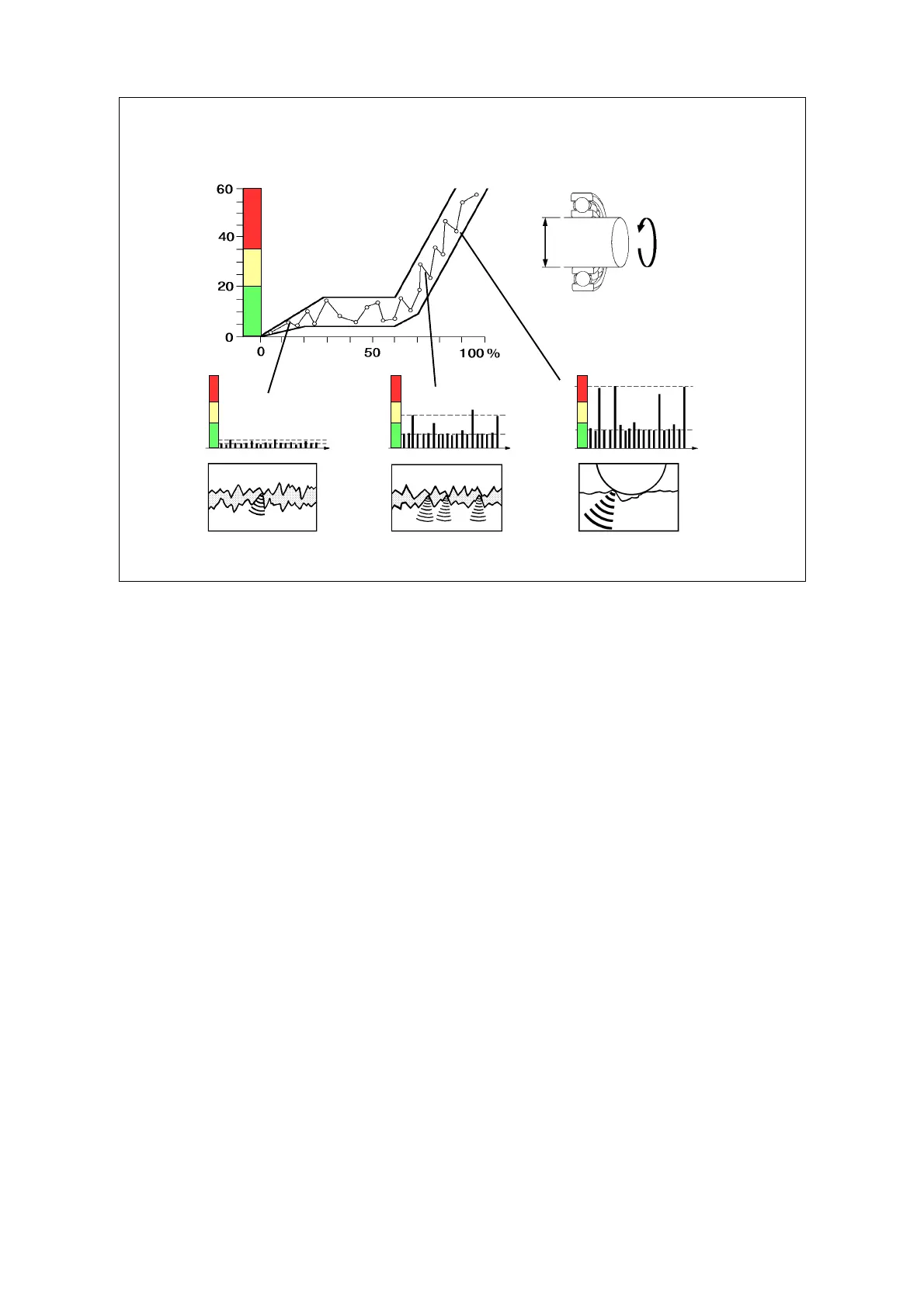
The dBm/dBc technique has been successfully applied for more than 30 years (instruments 43A,
T2000, T2001) and continues to be widely used. It is well suited for industrial condition monitoring,
because it works with few, easy to understand in- and output data and with ”reasonable accuracy”.
Even on a logarithmic scale, there is normally a large, distinct difference between the maximum
values from good and bad bearings. Thus, minor inaccuracies in the input data (rpm and shaft
diameter) have little effect on the evaluated measuring result.
Lubrication condition is indicated by the delta value, i.e. the difference between dBm and dBc.
High readings and a small delta value indicate poor lubrication or dry running. This is sufficient for
maintenance purposes.
dBm and dBc are now measured in a fixed time window and automatically displayed. After that, the
instrument continues to measure while the transducer is connected. The peak indicator blinks
when pulses stronger than the displayed level are detected.
The earphone is used to listen to the shock pulse pattern in case of suspect or high readings. This,
and the possibility to search for shock pulse sources with the probe transducer, is a means to verify
the measuring result and its cause.
dBm/dBc
RPM
Life time
d
dBm
dBc
dBm
dBc
dBm
dBc
18 dBm/dBc technique



 To Next Page