Technical data are subject to change without notice.
© Copyright SPM 2002-04. 71650.B
SPM Instrument AB • Box 504 • S-645 25 Strängnäs • Sweden
Tel +46 152 225 00 • Fax +46 152 15075 • info@spminstrument.se • www.spminstrument.se
Normalized and unnormalized readings
The absolute shock pulse level of a bearing, measured in dBsv (decibel shock value), is both a
function of rolling velocity and of bearing condition. To neutralize the effect of rolling velocity on
the measured value, the T30 has to be programmed with shaft diameter (in millimetre or inch) and
rotational speed (in rpm).
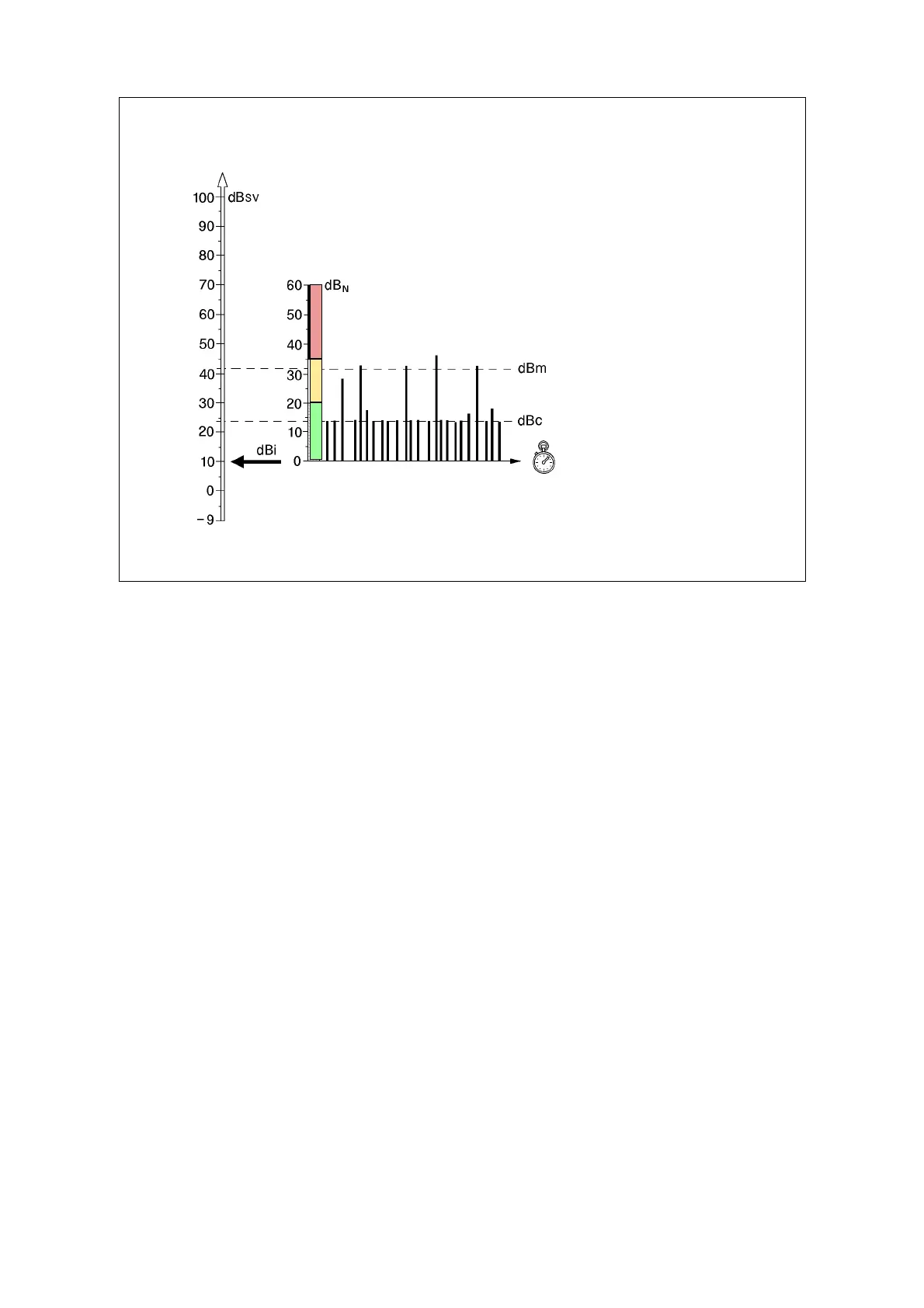
The T30 will then calculate the initial value dBi, the starting point of the condition scale for a
particular bearing. You can also input the dBi directly. The condition scale is graded in normalized
shock values, dBn.
The T30 takes a sample count of the shock pulses occurring over a period of time and displays:
• the maximum value dBm for the small number of strong shock pulses.
• the carpet value dBc for the large number of weaker shock pulses.
• an arrow against a field on the condition scale: green for dBm up to 20 dBn = good condition,
yellow for 21-34 dBn = caution, red for 35 dBn and more = bad condition.
The maximum value dBm defines the bearing’s position on the condition scale. The difference
between dBm and dBc is used for a finer analysis of the causes for reduced or bad condition.
When you set the dBi to ”--” (below -9), the T30 will take an unnormalized reading, in dBsv
(absolute shock values). The condition zones do not apply. This method is used for comparative
reading on different bearings and/or other shock pulse sources.
dBi = Initial value of a bearing
dBc = Carpet value (weak pulses)
dBm = Maximum value (strong pulses)
dBn = Unit for normalized shock level
dBsv = Unit for absolute shock level
dBm/dBc technique 19



 To Next Page