Technical data are subject to change without notice.
© Copyright SPM 2002-04. 71650.B
SPM Instrument AB • Box 504 • S-645 25 Strängnäs • Sweden
Tel +46 152 225 00 • Fax +46 152 15075 • info@spminstrument.se • www.spminstrument.se
Unnormalized readings on gear boxes
Shock pulses can sometimes spread through a machine housing without significant damping. This
means that the shock pulses from the bearing with the highest shock pulse level can, under
unfavourable circumstances, interfere with the readings on all the other bearings.
The problem is aggravated when the bearings are of different sizes and rotating at different
speeds, as in a gear box. A bearing with high rotational speed has a high dBi value and generates
relatively strong pulses even when its operating condition is good. The same shock pulse level
measured on a bearing with a low dBi may indicate bad bearing condition.
In such cases, you have to proceed as follows:
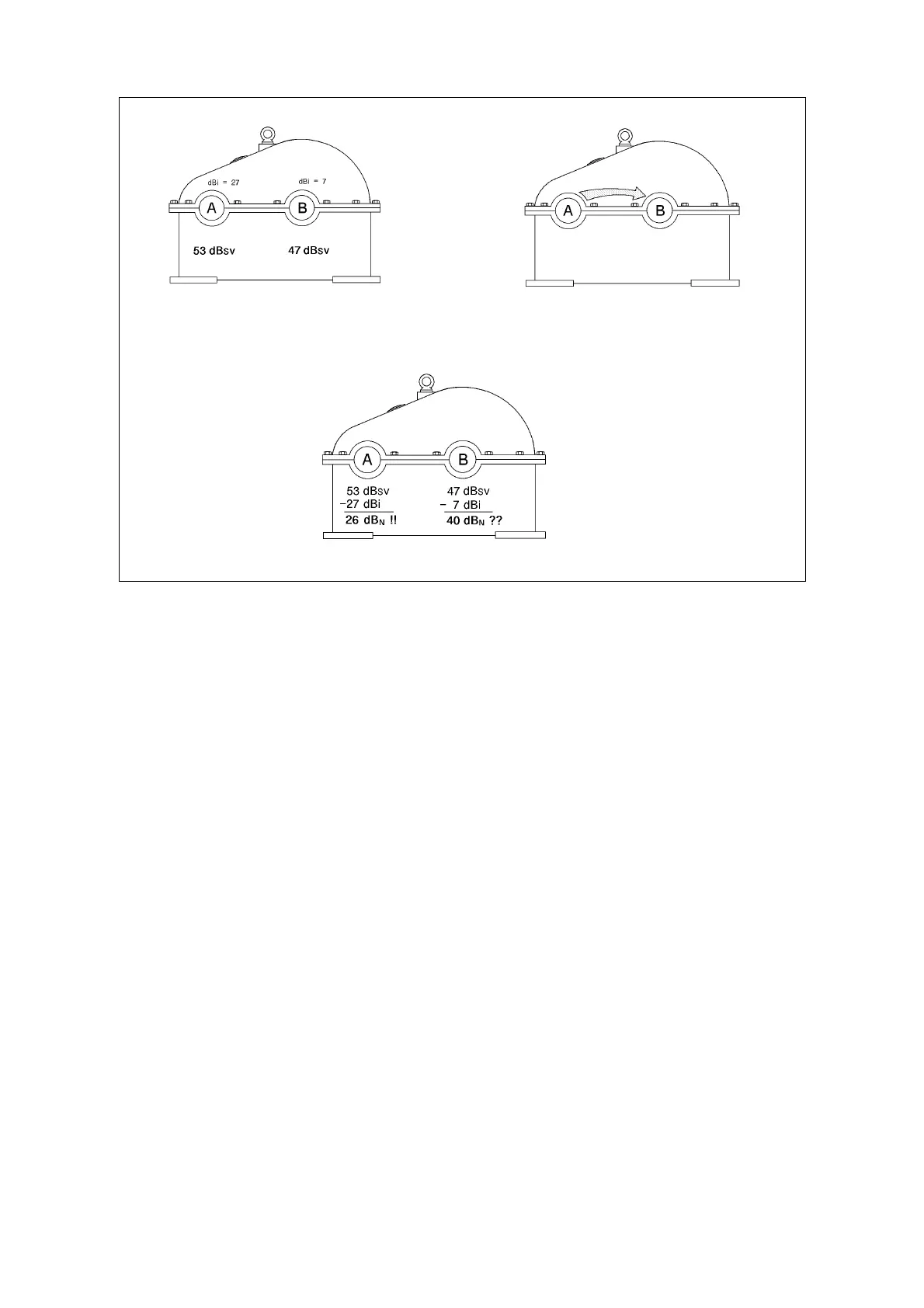
1 Take unnormalized readings (dBi set to – –) on all bearings. This will reveal the strongest shock
pulse source on the machine. In the example in the figure, you get a reading of 53 dBsv for
bearing A and 47 dBsv for bearing B.
2 Work out the direction of possible cross talk. You know that the stronger source can mask the
signal of the weaker source. In this case, cross talk must go from bearing A to bearing B.
3 Normalize the readings by subtracting the dBi values. In the example, you get 26 dB
N
for
bearing A, 40 dB
N
for bearing B.
You can now draw two conclusions: The reading for bearing A, coming from the stronger source, is
probably true. The bearing's condition is reduced (26 dB = yellow zone) but not seriously so.
The reading from bearing B is either true or false. If true, it indicates bad bearing condition (40 dB
= red zone), but you cannot confirm that with the instrument before condition gets worse and
bearing B becomes the stronger shock pulse source. Your solution is to take frequent readings and
compare the results from both bearings.
1 Unnormalized readings reveal the
stronger source
3 The reading from the
stronger source is
normally true
The reading from the
weaker source cannot
be confirmed
Cross talk !?
2 Cross talk must go from the
stronger to the weaker source
Evaluation of SPM measurements 39



 To Next Page