Technical data are subject to change without notice.
© Copyright SPM 2002-04. 71650.B
SPM Instrument AB • Box 504 • S-645 25 Strängnäs • Sweden
Tel +46 152 225 00 • Fax +46 152 15075 • info@spminstrument.se • www.spminstrument.se
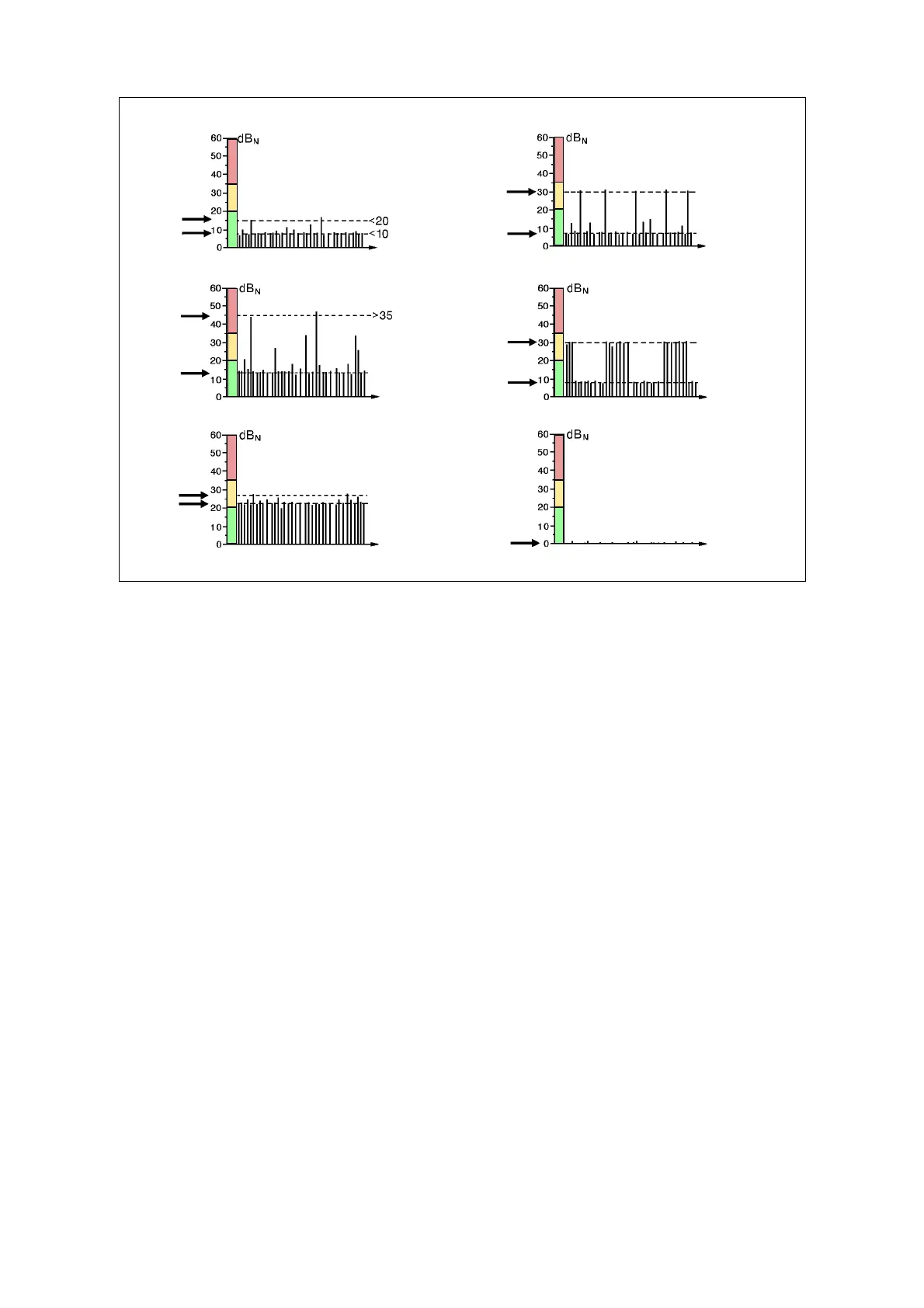
Different shock pulse patterns
The earphone is a means to verify and trace shock pulse sources. The signal from a bearing should
be highest on the bearing housing. If you get a higher signal outside of the bearing housing (across
an interface in the material), you are most likely measuring shock pulses from another bearing or
some other source. Typical for a bearing signals is that the stronger shock pulses, best heard a few
dB below the peak level, appear at random intervals.
A For a good bearing , the dBm is within the green zone. dBm and dBc are not close together.
B The shock pulse pattern from a damaged bearing contains strong pulses in the red zone, a
random sequence, and a large difference between dBm and dBc. When you grease lubricate
the bearing, the values should drop but rise again.
C A dry running bearing has a high carpet value very close to the dBm. When you grease
lubricate the bearing, the values should drop and stay low. A similar pattern is caused by
pump cavitation, in which case readings on the pump housing are stronger than those taken
on the bearing housing, and are not influenced by lubricating the bearing.
D A regular pattern, containing burst of strong pulses in a rhythmic sequence, is caused by e.g.
scraping parts.
E Individual pulses in a regular sequence are cause by clicking valves, knocking parts, regular
load shocks.
F A sudden drop in the shock pulse level is suspicious. Check your measuring equipment. If the
reading is correct, you may have a slipping bearing ring.
A
B
C
D
E
F
SPM measurement 23



 To Next Page