Technical data are subject to change without notice.
© Copyright SPM 2002-04. 71650.B
SPM Instrument AB • Box 504 • S-645 25 Strängnäs • Sweden
Tel +46 152 225 00 • Fax +46 152 15075 • info@spminstrument.se • www.spminstrument.se
Irregular measuring results
Large variations between consecutive readings are a danger sign. Damaged bearings do not
improve with time, although their shock values may temporarily drop.
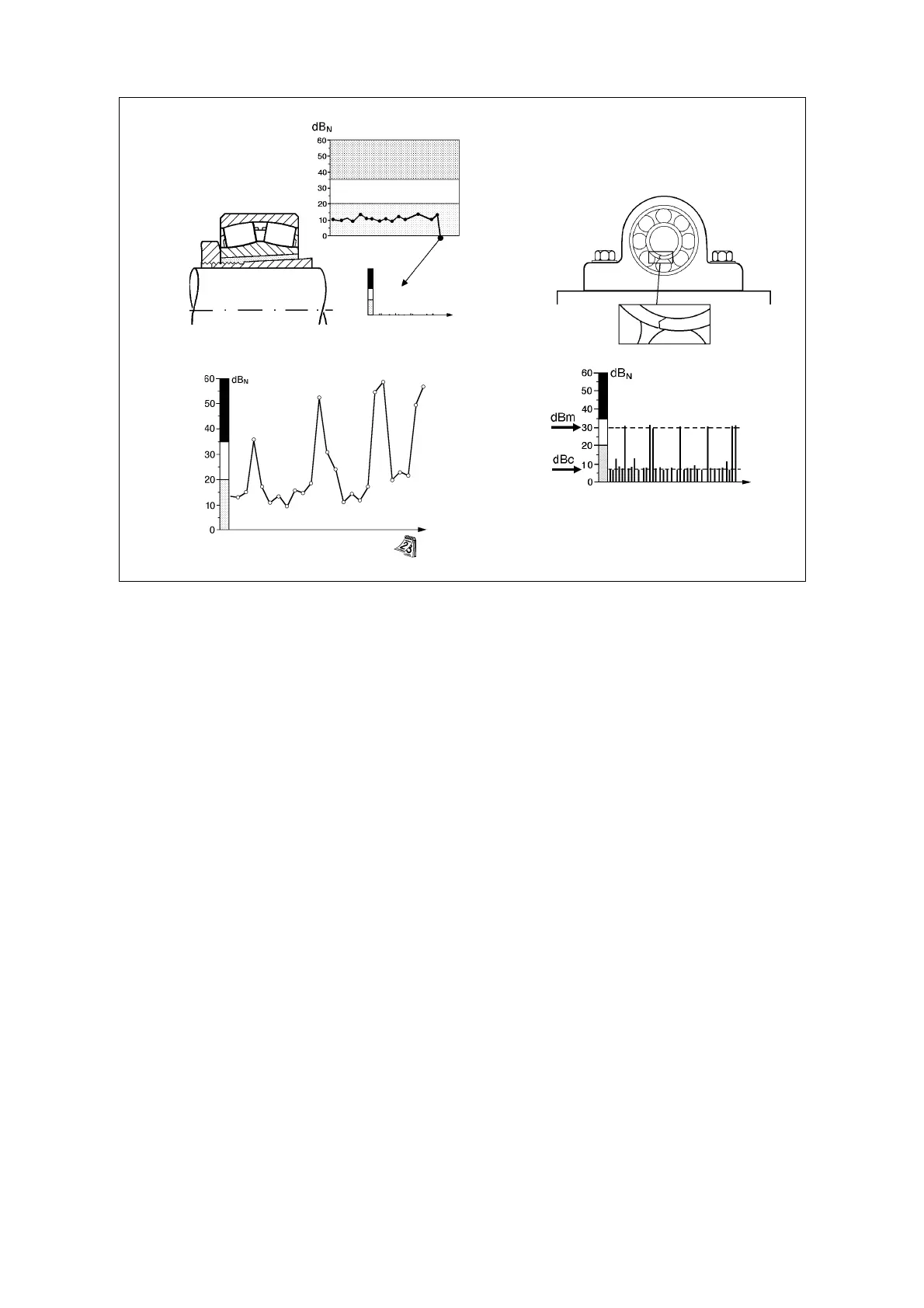
7 Large drop in the readings
If the shock pulse level drops after a sequence of normal readings, you have either a malfunction of
the instrument, a failure in a transducer installation, or a serious bearing fault.
Check the instrument by measuring on some other bearing. In case of an installed transducer, try
to get a reading by tapping on the bearing housing. If your reading is correct, it is possible that one
of the bearing races is slipping, either on the shaft or in the housing. In case of a heavily loaded
bearing with previous readings in the red zone, suspect cage failure.
8 Erratic readings on roller bearings
Wide variations in the readings taken at different times can occur on heavily loaded roller bearings
with surface damage. The high readings are caused by metal particles breaking off the surfaces and
by the sharp edges of new spallings. When particles and edges are rolled out, the readings will
drop again.
Note that ball bearings and roller bearings have different contact areas. A ball has point contact
with the raceway while a roller has line contact over the whole width of the raceway. Pitting in the
surface of a roller bearing's raceway will therefore not cause distinctive shocks as long as there is
enough undamaged surface area to carry the individual roller.
9 Cracked inner ring
A clean crack in the inner ring of a bearing is difficult to detect, especially at a low rpm. You may
get low readings through most of the bearing's rotation, then one or two peaks while the crack is in
the load zone. Signal strength can differ considerably as the crack opens or closes depending on
bearing temperature. In time, the surface tends to spall along the crack, leaving sharp edges and
metal particles which cause high shock values until they are rolled out.
7
8
9
Evaluation of SPM measurements 37



 To Next Page