Technical data are subject to change without notice.
© Copyright SPM 2002-04. 71650.B
SPM Instrument AB • Box 504 • S-645 25 Strängnäs • Sweden
Tel +46 152 225 00 • Fax +46 152 15075 • info@spminstrument.se • www.spminstrument.se
6a Patterns from poorly lubricated bearings
A high carpet value, very close to the maximum value, is typical for dry running bearings. The dBm
does not always reach the red zone – typical for poor lubrication is that the gap between dBm and
dBc is very small. If the signal is strongest on the bearing housing, it can have several causes:
1 insufficient lubricant supply to the bearing (poor oil flow; old , caked, or cold grease)
2 very low or very high bearing speed (preventing the build-up of an oil film separation between
the loaded rolling elements and the raceway)
3 installation fault (excessive preload) or out of round bearing housing
4 misalignment or bent shaft.
If possible, grease the bearing or increase the oil flow. Measure immediately afterwards, and again
a few hours later. In case 1 (see above), the shock pulse level should drop and stay low.
In case 2, one can try lubricants of a different viscosity or use additives to prevent metal to metal
contact between the bearing surfaces.
In cases 3 and 4 (installation faults, unround housings, and misalignment), the shock pulse level may
drop after lubrication but will soon rise again. Misalignment normally affects the bearings on both
sides of the coupling or at both ends of the shaft.
6b Cavitation and similar interference
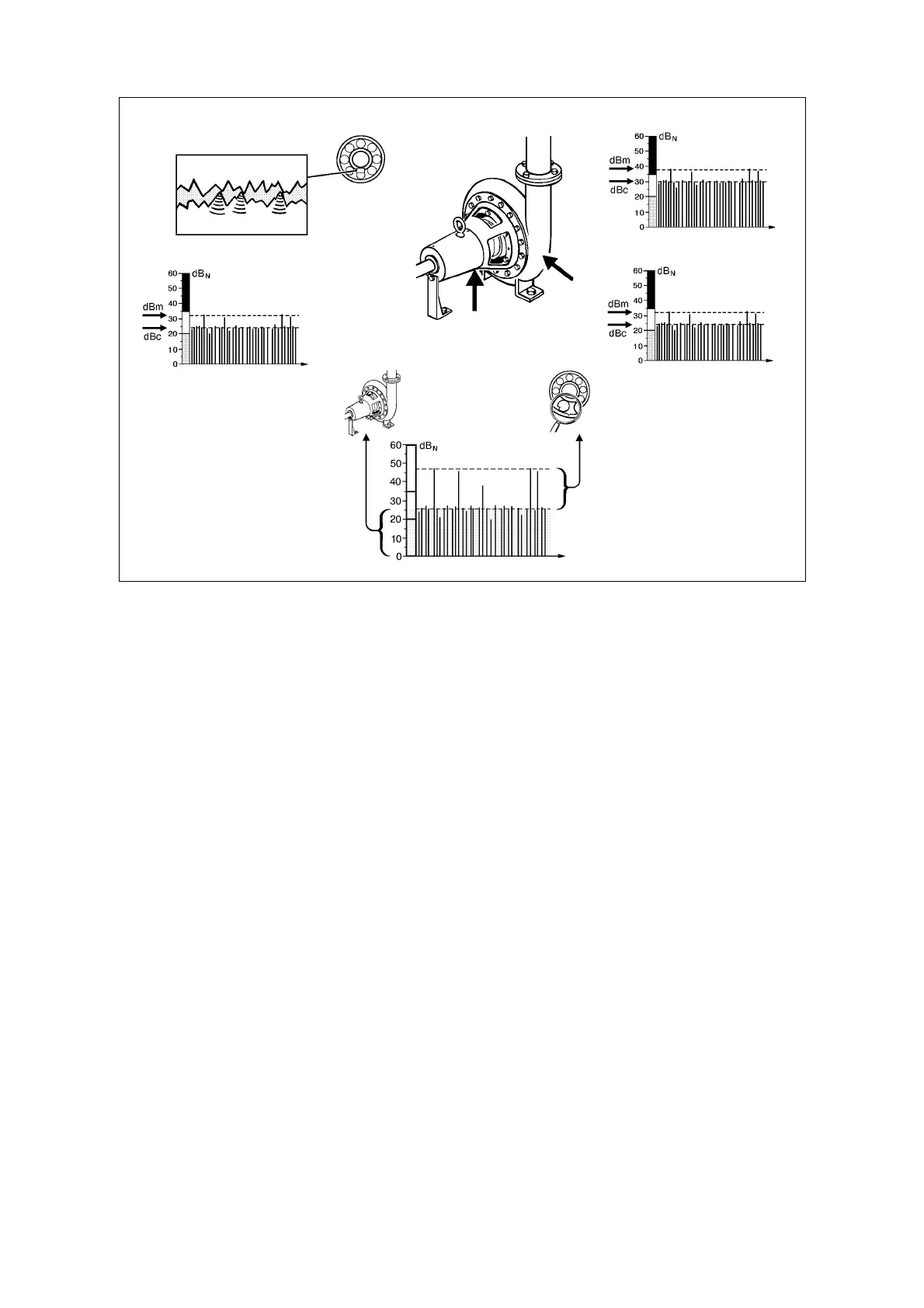
The shock pulse pattern caused by a cavitating pump or by persistent rubbing is identical with that
from a dry running bearing. You have an interference signal when the shock pulse level is highest
outside of the bearing housing and is not affected by lubricating the bearing.
If you cannot remove the cause of interference, you have a "blind spot": up to a certain level, the
interference signal (grey area in fig.) will mask the signal from one or more bearings. However, you
may still be able to detect bearing damage. When the dBm rises above the interference level, it
must be caused by something else – probably bad bearing condition. In that case, greasing the
bearing should cause the value to drop, at least temporarily.
A
B
6a
6b
36 Evaluation of SPM measurements



 To Next Page