Technical data are subject to change without notice.
© Copyright SPM 2002-04. 71650.B
SPM Instrument AB • Box 504 • S-645 25 Strängnäs • Sweden
Tel +46 152 225 00 • Fax +46 152 15075 • info@spminstrument.se • www.spminstrument.se
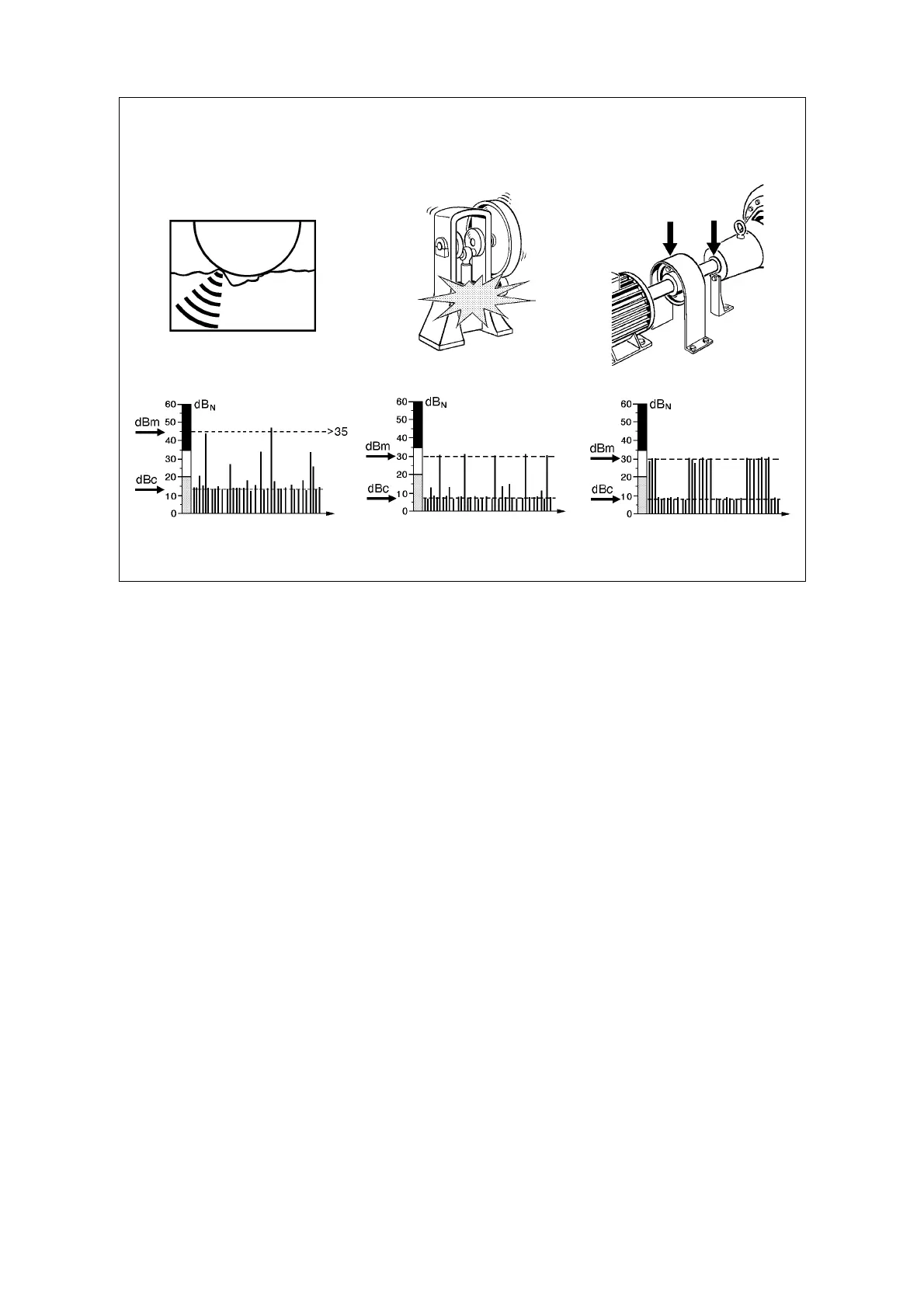
3 Signal from a damaged bearing
The pattern shown in figure 9 is typical for damaged bearing surfaces: a dBm above 35 dB, a large
gap between dBm and dBc, and a random pattern of strong pulses. The strength of the maximum
value dBm indicates the degree of damage:
35 – 40 dB
N
Slight damage
40 – 45 dB
N
Severe damage
> 45 dB
N
High breakdown risk.
Note: a similar pattern is caused by contaminations in the lubricant (metal or dirt). The particles
either originate from parts of the bearing itself, for instance from a damaged cage, or they are
transported by the lubricant into the (undamaged) bearing. Test bearing and lubricant according to
the description “Confirming bearing damage” in this manual.
4 Rhythmical peaks
Single, rhythmical peaks can be caused by load and pressure shocks which occur during the
machine's normal operation. Other possible causes are clicking valves or loose parts knocking
regularly against the machine frame.
If the signal is strongest on the bearing housing, you can suspect a cracked inner ring.
5 Periodic bursts
Periodic bursts are a typical interference signal, caused by rubbing between machine parts, e.g.
shaft against bearing housing or seal. The burst occurs at an rpm related frequency.
34 5
Evaluation of SPM measurements 35



 To Next Page