Technical data are subject to change without notice.
© Copyright SPM 2002-04. 71650.B
SPM Instrument AB • Box 504 • S-645 25 Strängnäs • Sweden
Tel +46 152 225 00 • Fax +46 152 15075 • info@spminstrument.se • www.spminstrument.se
Experience before full scale monitoring
Shock pulse monitoring should be started on a small scale. The best place to start is a "quiet
corner" where monitoring personnel can train under good working conditions, without causing an
interruption or being disturbed by others.
Select a few machines and go through all the operations. With Condmaster
®
Pro, you have to learn
the functions and possibilities of the program. Keep working with these machines until you are
satisfied with your measuring routines and can time the various operations, like adapter installa-
tion, taking readings, recording, etc.
Levels of skill
Shock pulse monitoring requires two levels of skill: data collection and machine condition evalua-
tion. The term ”data collection” is here used in the sense of obtaining readings from the measuring
points. Data collection requires moderate skill: familiarity with the instrument functions, with the
follow-up form or the downloading functions of Condmaster
®
Pro, and some hands-on training with
the shock pulse and vibration transducers. Experience shows that about nine tenths of the
monitoring work is simple data collection.
Condition evaluation, necessary on new measuring points and in case of significant changes in the
readings, requires additional skills. While the "data collector" presents instrument readings, the
"machine inspector" should be able to provide the maintenance crew with a detailed description
of the nature and location of the trouble spot.
Finding trouble spots is detective work, where the shock pulse meter is strictly a tool, used with
common sense and backed up by the operator's experience with the type of equipment that is
being monitored.
An important aspect of monitoring work is to convince others that the readings are both useful and
reliable. Measuring personnel with skills at the "machine inspector" level will find it easier to be
believed.
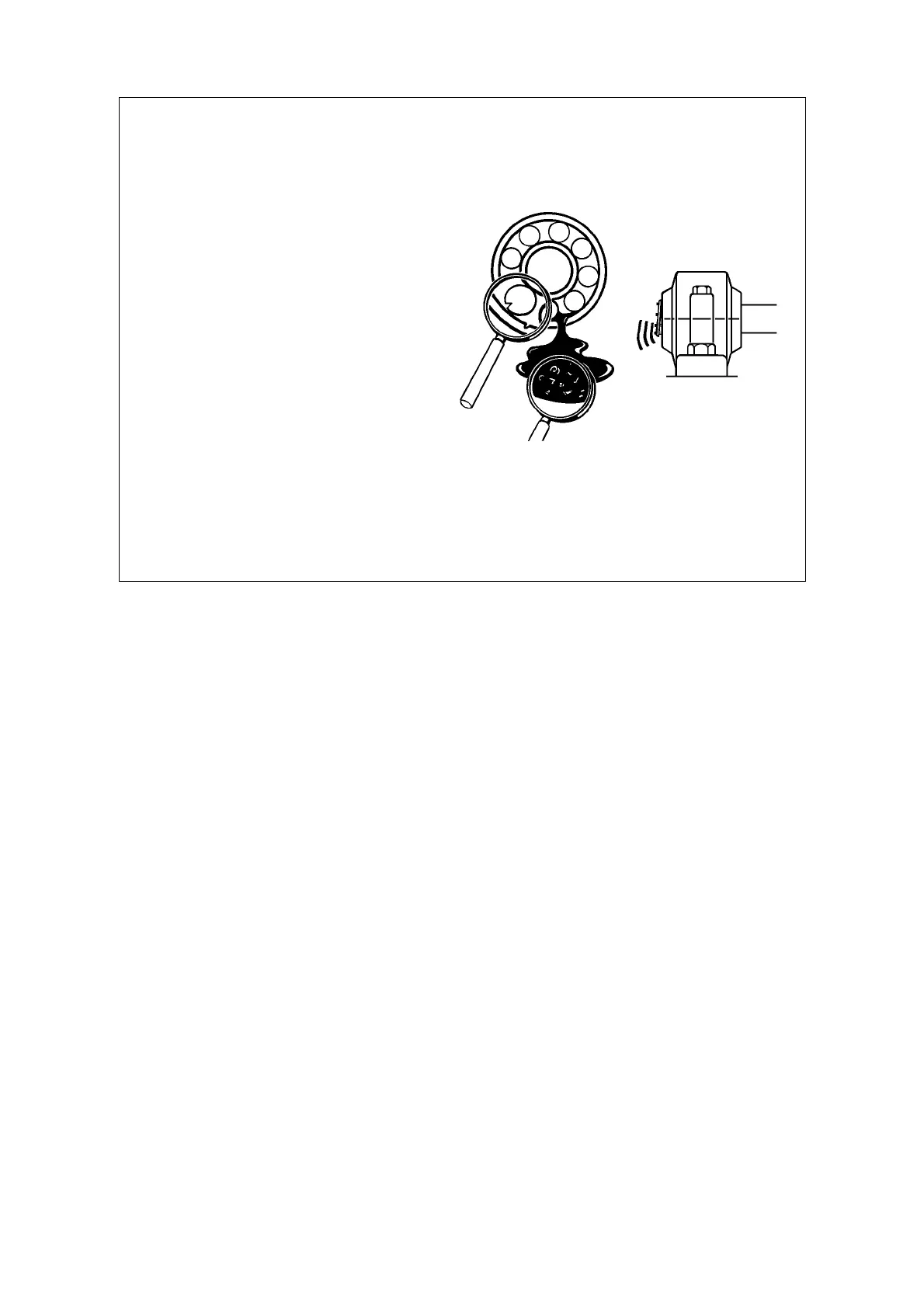
What causes the
high reading?
The maintenance
crew needs a
correct answer !!
Train all operations:
1 Selection of measuring points
2 Normalized and unnormalized
readings with all transducer types
3 Installation of adapters
6 Record keeping, in Condmaster
®
Pro
or manually on follow-up forms
7 Recognition of typical patterns
(earphone mode)
8 Probing for interference
9 Lubrication test
General remarks on SPM measurement 27



 To Next Page